New Young-Men Vote Data Turns JD Vance's Coalition Warning Into a Measurable Test
Fresh youth-vote data shows a sharp 2026 swing among young men, supporting parts of JD Vance's post-midterm diagnosis while leaving major questions about turnout, causation and durability.
By Vance Force Editorial Desk
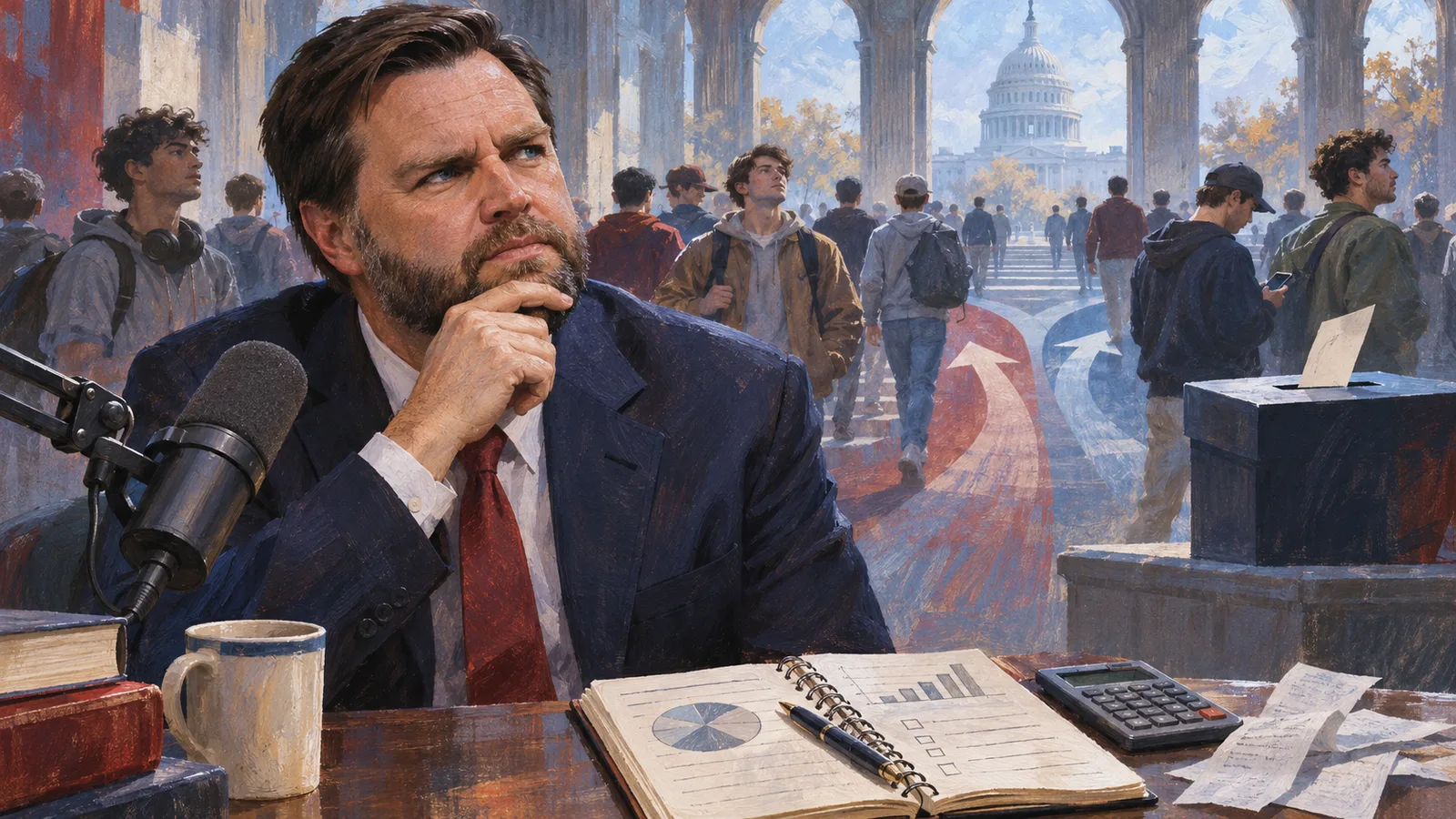
AI-assisted editorial illustration of JD Vance considering young male voters and diverging civic paths in Washington
DISCUSSION OPENRead the source brief, then add your evidence and argument.
The newest national youth-vote data gives JD Vance a measurable version of the warning he issued after Republicans lost Congress: young men who helped power the 2024 Trump-Vance victory did not simply disappear in 2026. Many appear to have voted the other way.
That distinction matters. It turns a familiar argument about turnout into a harder question about persuasion, trust and delivery. According to a new Reuters report, an estimated 59% of men ages 18 to 29 backed Democratic House candidates in the November 3 midterms, while 37% backed Republicans. In 2024, AP VoteCast found the same age-and-gender group favored Donald Trump over Kamala Harris by 56% to 42%.
Those figures do not prove that every young man who voted Republican in 2024 switched parties two years later. They do show that a constituency Vance has cultivated is mobile, dissatisfied and central to the argument over the Republican coalition's future.
What the new numbers actually establish
The underlying analysis comes from Tufts University's Center for Information & Research on Civic Learning and Engagement, or CIRCLE, using NORC Civic Health & Elections Project data. CIRCLE reported that voters ages 18 to 29 favored Democratic House candidates nationally by 66% to 30%. Among young men, the Democratic advantage was 59% to 37%.
The movement crossed demographic lines. CIRCLE estimated that young white men favored Democratic House candidates 54% to 43%, after young white men had backed Trump 63% to 35% in the 2024 presidential contest. Young Latino men favored Democrats 66% to 28% in 2026, after a nearly even split in the 2024 presidential race.
The Associated Press's separate voter survey points in the same broad direction. Its poll of more than 100,000 voters found roughly seven in ten voters under 30 supported Democratic candidates, while about three in ten supported Republicans. The AP also found that young voters represented only about one in ten voters overall, a reminder that a striking subgroup shift is not the whole electorate.
AI-assisted conceptual illustration of a fluid young-male electorate choosing between competing political paths; it does not depict an actual polling place or event.AI-assisted editorial illustration.
The comparison needs a warning label
CIRCLE is explicit about the limits. The 2024 figures describe a presidential choice; the 2026 figures describe House choices. Different young people may have turned out or stayed home in each election. A midterm electorate is not identical to a presidential electorate, and national estimates can conceal state-level variation.
That caveat blocks the most sweeping conclusion. The data cannot tell us that young men have permanently realigned with Democrats, or that a precise share of Trump-Vance voters switched. A Republican official interviewed by Reuters called 2026 a “punishment election” rather than a durable realignment and predicted the group would come back.
Yet the caveat does not erase the result. Two independent survey systems recorded a large Democratic advantage among young voters, while CIRCLE found a dramatic change among young men. The prudent reading is neither permanent realignment nor statistical noise. It is a warning that loyalty was conditional.
Why the result strengthens Vance's diagnosis
On November 4, Vance argued that Republicans lost because of the Iran war. As CBS News documented, he said some 2024 Trump-Vance voters backed Democrats to end the war, address the cost of living and inflation, put America first and change the U.S. relationship with Israel. He also acknowledged that Republican economic messaging may not have been sharp enough.
Reuters now supplies evidence consistent with that account. Its reporting says economic anxiety was a major factor in the youth shift and that young men were more likely than young women to identify the Iran war as an important issue. Republican strategists interviewed by Reuters highlighted the same paired remedy: end the war and lower costs.
Consistency is not the same as proof of a single cause. Voters can hold several motives at once, post-election explanations are often self-interested, and survey wording affects what respondents emphasize. Vance's diagnosis also places responsibility on an administration in which he serves. That makes it politically consequential, but it does not make it neutral.
Still, the new evidence makes the core claim harder to dismiss. Our earlier analysis of Vance's challenge to the administration's Iran argument showed the institutional tension. The youth data now identifies a constituency in which that tension may have had electoral consequences.
AI-assisted conceptual illustration connecting household affordability with work, housing, trade and energy costs; it is not a photograph of a documented individual.AI-assisted editorial illustration.
The coalition test is about material credibility
Vance has spent years presenting himself as a translator of young men's economic and cultural frustrations. At the Republican convention in Dallas on September 10, he directly addressed young people worried about whether they could afford a home, raise a family and gain a stake in the country's future. The full speech transcript shows that affordability and family formation were not secondary themes; they were part of his case for the Republican project.
The 2026 result therefore tests more than campaign outreach. Podcasts and social media helped Republicans reach young men in 2024, but access is not ownership. Reuters reported that some influential podcasters later criticized the Iran war, while Democrats expanded their own long-form podcast presence. The communications advantage narrowed just as governing outcomes became more salient.
For Vance, the opportunity is also a constraint. He can argue that he heard the coalition's objections earlier or more clearly than others did. But winning those voters back would require demonstrating influence over policy, not merely accuracy after a defeat. A message about affordable homes, stable work and family formation must be tied to results that young people can recognize in rent, groceries, fuel, wages and interest payments.
That is why the young-men data should be read beside, not instead of, the broader evidence. Lower-income voters also moved toward Democrats, according to the AP survey. CIRCLE found movement among non-college youth and rural youth as well. The story is not reducible to masculinity, online culture or a single foreign-policy dispute. It is about whether a governing coalition can convert identity-based connection into economic security and credible restraint.
What to watch between now and 2028
Three tests will show whether this is Vance's opening or his warning label.
First, policy: Does the administration change course on the Iran conflict or reduce the household costs associated with it? Second, economics: Do housing, food, energy and borrowing costs improve in ways younger workers can feel? Third, accountability: Does Vance press his diagnosis when it conflicts with the president, or soften it once the immediate post-election debate fades?
The answer will also shape speculation about 2028. Polls discussed in our review of Vance's early 2028 strength measured recognition and partisan preference, not the durability of the young coalition under governing stress. The midterm numbers are a more demanding signal because they record behavior after two years of policy outcomes.
Young men remain persuadable. That is the encouraging reading for Vance, and also the uncomfortable one. He has not lost an unreachable bloc; he faces voters who appear willing to reward or punish parties based on war, prices and the possibility of building a stable adult life. The new data turns his post-election warning into a public benchmark. If he wants to be the coalition's guarantor, he now has to show that his analysis can change what government does.
*Vance Force is an independent fan community. This article is original editorial analysis based on cited public sources; it is not affiliated with or authorized by JD Vance, his office, any campaign or any political party.*