JD Vance’s Hegseth Defense Tests His Case Against Impeachment
Vance calls the Hegseth impeachment drive a show. The constitutional question is harder: eight allegations mix disputed war powers with claims of abuse.
By Vance Force Editorial Desk
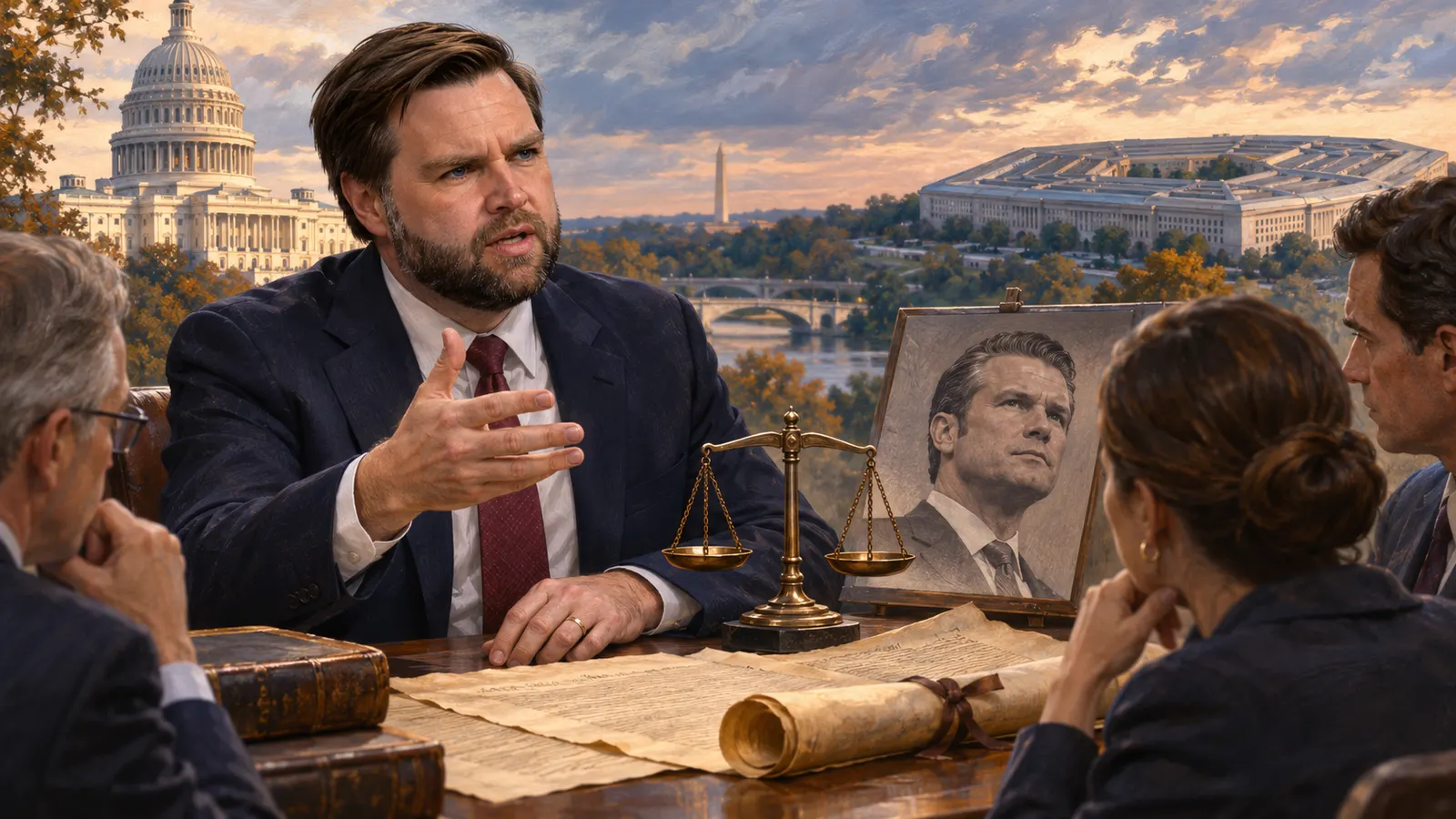
AI-assisted editorial illustration of JD Vance presenting the Hegseth impeachment argument between the U.S. Capitol and Pentagon.
DISCUSSION OPENRead the source brief, then add your evidence and argument.
Vice President JD Vance entered the fight over Defense Secretary Pete Hegseth on Tuesday with an argument bigger than one Cabinet official. Impeachment, Vance said, has become “a ridiculous show that stands in for actual policymaking.” He added that legislation is hard while impeachments are easy. The immediate target was Republican Rep. Thomas Massie’s eight-article resolution against Hegseth, but Vance’s message was also an institutional claim: Congress is substituting spectacle for governing.
That criticism deserves to be taken seriously. Impeachment can become a partisan shortcut, and the Constitution does not make every policy dispute an impeachable offense. Yet Vance’s framing is too sweeping to settle this case. Impeachment is not an alien distraction from congressional work; it is one of the powers the Constitution assigns to Congress. Massie’s resolution also alleges more than bad strategy. It accuses Hegseth of unlawful war-making, ignoring civilian-protection rules, retaliating against a senator and carrying out other abuses of power. Those are allegations, not established findings, but dismissing them all as theater skips the evidentiary question Congress is supposed to examine.
Vance’s Argument Is About Process as Much as Hegseth
Vance’s November 10 comments, reported by Axios, defended Hegseth as a reformer confronting Pentagon bureaucracy. That is a political defense of the secretary’s record. The vice president’s sharper point, however, was procedural: lawmakers should write laws rather than stage impeachment fights they expect to be inconsequential.
There is force behind that objection. Congress has tools short of impeachment: hearings, subpoenas, appropriations limits, war-powers votes, censures and ordinary legislation. If lawmakers reach first for removal whenever control of the House changes, the constitutional remedy can look like a permanent campaign tactic. The 2024 impeachment of Homeland Security Secretary Alejandro Mayorkas illustrates the danger. The House approved two articles 214–213, and the Senate later dismissed them without a trial, according to the Library of Congress impeachment guide.
But the history cuts both ways. The fact that a prior impeachment was partisan does not prove a later one is empty. Nor does the availability of legislation eliminate impeachment. The House must decide whether the alleged conduct is a policy dispute that belongs in ordinary oversight or an abuse of public power serious enough to justify constitutional charges.
What the Eight Articles Actually Allege
Massie’s official November 9 release groups the accusations into eight articles. Three concern the Iran war: beginning hostilities without a declaration of war or an imminent threat, continuing after Congress directed withdrawal, and exceeding the War Powers Resolution’s time limits. A fourth alleges that Hegseth ignored rules intended to reduce civilian casualties.
The remaining articles concern military strikes on suspected drug-trafficking boats, alleged retaliation or intimidation directed at Sen. Mark Kelly, the seizure of Nicolás Maduro and Cilia Flores in Venezuela, and military action in Yemen. Hegseth disputes the premise. At a Pentagon briefing, he described the operations as lawful actions ordered by the president, notified to Congress and carried out by service members.
That disagreement matters because an impeachment resolution is a set of charges, not a verdict. Massie’s filing does not by itself establish that Hegseth broke the law, knowingly executed unlawful orders or abused his office. It does establish that Vance’s “show” description cannot replace a count-by-count answer. Some articles turn on contested legal theories; others make factual claims that could be tested through records, testimony and oversight.
AI-assisted conceptual imagery of congressional impeachment debate; it does not depict an actual House session or vote.AI-assisted editorial illustration.
“Policy Disagreement” Is Not the Whole Constitutional Test
The Constitution permits impeachment of civil officers for treason, bribery or other high crimes and misdemeanors, but it does not define the final phrase. A March 2026 Congressional Research Service report explains that the House can impeach by a simple majority and the Senate can convict only by a two-thirds vote of senators present. The report also describes a long dispute over whether impeachment reaches serious abuses of office that are not ordinary crimes.
That uncertainty makes slogans dangerous on both sides. Calling military policy unpopular does not make it impeachable. Calling the commander in chief’s orders lawful does not automatically immunize subordinates from scrutiny. The central questions are whether the conduct occurred, what legal authority governed it, what Hegseth knew and whether any violation amounted to a grave abuse of public trust.
The strongest argument for Vance
The strongest version of Vance’s position is not that impeachment is always illegitimate. It is that Congress should preserve a high threshold. The president holds substantial authority as commander in chief, while the scope of the War Powers Resolution and its interaction with presidential power remain contested. PolitiFact’s review found that legal experts viewed the war-powers counts as constitutionally unsettled, even as some considered allegations involving retaliation or boat strikes potentially stronger.
On that record, lawmakers could reasonably conclude that several counts belong first in oversight, litigation or legislation. They could also worry that impeaching a Cabinet secretary for carrying out a president’s disputed policy would transfer a disagreement with the president onto an official with less independent authority. A durable constitutional standard should not rise and fall with which party controls the chamber.
The strongest argument against Vance
The strongest response is that Massie did not file a resolution merely saying the Iran war is unpopular. He alleged unlawful conduct and abuse of power. Congress cannot know whether those allegations meet the constitutional threshold without examining evidence. Claims of retaliation against a senator, avoidable civilian deaths or extrajudicial killings are not converted into routine policy disagreements simply because they occurred during military operations.
Impeachment is also congressional work. It may be wise or unwise, substantiated or opportunistic, but the House’s responsibility is to judge those distinctions rather than declare the mechanism inherently unserious. Vance’s institutional critique would be stronger if he separated weak counts from strong ones and explained why each fails.
AI-assisted conceptual imagery contrasting congressional oversight and military command; it is not a photograph of a real briefing.AI-assisted editorial illustration.
The Iran Tension in Vance’s Position
Vance’s intervention contains a notable tension. After the midterms, he argued that the Iran war helped drive Republican losses, a claim we examined in our analysis of his election diagnosis. He has also faced questions over whether he would support repeating the intervention, covered in our review of the “do it again” debate. Now he says the Hegseth effort is not really about Iran but about opposition to a secretary challenging the Pentagon establishment.
Those positions are not automatically contradictory. A vice president can believe a war was politically costly, defend its legality and oppose impeachment. Political judgment and an impeachable offense are different tests. But three of Massie’s eight articles directly concern the Iran conflict, and a fourth concerns civilian protections during military operations. It is therefore too categorical to say Iran is absent from the case. A more precise defense would acknowledge that the war is central to several charges while disputing whether they prove misconduct by Hegseth.
That precision matters because Vance may be shaping a broader Republican standard for divided government. If impeachment is always dismissed as spectacle when directed at an ally, future claims of executive overreach will be judged primarily by party identity. If every controversial use of military force becomes grounds for removal, the remedy will lose its exceptional character. The difficult middle is to insist on evidence and a consistent threshold.
What Tuesday’s Vote Can—and Cannot—Prove
As of publication Tuesday afternoon, the House was preparing for a procedural vote that could block the resolution, send it to committee or clear a path toward a final vote as soon as Wednesday. The Associated Press reported that Democratic leaders backed the effort while Republican leaders expected to defeat it. Even if the House impeached Hegseth, removal would require a two-thirds Senate vote.
The vote will measure political support, not independently establish the truth of every allegation. A referral to committee could bury the resolution or create space for investigation. A quick defeat could reflect confidence in Hegseth, loyalty to the administration, skepticism about the legal theories or discomfort with the timing. A successful procedural vote would show that the issue has bipartisan momentum, but it would not substitute for evidence either.
That is why Vance’s “easy” label is only partly persuasive. Forcing a vote may be procedurally easy. Persuading a majority of the House and two-thirds of the Senate is deliberately difficult. The constitutional architecture already supplies a high political barrier.
A More Durable Standard for Vance
Vance could turn a sharp political defense into a more durable governing argument by answering three questions. First, which allegations are merely policy disagreements and which, if true, would constitute abuse of office? Second, what evidence shows that Hegseth acted lawfully or lacked the intent alleged? Third, which alternative congressional tools should be used to resolve the disputed conduct?
Those answers would not require Vance to endorse impeachment. They would demonstrate that he takes both executive authority and congressional accountability seriously. His warning about political theater should remain part of the debate; impeachment should not become a substitute for legislation or a ritual response to every defeat. But the warning is not a verdict.
The fairest conclusion is that Vance identifies a real institutional risk while understating the constitutional burden of the case before Congress. Massie still has to prove serious allegations, and lawmakers should resist treating disagreement as guilt. Hegseth and his defenders, in turn, should address the charges individually rather than assume that “policy” ends the inquiry. The Constitution makes impeachment exceptional, not imaginary.
Independent fan-community disclosure
Vance Force is an independent English-language fan community and is not affiliated with, authorized by or speaking for JD Vance, the White House, any campaign or the Republican Party. This analysis separates documented allegations, reported statements and procedural facts from our editorial judgment. No allegation described here is presented as a proven fact unless an official finding establishes it.