JD Vance’s Iran-War Verdict Is Politically Sharp—and Empirically Incomplete
Vance blamed the Iran war for Republican losses. Voter surveys support that concern but point to a broader verdict on prices, corruption and governing power.
By Vance Force Editorial Desk
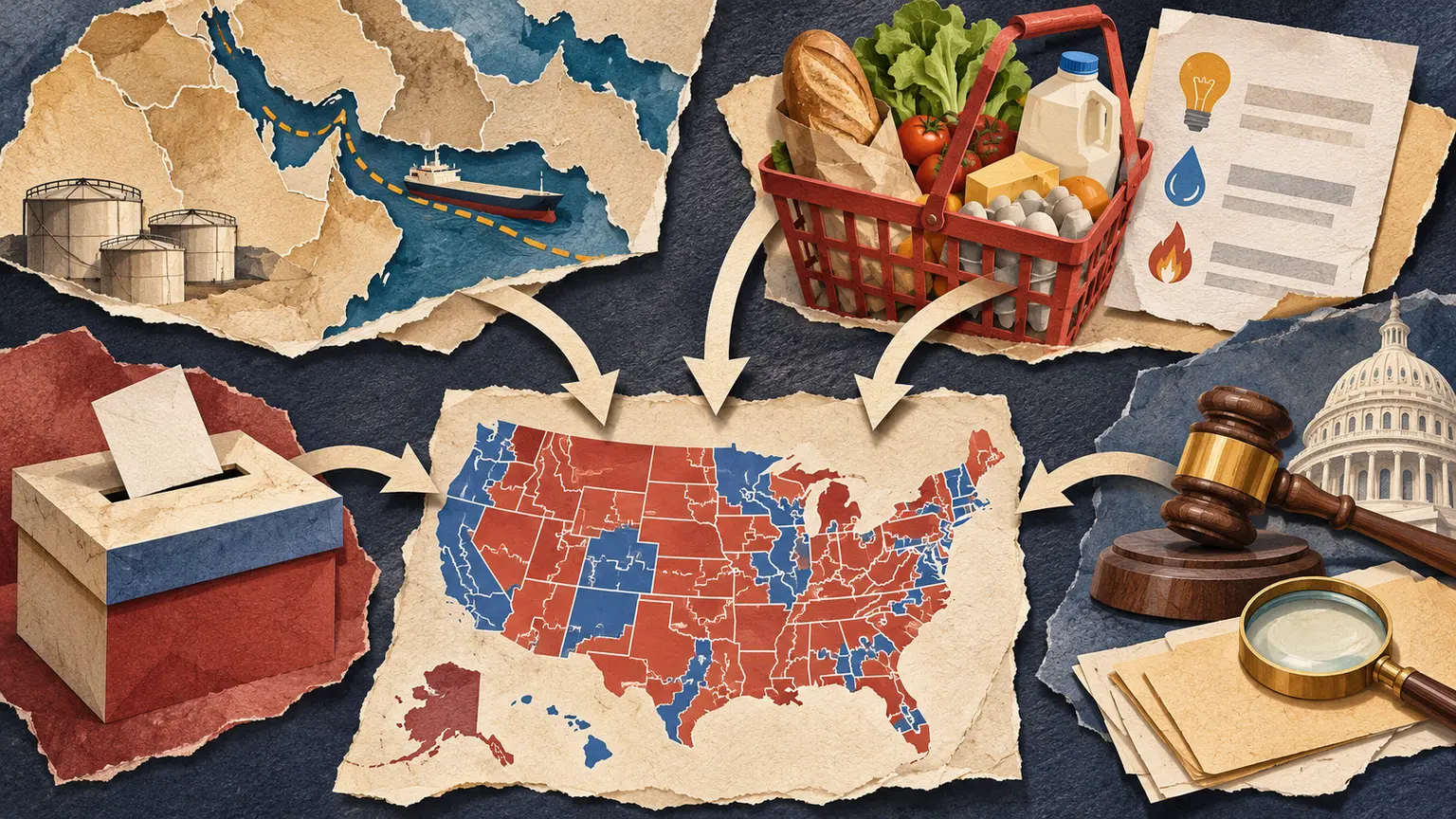
AI-assisted editorial illustration of JD Vance weighing Iran-war policy, household costs and midterm election evidence.
DISCUSSION OPENRead the source brief, then add your evidence and argument.
Vice President JD Vance did not wait for a long Republican autopsy. By late Wednesday morning, he had offered a blunt explanation for the party's loss of both chambers of Congress: “The reason we lost is the war.” His post argued that Republican turnout was not the central failure because many voters who backed Trump and Vance in 2024 returned to the polls but voted Democratic in 2026. He connected that defection to the Iran war, household costs, an “America First” expectation and dissatisfaction with the U.S. relationship with Israel.
That is a consequential intervention, not merely a complaint about campaign tactics. Vance is the sitting vice president, a former Marine who has long criticized open-ended wars, and a likely participant in the coming debate over the Republican Party's future. Yet the first wave of public voter evidence supports only part of his case. The Iran war was deeply unpopular and probably magnified economic pain. It was not, however, the only concern voters identified—and the available surveys do not establish it as the sole cause of a national result.
The stronger interpretation is that Vance has identified a real source of Republican damage while compressing several overlapping failures into one politically useful story.
What Vance Actually Argued
Vance's November 4 post on X made two connected claims. First, he said the electorate's partisan composition was not catastrophically bad for Republicans. In his telling, “our people” showed up, but some 2024 Trump-Vance voters crossed over. Second, he said a respected pollster asked those defectors what would bring them back and received four leading answers: end the war, focus on the cost of living, put America first and change the U.S. relationship with Israel.
Vance then collapsed that four-part account into a single verdict: the war caused the loss. He also accepted that Republicans' economic message was not sharp enough, and he opened the door to changing immigration enforcement by focusing more on employers that hire unauthorized workers while rejecting amnesty.
The post is valuable because it rejects an easy turnout excuse. It treats voters as people who made a choice rather than as missing partisan units. It also acknowledges that foreign policy can become domestic economic policy when energy prices, shipping risk and federal spending reach household budgets.
But Vance did not publish the pollster's questionnaire, sample, weighting or cross-tabs. “The smartest data guy I know” is testimony, not a replicable dataset. The claim deserves scrutiny against surveys whose methods and findings are public.
AI-assisted conceptual imagery showing several overlapping voter concerns; it is not an official result map or evidence display.AI-assisted editorial illustration.
The Public Data Support the War Argument—Up to a Point
The strongest evidence for Vance is straightforward. An Associated Press report on the AP Voter Poll said about six in ten voters regarded U.S. military action against Iran as the wrong decision. Most voters dissatisfied with the war backed the Democratic candidate in their House race. That is not a marginal signal.
The war also cannot be neatly separated from prices. Energy disruption and uncertainty around the Strait of Hormuz can raise the cost of fuel and transport. Democrats explicitly linked the conflict to gas and other household expenses. If a voter said the cost of living was decisive, the war might still have shaped that judgment.
President Donald Trump partly acknowledged the connection. Reuters reported that Trump called Iran “a piece” of the result and recognized the short-term pain from higher gasoline prices. He nevertheless defended the decision to begin the conflict and said he would make it again.
That creates a genuine policy divide inside a shared administration. Vance's emphasis is on political cost and the case for ending the conflict; Trump's emphasis is on the claimed strategic necessity of preventing an Iranian nuclear weapon. The disagreement should not be exaggerated into a complete rupture. Trump called Vance's post “good” and said he understood his position, according to the AP report. But it is more than a difference in tone: they assign different weight to the war's benefits, costs and future course.
Why “The War” Is Too Narrow as a Full Explanation
The same voter data that validate Vance's concern also limit his conclusion. ABC News reported that 34% of House voters called the Iran war crucial to their vote. The cost of living was crucial to 49%, while government corruption was crucial to 55%. Those categories can overlap, but the rankings matter. More voters independently identified prices and corruption than the war itself.
The AP's broader voter-poll analysis adds other pressures. Roughly two-thirds said Trump administration policies had made the economy worse, and about seven in ten said Congress was not doing enough to check presidential power. Candidate quality also mattered in several states. Those findings describe a wider judgment about governing priorities, inflation, institutional restraint and nominees—not one isolated foreign-policy decision.
This does not refute Vance. It changes the causal picture. The war may have acted as an amplifier: it could worsen fuel prices, contradict an anti-intervention promise and reinforce a belief that Washington was focused elsewhere. But an amplifier is not necessarily the original source of every grievance.
Our morning report on Vance's closing campaign route documented losses by candidates he personally promoted in Ohio, North Carolina and Texas. Those candidates had distinct records and liabilities. A national backlash can coexist with local weaknesses. Any serious party review has to leave room for both.
A Foreign-Policy Argument With a 2028 Shadow
The timing makes Vance's post politically significant. Reuters reported that some White House officials saw it as a foreign-policy break and that renewed military action remained under consideration. The outlet also noted speculation that the statement could mark the beginning of Vance's 2028 positioning.
That last point is analysis, not a verified declaration of candidacy. Vance has said he would consider his future after the midterms, but he has not announced a presidential campaign. It is reasonable to observe that the post distinguishes him from the war's strongest advocates. It would be irresponsible to claim knowledge of his private motive.
AI-assisted conceptual imagery of the tension between governing responsibility and future political positioning; it depicts no real location or event.AI-assisted editorial illustration.
The vice presidency makes the distinction difficult. Vance can argue that he urged negotiation and restraint. He also serves in the administration that launched and continues to manage the war. Voters may hear his criticism as candor, self-protection or both. The credibility test will be what he does with the diagnosis.
If the war truly drove the defeat, Vance's next steps should be measurable: press for a diplomatic off-ramp, explain the administration's attainable objectives, disclose the economic tradeoffs and oppose renewed operations that lack a clear path to a settlement. Our earlier analysis of Vance's proposed Iran medical-supply channel showed how even a limited humanitarian promise encounters sanctions, banking and shipping constraints. Ending a war is harder than naming its political cost.
The Better Republican Autopsy Is Additive, Not Exclusive
Vance is right to resist a comforting story in which Republican voters simply stayed home. The results and surveys indicate active dissatisfaction, including among parts of the coalition that returned Trump to office in 2024. His willingness to say that plainly is more useful than blaming weather, campaign mechanics or insufficient loyalty.
He is on weaker ground when he turns a multivariable defeat into a monocausal verdict. The public evidence available on November 4 says the Iran war mattered; cost of living mattered more to many voters; corruption and checks on presidential power also mattered; and candidate-specific weaknesses shaped individual races. Preliminary surveys can still change as weighting and final vote totals are updated, so every percentage should be treated as an estimate rather than a final census of voter motives.
The political attraction of “the war did it” is obvious. It lets Vance defend much of the administration's domestic agenda while arguing for a foreign-policy correction that matches his preexisting brand. The analytical risk is just as obvious: if Republicans accept too narrow a diagnosis, they may miss the broader demand for affordable living, competent candidates and limits on executive excess.
Vance has opened the right argument. He has not yet supplied a complete answer.
Independent fan-community disclosure
Vance Force is an independent fan community and is not affiliated with, authorized by or speaking for JD Vance, the White House, any campaign or the Republican Party. Verified statements and survey findings are separated above from our editorial analysis. This article treats claims about political motive and 2028 positioning as inference, not established fact.