JD Vance’s Weatherford Rally Turns on a Texas Turnout Test
JD Vance’s completed Weatherford rally made Republican participation the closing argument in a competitive Texas Senate race, but turnout models and one close poll cannot yet show who is winning.
By Vance Force Editorial Desk
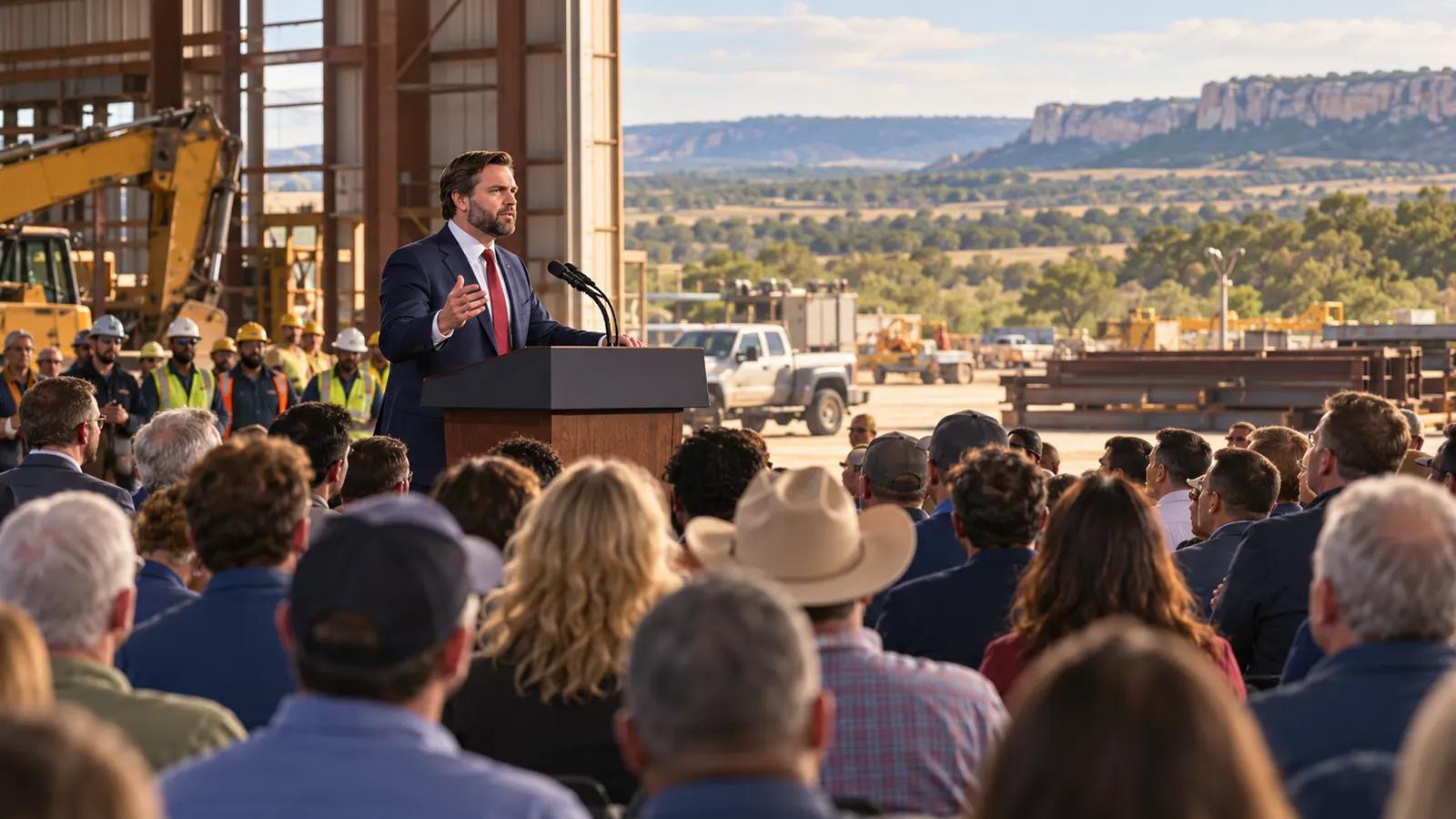
AI-assisted editorial illustration of JD Vance delivering a Texas turnout speech inside a construction hangar before a gathered audience
DISCUSSION OPENRead the source brief, then add your evidence and argument.
The most consequential part of Vice President JD Vance’s Thursday stop in Weatherford, Texas, was not a new policy announcement. It was the timing. Vance arrived one day before in-person early voting closes in a Senate race that public polling describes as genuinely competitive, and he used the appearance to turn a familiar campaign endorsement into an urgent test of Republican turnout.
The event was a completed rally, not merely a scheduled stop. A full local video posted Thursday afternoon shows Vance making the case for Republican Senate nominee Ken Paxton, while a later CBS Texas report documented the speech and the concern among Republican organizers about participation. That distinction matters: the verified news is what Vance said and did in Weatherford on October 29, while the effect on voting remains unknown.
A closing argument built around participation
The official event listing placed the rally at JRJ Construction in Weatherford, with doors opening at 10 a.m. and the program beginning at 12:15 p.m. Central time. The full FOX 4 video, posted at 3:16 p.m., confirms that Vance appeared and spoke to supporters.
Vance framed the Texas contest as nationally important and endorsed Paxton directly. CBS Texas quoted him calling it “one of the most important Senate races in America.” His closing appeal asked supporters to “send a message on November 3rd.” Those are attributable remarks from a reported, filmed event; they are not evidence by themselves that the rally moved votes.
The setting reinforced the political message. A construction-site venue offered an industrial backdrop, and the speech was aimed less at undecided voters than at Republicans who might still be sitting out. That is consistent with Vance’s recent role as a turnout surrogate. At his October 29 Kinston rally, the operative question was also whether national visibility could be translated into local participation. Weatherford made that question sharper because the early-vote window was about to close.
The early-vote numbers explain the urgency
CBS Texas cited Ryan Data and Research figures showing that, through Tuesday, more than 800,000 people with a history of voting in at least one of the previous four Republican primaries had not yet voted. The report also said voters with Democratic-primary histories outnumbered those with Republican-primary histories among ballots cast, with the difference narrowing from nearly 71,000 through Tuesday to nearly 57,000 through Wednesday.
Those figures are useful, but they have strict limits. Primary history is not a record of a person’s general-election choice. Texans can change their preferences, skip a party contest, or vote across party lines in November. The dataset measures who has participated before and who has returned so far; it does not reveal the contents of a ballot. Treating it as a live partisan vote count would overstate what the evidence can show.
AI-assisted conceptual illustration of early-voting participation; it does not depict a photographed polling place or reveal any voter’s choice.AI-assisted editorial illustration.
The calendar is clearer. The Texas secretary of state’s official schedule lists Friday, October 30, as the final day of in-person early voting, with Election Day on Tuesday, November 3. That made Thursday’s rally a last-day mobilization effort in practical terms: supporters persuaded by Vance still had one more early-vote day, followed by Election Day.
Turnout concern is not the same as a forecast
Republican speakers at the rally described the early-vote pattern in alarmed terms. The most defensible interpretation is narrower. Their concern shows what the campaign believed it needed from Vance: attention, urgency and a reminder to vote. It does not establish that Republicans are losing the final count, because neither primary-history modeling nor raw turnout totals assign votes to candidates.
A close poll, with important caveats
The University of Texas/Texas Politics Project provides a separate window into the race. Its October 13 analysis reported Democrat James Talarico at 50 percent and Paxton at 47 percent among 861 likely voters. The three-point difference was within the survey’s plus-or-minus 3.34-point margin of error. Fieldwork ran from September 25 through October 5, well before the Weatherford rally and before early voting began.
That poll supports two conclusions, neither of them a prediction. First, the race was competitive enough to justify high-level surrogates. Second, Republican consolidation was incomplete in that sample: 92 percent of Republican likely voters backed Paxton, compared with 98 percent of Democratic likely voters backing Talarico. The survey also found Talarico ahead among self-identified independents, 69 percent to 11 percent, but that subgroup represented only 5 percent of the likely-voter sample. A dramatic subgroup percentage drawn from such a small slice deserves caution.
The polling therefore helps explain Vance’s strategic value. He was not visiting a safe state merely to celebrate. He was trying to narrow a participation and consolidation problem that Republicans’ own public rhetoric acknowledged. But no responsible analysis can infer a rally bounce before new, methodologically sound data—or the election result—exists.
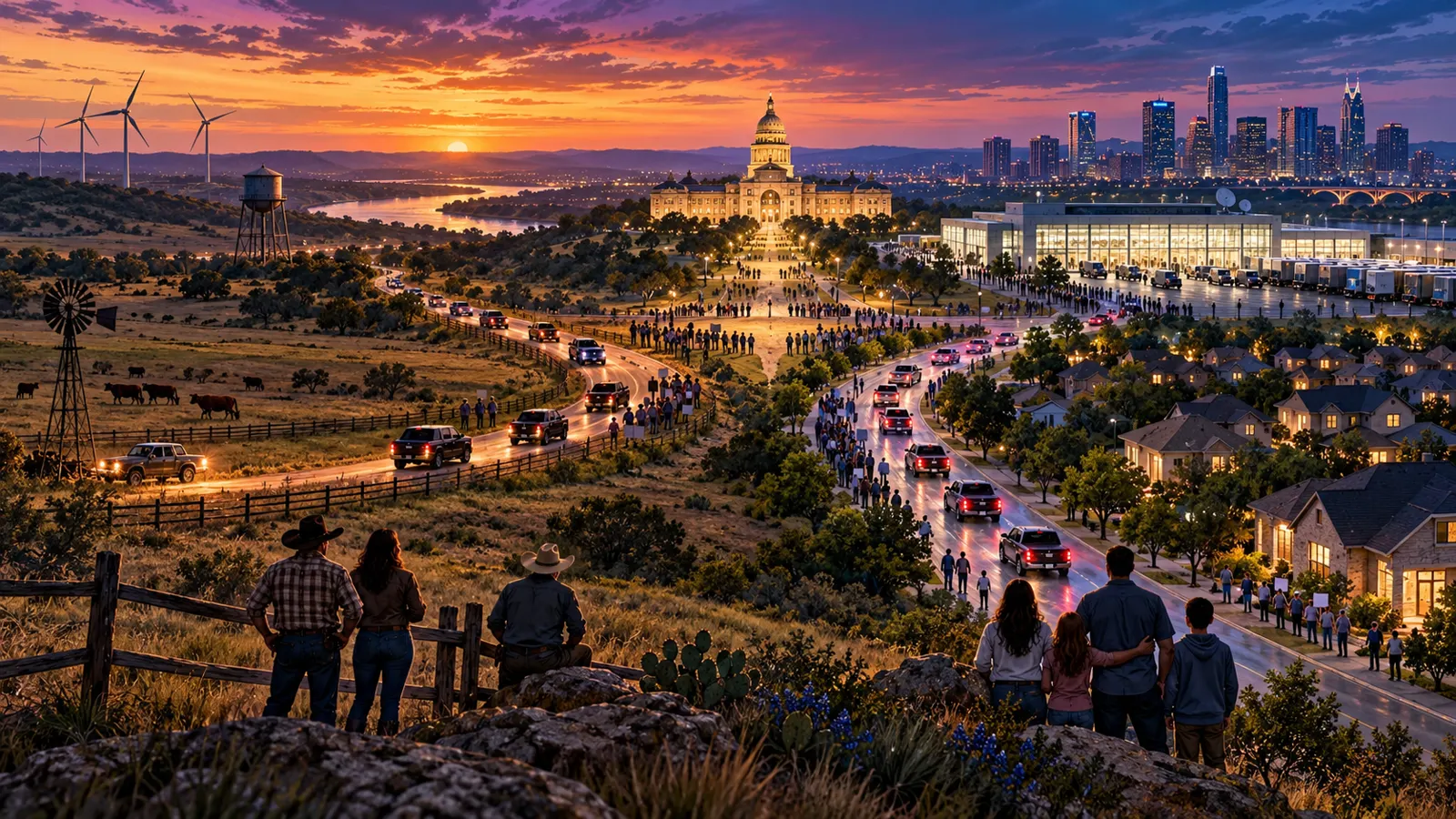
AI-assisted conceptual illustration of statewide turnout and persuasion across rural and suburban Texas, not a real campaign motorcade or event.AI-assisted editorial illustration.
Vance emphasized stakes; the opposition emphasized Paxton
Vance’s argument was national and partisan: keep the Senate seat, defend Texas’s political identity, and prevent a change in control. Talarico’s counterargument, summarized by CBS Texas from a Tuesday rally in Lubbock, was candidate-specific. He invoked Paxton’s impeachment by the Republican-led Texas House and appealed to independents and Republicans unwilling to support the GOP nominee. Paxton was acquitted by the Texas Senate in 2023, a fact essential to the full context.
Those competing frames reveal the core strategic contest. Vance wants voters to see the race as a referendum on national power and party control. Talarico wants enough voters to separate their view of Texas or the Republican Party from their view of Paxton personally. The UT poll’s issue results show why neither side can rely on a single message: respondents trusted Paxton more on immigration, national security, public safety and taxes, while Talarico led on healthcare, cost of living and political corruption. Foreign policy was tied in that survey.
For Vance, that creates a delicate task. A purely national speech may energize loyal Republicans but leave candidate-specific objections unanswered. A detailed defense of Paxton, however, could keep the opposition’s preferred controversy in view. His Weatherford appearance leaned toward the first option: elevate the stakes, praise the nominee, and make nonparticipation feel costly.
What the rally says about Vance’s 2026 role
Weatherford fits a broader pattern in Vance’s midterm schedule. He has become a bridge between the administration’s national agenda and campaigns that need a final push from high-propensity conservative voters. The mechanism resembles the economic case he tested during his Kansas factory stop: take an abstract national argument and place it in a physical setting tied to work, community and local consequence.
The benefit is obvious. A vice president can draw press attention, create shareable video and give down-ballot candidates a national storyline. The risk is also real. If the audience is already highly committed, the event may mostly preach to voters who planned to participate anyway. And when the race contains candidate-specific liabilities, nationalizing it can only do so much.
This is why the last-day turnout data matter more than any crowd-size boast. The official rally page verifies the time, place and sponsor, but it does not quantify attendance. Descriptions of a “large crowd” come from news reporting; organizer claims about records should be treated as claims unless independently audited. The measurable question is not how full the venue looked. It is whether targeted voters cast ballots by Friday or on November 3.
What can be concluded on Friday morning
Three points are verified. Vance spoke in Weatherford on October 29 and endorsed Paxton. He made turnout and Senate control central to his appeal. The speech landed immediately before the final day of in-person early voting in a race that the latest UT/Texas Politics Project poll placed within its margin of error.
Three other points remain uncertain. Public data do not disclose how the early ballots break between candidates. The rally’s effect cannot yet be isolated from advertising, other campaign events or normal late voting. And one poll—especially one completed weeks before Election Day—cannot settle the race.
That leaves a disciplined reading of Vance’s move. Weatherford was a rational response to a close contest and visible Republican anxiety, not proof that the anxiety was justified or cured. His job was to convert national stature into one more day of early votes and a stronger Election Day operation. Whether that conversion happened will be answered by ballots, not by the volume inside a hangar.
*Vance Force is an independent fan community and is not affiliated with JD Vance, his office, any campaign, or any political party. This editorial distinguishes verified reporting from analysis and includes opposing evidence where available.*