JD Vance’s Kansas Factory Stage Puts His Tariff Case to a Harder Test
JD Vance chose a Topeka steel fabricator to make the Republican case for manufacturing. The setting helps his argument—but its unusual insulation from tariffs exposes the broader Kansas cost test.
By Vance Force Editorial Desk
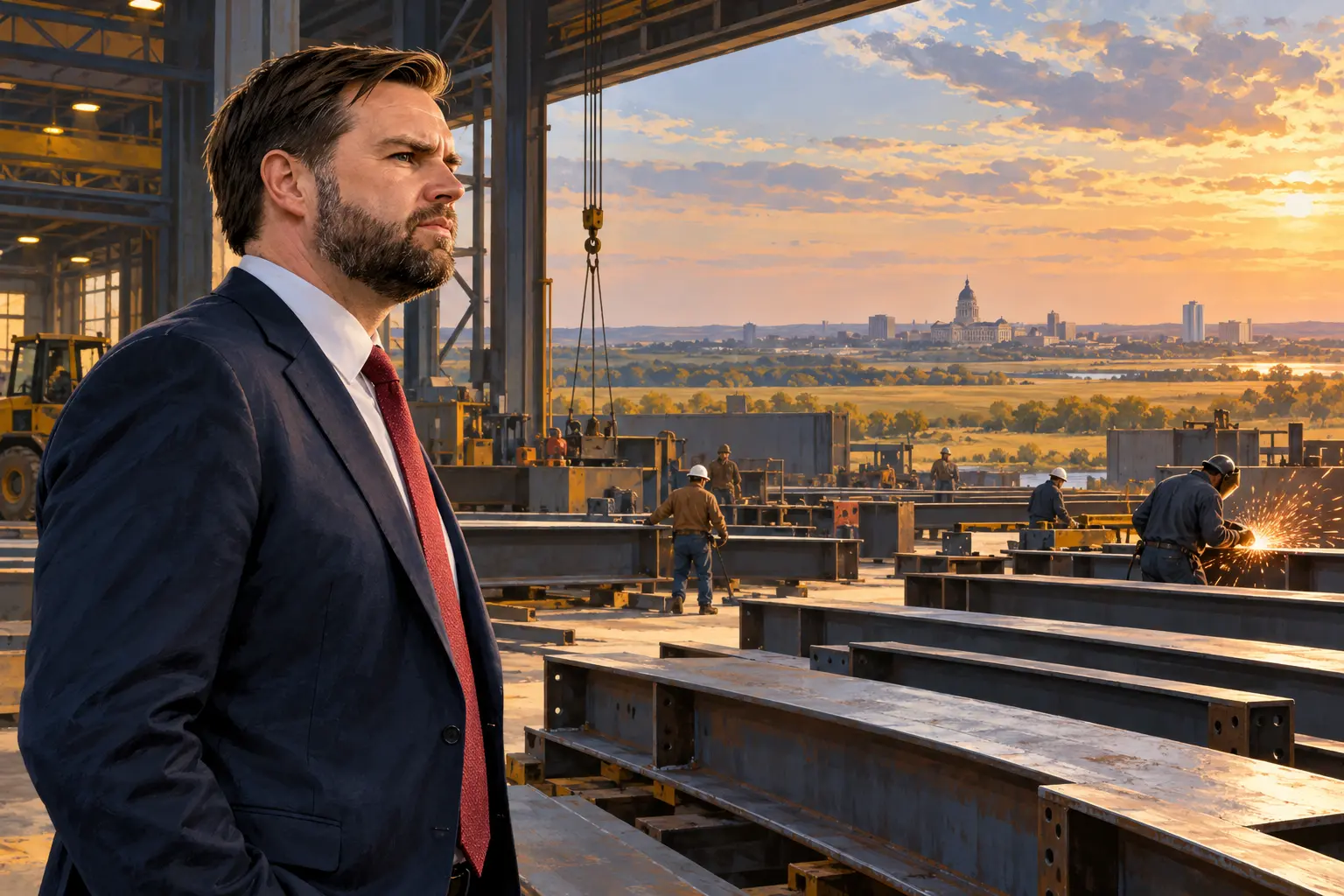
AI-assisted editorial illustration of JD Vance surveying a Kansas steel fabrication floor, representing the JD Vance Kansas tariff message.
DISCUSSION OPENRead the source brief, then add your evidence and argument.
Vice President JD Vance selected a steel fabrication business in Topeka for his October 26 closing argument on behalf of Republican Sen. Roger Marshall. It is an effective visual choice: structural beams, welders and a two-year order backlog make a concrete case for the dignity of skilled work and the value of domestic production. But the same setting also reveals the limit of a campaign argument built around tariffs and industrial revival.
The official Republican event page listed the rally at HME Inc. for 3:30 p.m. Central, and KWCH reported that Vance was expected to speak around 5:15 p.m. At the time this analysis was prepared, no verified transcript of those Topeka remarks was publicly available. We therefore do not attribute unconfirmed claims to Vance or describe the speech as completed. The evidence-based question is what the chosen venue already says about the economic case he is trying to make.
That question matters because Kansas is no longer behaving like a routine Republican hold. The Washington Post's account of the final Senate debate said most forecasters treated the contest between Marshall and Democratic challenger Adam Hamilton as a toss-up. The Hill and Decision Desk HQ's October 26 average placed the two candidates within half a percentage point. Poll averages are estimates, not election results, but they explain why Vance returned to Kansas for the second time in roughly six weeks.
The factory is a strong argument—and a selective one
HME offers Vance nearly every favorable element of his economic story. It is a Kansas company founded in the 1990s, fabricating structural steel, employing skilled workers and reporting substantial demand. After Labor Secretary Keith Sonderling visited the business, local reporting by KCTV/WIBW quoted HME president Jon Haas saying the company had a two-year order backlog. That is real evidence of activity, not merely a campaign promise.
Yet Haas also supplied the qualification that should anchor any honest analysis. He said HME buys mostly American steel and therefore has not seen a large tariff impact; supply and demand, he said, matter more for the company's raw-material prices. That does not disprove the administration's tariff strategy. It shows that HME is unusually well positioned to benefit from a domestic-production message while avoiding some costs faced by firms that depend on imported inputs.
In other words, Vance picked a business where the tariff case looks strongest. Voters are entitled to ask whether the policy works as well outside that frame. A fabricator with domestic suppliers and a long backlog is not the same as an equipment maker buying specialized imported parts, a retailer sourcing finished goods, or a farmer paying for fuel, fertilizer and machinery. The policy test cannot stop at the factory door.
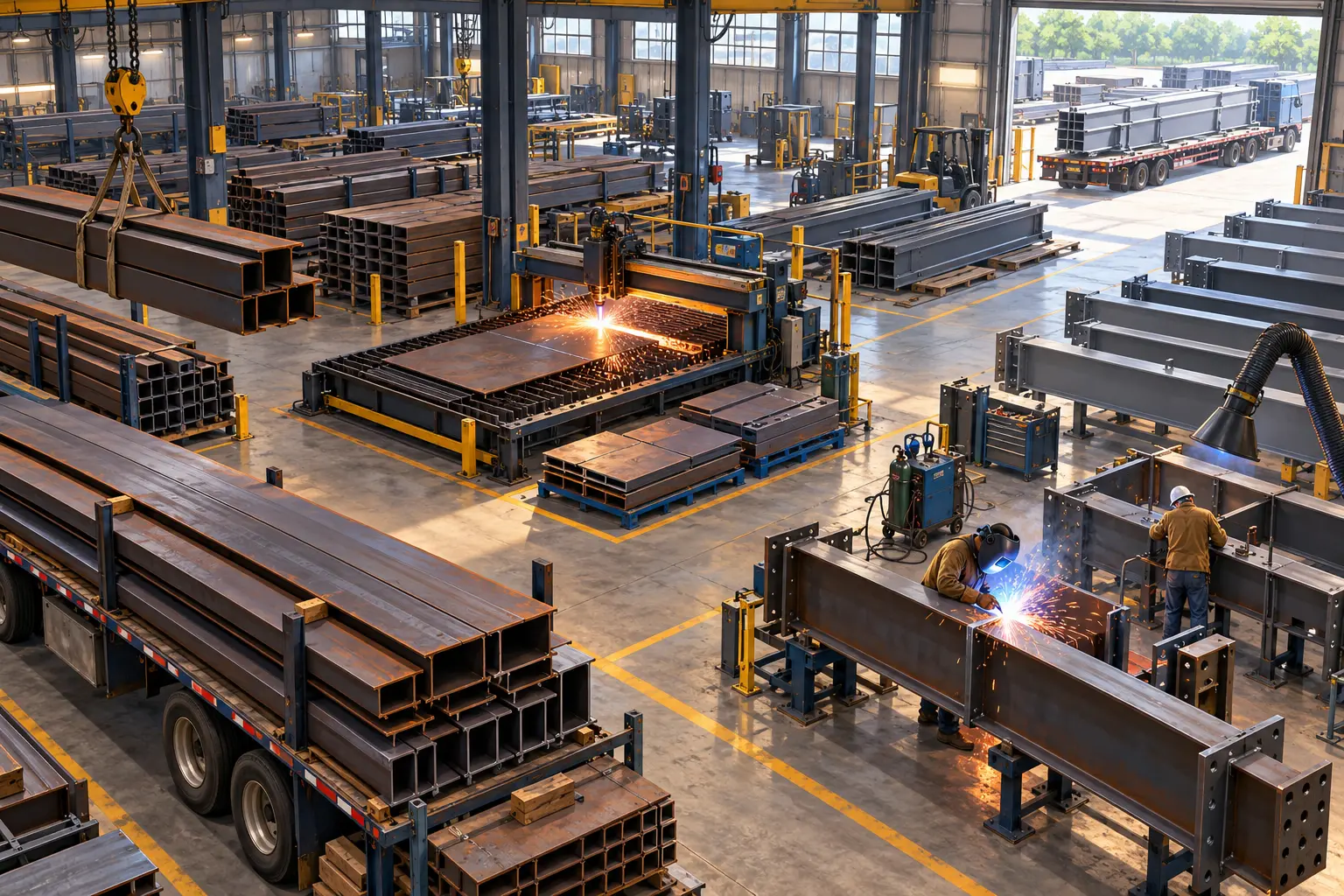
AI-assisted conceptual illustration of a domestic steel supply chain; not a photograph of HME or the Topeka rally.AI-assisted editorial illustration.
Vance has made this argument before in Kansas
The Topeka appearance follows a September 14 campaign event at another Kansas metal fabricator in Olathe. In the full transcript preserved by Roll Call Factba.se, Vance praised welders and machinists, argued that American leaders had spent decades dismissing skilled industrial work, and promised more factories and demand for metal cutting, painting and machine tools. He presented Marshall as an ally of that agenda.
That earlier speech reveals the core of the JD Vance Kansas tariff message: production is not just an efficiency calculation but a civic commitment to workers, wages and resilient supply chains. Supporters have a reasonable case. Domestic capacity can reduce exposure to foreign disruptions, sustain technical skills and support communities that lost stable industrial employment. HME's backlog and workforce needs show why that message resonates.
But Vance's September claims also illustrate why measurement matters. A politician can cite national job totals or new facilities without showing which gains came from tariffs, tax policy, energy prices, defense demand or the normal business cycle. A stronger case would publish sector-specific results: domestic investment, output, real wages, input costs, productivity and completed capacity—not announcements alone.
Our earlier analysis of Vance's Montana-Kansas campaign swing focused on what the travel schedule says about the Republican map. The Topeka factory adds a different question: whether Vance can turn the symbolism of industrial work into a policy explanation that accounts for both protected producers and cost-bearing consumers.
Kansas farmers face a different balance sheet
The clearest opposing evidence comes from agriculture. Reuters reported from western Kansas that diesel and fertilizer costs had risen sharply during the Iran conflict. One wheat farmer said fuel expenses had nearly doubled and added roughly $50,000 in unexpected costs. Reuters also quoted a Republican farmer who noted that high diesel prices have occurred under multiple administrations and was willing to tolerate some pain. Both accounts belong in the picture.
The dispute is not simply whether tariffs are good or bad. Farm businesses experience several shocks at once: energy prices, interest rates, export-market access, fertilizer supply and equipment costs. Some pressures come from war and shipping disruption rather than tariffs. Some can be offset by domestic energy or agricultural assistance. The analytical mistake would be to use a thriving steel shop as proof that every Kansas balance sheet is improving—or to use a struggling farm as proof that domestic manufacturing policy has failed everywhere.
The Marshall-Hamilton debate made this divide explicit. The candidates disagreed over whether the Iran war, the Ukraine war, climate policy or insufficient refinery capacity best explained high diesel costs. Those competing explanations deserve scrutiny, but voters ultimately experience a combined price, not a partisan attribution chart. Vance's advantage is that he acknowledges pain more readily than some administration voices. His burden is to connect that empathy to a credible path for lower operating costs.
AI-assisted conceptual illustration of farm fuel and fertilizer cost pressure; not a photograph of a specific Kansas farm.AI-assisted editorial illustration.
A better tariff defense would admit uneven effects
Tariffs redistribute pressure. They can improve the position of a domestic producer competing with subsidized imports while raising costs for a downstream manufacturer that buys the protected input. They may encourage investment over time, but the transition can be expensive and uneven. That is why the relevant question is not whether one favored company is busy. It is whether the broader mix of output, wages, prices and resilience improves enough to justify the costs.
Vance could make a more durable case by using HME as the beginning of the argument rather than the end. First, identify which supply chains require protection for national or economic security. Second, publish a schedule for reviewing tariffs against measurable investment and capacity targets. Third, offer narrow, temporary relief when domestic substitutes are unavailable. Fourth, distinguish war-driven fuel shocks from trade-policy costs instead of asking one slogan to explain both.
That approach would also answer critics who treat every tariff as pure consumer loss. A policy can impose short-term costs and still be justified if it produces verifiable capacity, bargaining power or security. But supporters should demand evidence of those gains. The administration's refinery-expansion push offers a useful comparison: public money and emergency authorities should be tied to milestones, capacity added and prices actually affected. The same accountability should apply to tariffs.
What the Topeka stop can—and cannot—prove
The rally itself can energize Republican voters and highlight a company with a compelling workforce story. It cannot prove that Marshall will win, that tariffs caused HME's backlog, or that the administration has solved Kansas's affordability pressures. Nor can a close poll establish the final result. Early voting is underway, and late movement, turnout and polling error can all change the outcome.
Vance's strength as a messenger is his ability to connect industrial policy to the lived dignity of work. The factory backdrop reinforces that strength. His risk is presenting a protected slice of the economy as though it were the whole. HME's own explanation—that mostly domestic sourcing reduces its tariff exposure—should encourage a more precise argument, not be treated as an inconvenient footnote.
For supporters, precision is not disloyalty. It is the best way to defend a policy that asks voters to accept tradeoffs. If domestic production is the goal, the administration should show where capacity has grown, where costs have risen, who bears them, and when the public should expect the balance to turn positive. If farmers and import-dependent manufacturers need transitional relief, that should be acknowledged directly.
The bottom line
JD Vance chose a credible symbol for his Kansas manufacturing pitch. A busy steel fabricator with American suppliers demonstrates that domestic industry can be competitive, skilled and locally rooted. It also demonstrates why anecdotes need boundaries: this particular company says it is largely insulated from tariff costs, while other Kansas businesses and farms face a more difficult mix of fuel, fertilizer and input pressures.
The stronger Vance argument is not that every cost has already fallen or every firm has benefited. It is that rebuilding domestic capacity is worth pursuing—and that the government will measure the gains, disclose the costs and adjust when the burden falls in the wrong place. Kansas voters are not only being asked to applaud a factory. They are being asked to decide whether the broader economic ledger adds up.
*Vance Force is an independent fan community and is not affiliated with JD Vance, his office, any campaign, the Republican Party or the U.S. government. This article separates verified schedules, transcripts and reported business conditions from analysis; it does not treat unverified or not-yet-published remarks as fact.*
JD Vance’s Kansas Tariff Message Faces a Cost Test