JD Vance’s Montana-Kansas Sprint Shows the GOP’s Defensive Map
JD Vance’s planned October 26 stops in Montana and Kansas reveal a late Republican turnout push in two traditionally red states—and test whether his message can travel.
By Vance Force Editorial Desk
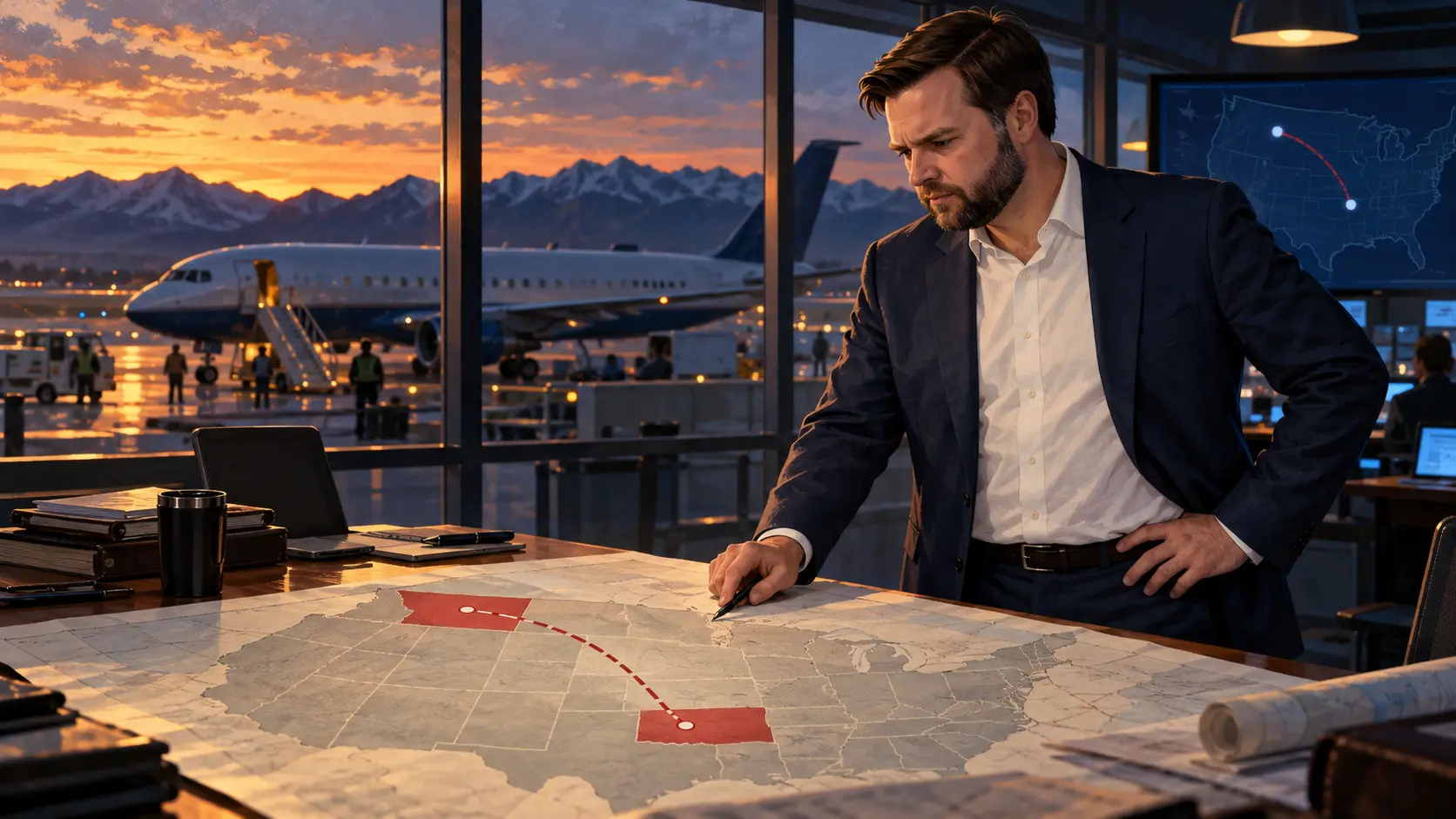
AI-assisted editorial illustration of JD Vance planning a Montana-to-Kansas campaign swing beside an airport route map at sunset.
DISCUSSION OPENRead the source brief, then add your evidence and argument.
The newly announced Monday itinerary for Vice President JD Vance is more revealing than either stop looks on its own. He is scheduled to begin at an airport hangar in Belgrade, Montana, and later appear at a steel-fabrication business in Topeka, Kansas. Both states voted comfortably Republican in 2024. Yet with the November 3 midterms days away, the party is sending one of its strongest turnout messengers into races that Republicans once would have expected to control with less national help.
That does not prove a wave is coming, and it does not mean either Republican candidate is doomed. Campaigns often deploy high-profile surrogates to protect an advantage, energize infrequent voters, or exploit a favorable media market. But the timing and geography make the trip a useful test of Vance's political value: can he turn cultural affinity with conservative voters into ballots when the candidates onstage are not Donald Trump?
What the Monday Schedule Actually Confirms
The Republican event page for Belgrade lists an October 26 rally at an airport hangar, with doors opening at 8:30 a.m. Mountain time and the event beginning at 10:30. The Topeka listing places Vance at Haas Metal Engineering later that day, with the event beginning at 4 p.m. Central time.
Those listings confirm the places, dates and organizers. They do not confirm what Vance will say, how large the crowds will be or whether either appearance will change votes. Those are future outcomes, and they should remain treated as such.
Independent reporting explains why the stops matter. Montana Free Press reported that Vance's arrival would be the third Montana visit in two weeks by a top national Republican, following President Trump and House Speaker Mike Johnson. KRTV reported that the Western District House contest between Republican Aaron Flint and Democrat Sam Forstag has drawn national attention and toss-up assessments.
In Kansas, The Associated Press described Vance's return as part of the effort to help Republican Sen. Roger Marshall against Democrat Adam Hamilton. AP reported $71 million in combined committed advertising and noted that no Democrat has won a Kansas Senate seat since 1932. That history is a Republican strength, not a prediction.
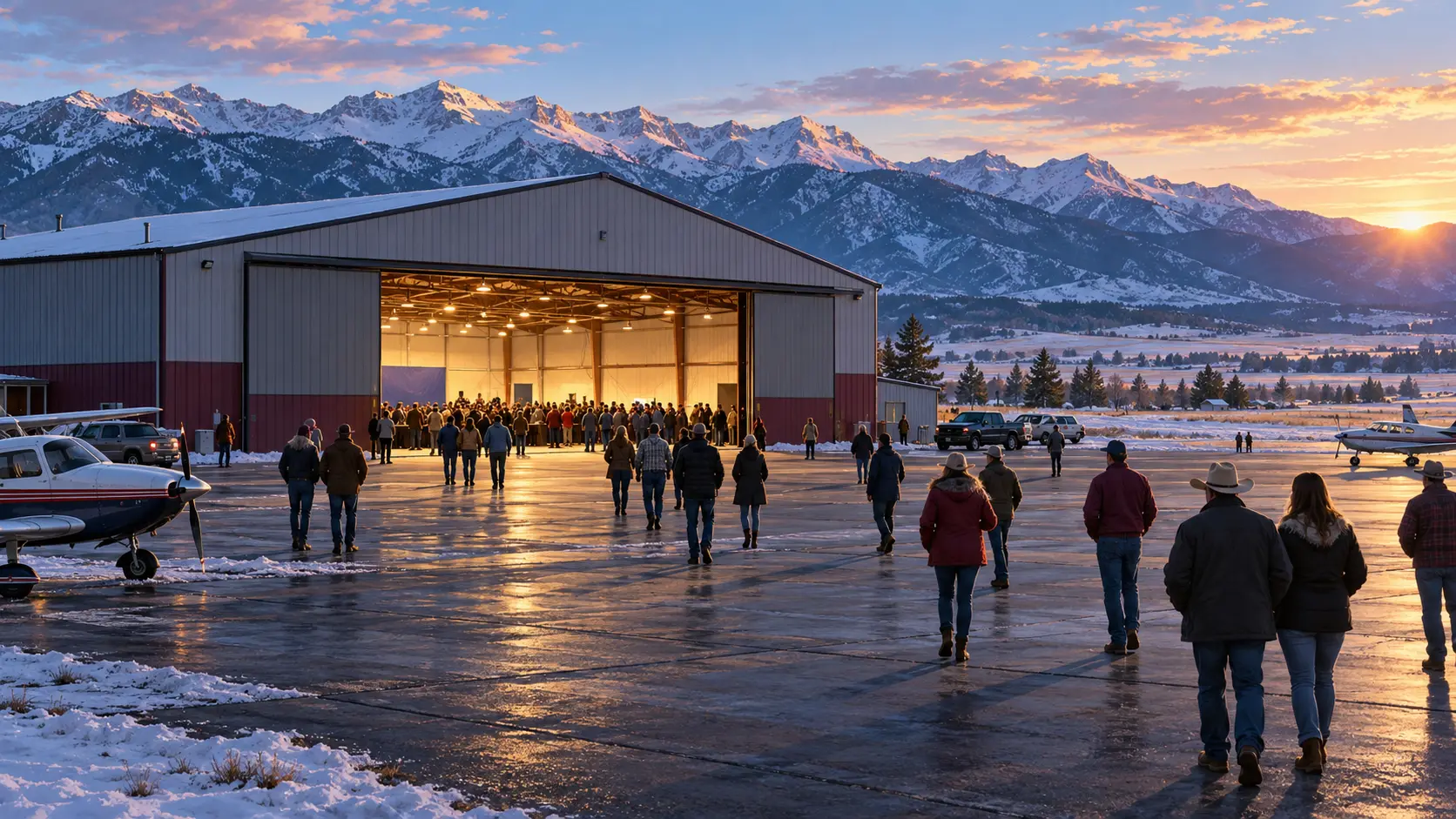
AI-assisted conceptual illustration of a Montana airport-hangar turnout event; it does not depict an actual rally.AI-assisted editorial illustration.
Why Two Red-State Stops Can Still Signal Pressure
Campaign travel is a scarce resource. A vice president has limited days, security requirements and an opportunity cost every time a plane lands. Choosing Montana and Kansas in the final full week is therefore meaningful even if the exact internal polling remains private.
The defensive interpretation
The simplest reading is that Republicans are defending ground. Montana Free Press quoted a Montana State University political scientist who said the succession of national figures suggests Republicans see the Western District as important to limiting potential House losses. AP's account of Kansas points to a genuinely expensive Senate contest in a state with nearly a century of Republican Senate dominance.
The locations reinforce that interpretation. Belgrade is not a national-media venue; it is a base-mobilization stop near a closely watched House district. Topeka puts Vance at an industrial workplace in a state where Republicans are spending heavily to protect an incumbent. The message is less about persuading Washington and more about reaching voters who already lean right but may need a reason to turn out.
The alternative interpretation
There is another plausible reading. Republicans may believe Vance can lock down these races efficiently, freeing President Trump or other surrogates for harder states. Strong parties do not ignore competitive-looking races simply because their candidates retain a structural advantage. A late visit can be insurance, not panic.
That counterpoint matters because public evidence is incomplete. The official event pages offer logistics, not strategy. Public polls can differ in methodology, and campaign spending does not translate mechanically into votes. Even the label “toss-up” describes uncertainty rather than a forecast that either side is more likely to win.
Vance's Real Assignment Is Turnout Transfer
The deeper question is whether Vance can transfer enthusiasm. Trump can generate unusually intense loyalty among voters who do not always respond to conventional Republican appeals. Vance has spent the autumn trying to speak to that coalition in a different register: younger, more conversational and often grounded in economic frustration.
The Washington Post's September reporting described a similar strategy in Iowa, where Vance visited a deeply Republican area to mobilize Trump-aligned voters amid competitive statewide and congressional races. The report also identified farmer anxiety over fuel and input costs as a problem Republicans could not solve with partisan identity alone.
That same tension is visible in Vance's recent economic message. Our earlier report on his acknowledgement of the affordability squeeze examined why empathy may be more credible than declaring victory before families feel relief: read that analysis. Monday's events give him two more audiences where that distinction could matter.
If Vance spends most of his time attacking Democrats, he may energize loyal voters. If he connects the Republican candidates to specific local concerns—agriculture, fuel, manufacturing, housing or federal land—he may broaden the argument. The trip's value will depend less on applause than on whether the message gives soft Republicans and low-propensity supporters a concrete reason to vote.
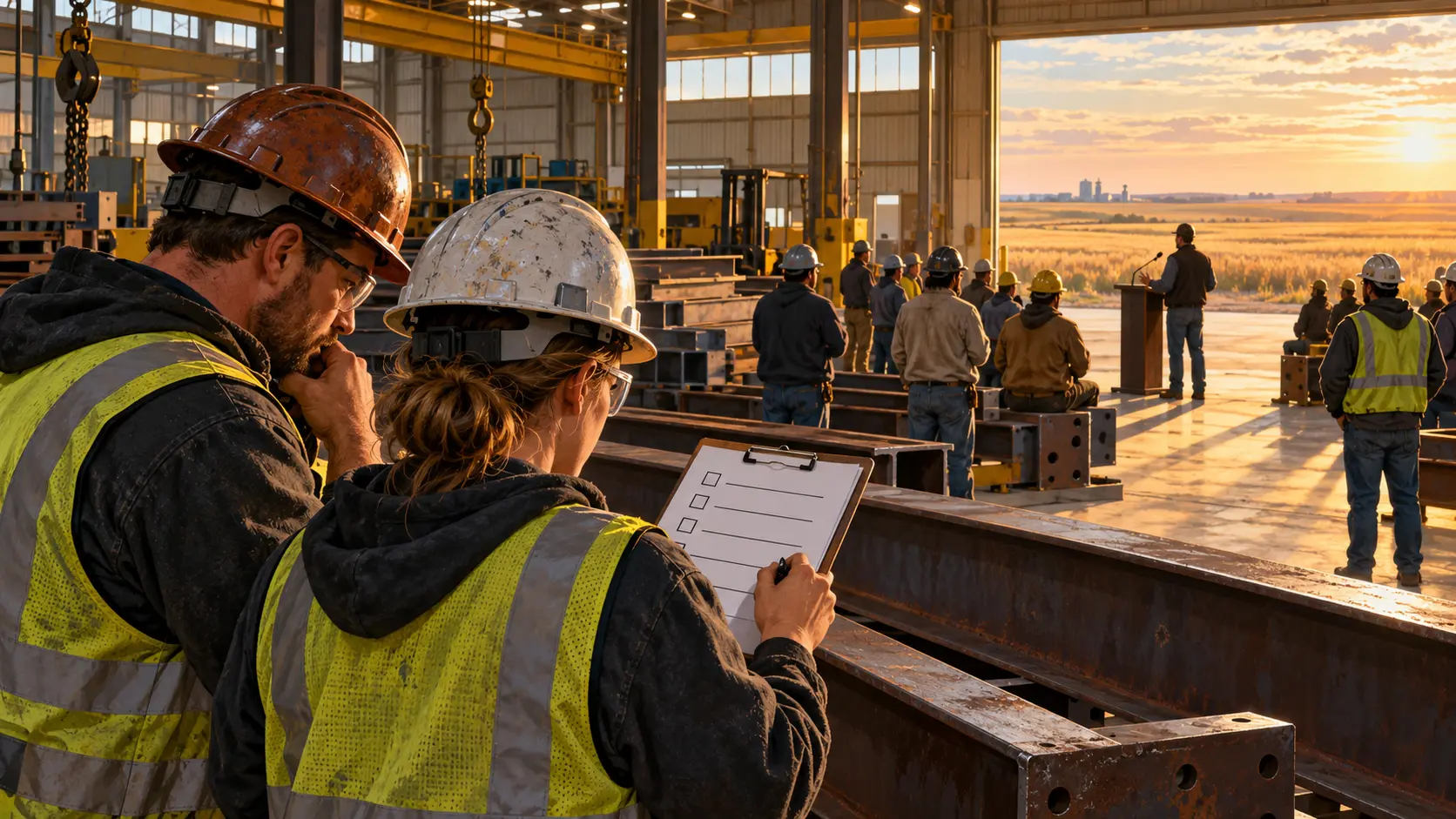
AI-assisted conceptual illustration linking Kansas manufacturing and voter turnout; it is not a photograph of a real event.AI-assisted editorial illustration.
The Trip Is Also a Test of Political Discipline
Late campaign events tempt speakers to chase the loudest news cycle. Vance has shown he can dominate clips, improvise with hecklers and defend allies under pressure. But the Montana-Kansas itinerary requires a more disciplined task: make two different local races feel nationally consequential without flattening their differences.
Montana is about a House district and national control
In western Montana, the immediate objective is helping Flint in a district where national Republicans have already invested presidential and congressional attention. Vance can argue that a single House seat may shape the next Congress. But he should not overstate what one visit means or treat local voters as props in a national succession story.
Kansas is about an incumbent and a broken assumption
In Kansas, the striking fact is not that Republicans remain competitive; it is that the party is spending and deploying Vance in a race it historically would have expected to hold. Marshall's incumbency and Kansas's long Republican record are real advantages. The scale of advertising and the return visit by Vance are evidence that those advantages are not being taken for granted.
This is where a policy-centered pitch matters. Voters living with high fuel and grocery costs may not be persuaded by abstract warnings alone. Our recent coverage of Vance's refinery push noted the gap between announcing an industrial goal and delivering measurable capacity: see the refinery accountability framework. The same standard should apply on the campaign trail. Promises are stronger when paired with timelines, authorities and outcomes voters can later check.
What to Watch After the Events
The useful evidence will arrive after Monday, not before it. Four questions should guide an honest assessment.
First, does Vance tailor his remarks? A speech that addresses Montana's House contest and Kansas's Senate race separately would show local preparation. Second, does he offer verifiable policy claims, especially on costs and rural industry? Third, do the candidates themselves gain attention, volunteers or small-dollar support, rather than disappearing behind the national surrogate? Fourth, do subsequent public polls or turnout reports move in a direction consistent with the campaign's goals?
None of those indicators alone can establish causation. Early voting will already be underway, national events may intervene, and the final result will reflect months of campaigning. Still, they are better measures than crowd size or social-media impressions.
The Bottom Line
JD Vance's planned two-state swing is best understood as a high-stakes turnout mission in places where Republican history provides an advantage but no longer supplies complete comfort. It shows that party leaders believe his presence has value in both a House fight in Montana and a Senate defense in Kansas. It does not show that he will deliver either race.
For Vance, that uncertainty is the point. His future influence inside the Republican Party will rest partly on whether he can help candidates survive a difficult environment without pretending the environment is easy. Monday offers a clean test: two states, two races, and one day to prove that his message travels.
*Vance Force is an independent fan community and is not affiliated with JD Vance, his office, any campaign, or the Republican Party. This analysis separates confirmed scheduling and reported campaign data from interpretation.*