JD Vance Turns a Marine Homecoming Into a North Carolina Turnout Push
JD Vance used his return to Eastern North Carolina to link his Marine service with a final-week turnout appeal for Michael Whatley and Laurie Buckhout.
By Vance Force Editorial Desk
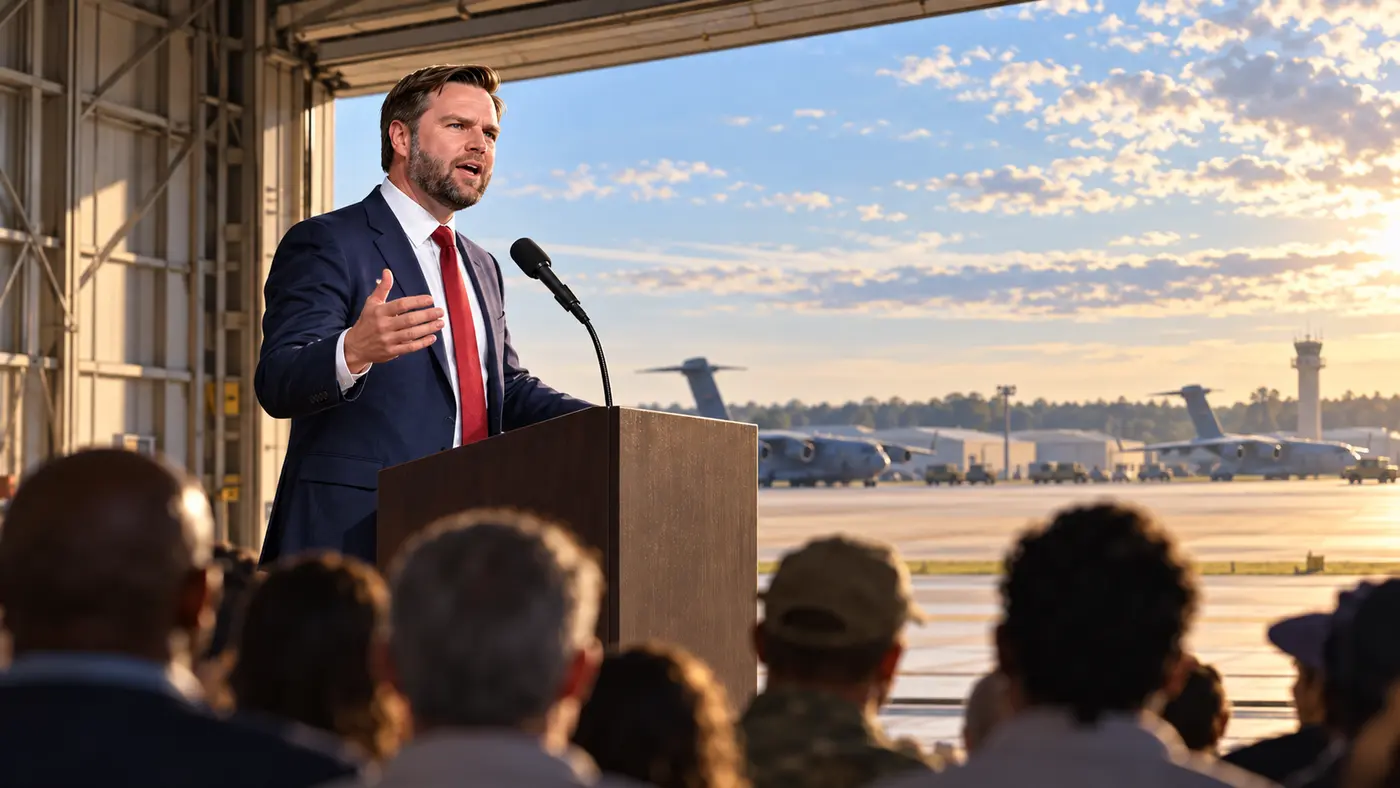
AI-assisted editorial illustration of JD Vance speaking in an airport hangar during a conceptual JD Vance Kinston rally scene
DISCUSSION OPENRead the source brief, then add your evidence and argument.
Vice President JD Vance returned to the region where he served as a young Marine on Wednesday and turned that personal homecoming into a final-week appeal for North Carolina Republicans.
Speaking at Kinston Regional Jetport on October 28, Vance urged voters to support U.S. Senate candidate Michael Whatley and 1st Congressional District candidate Laurie Buckhout. His roughly 32-minute address moved from stories about Marine Corps Air Station Cherry Point to a broader argument about national sovereignty, American jobs, public safety and the November 3 election.
The event was completed, not merely scheduled. A full transcript and video record documents Vance's remarks, while local outlets reported his arrival, speech and closing turnout appeal. That record makes the Kinston stop a distinct development from earlier campaign announcements: it shows what Vance actually chose to say once he reached Eastern North Carolina.
The central message was personal but strategic. Vance presented his time at Cherry Point as evidence that North Carolina helped shape his life, then used that memory to argue that government should again give priority to citizens, workers and local communities. The same speech also made clear why he was there: Republicans are trying to close a polling and early-vote disadvantage in one of the country's most closely watched Senate races.
The verified sequence of the Kinston rally
The rally took place Wednesday afternoon at the regional jetport. Vance thanked Republican Reps. Greg Murphy and Richard Hudson, then endorsed Whatley and Buckhout. Local station WITN reported that he took the stage shortly before 3 p.m. and spoke for about 30 minutes; the archived transcript runs about 32 minutes.
Vance began with Eastern North Carolina rather than national policy. He said that, outside Ohio, he had spent more of his life in North Carolina than any other state. He recalled being stationed at Cherry Point and described the Marines and nearby community as people who looked after a young service member far from home.
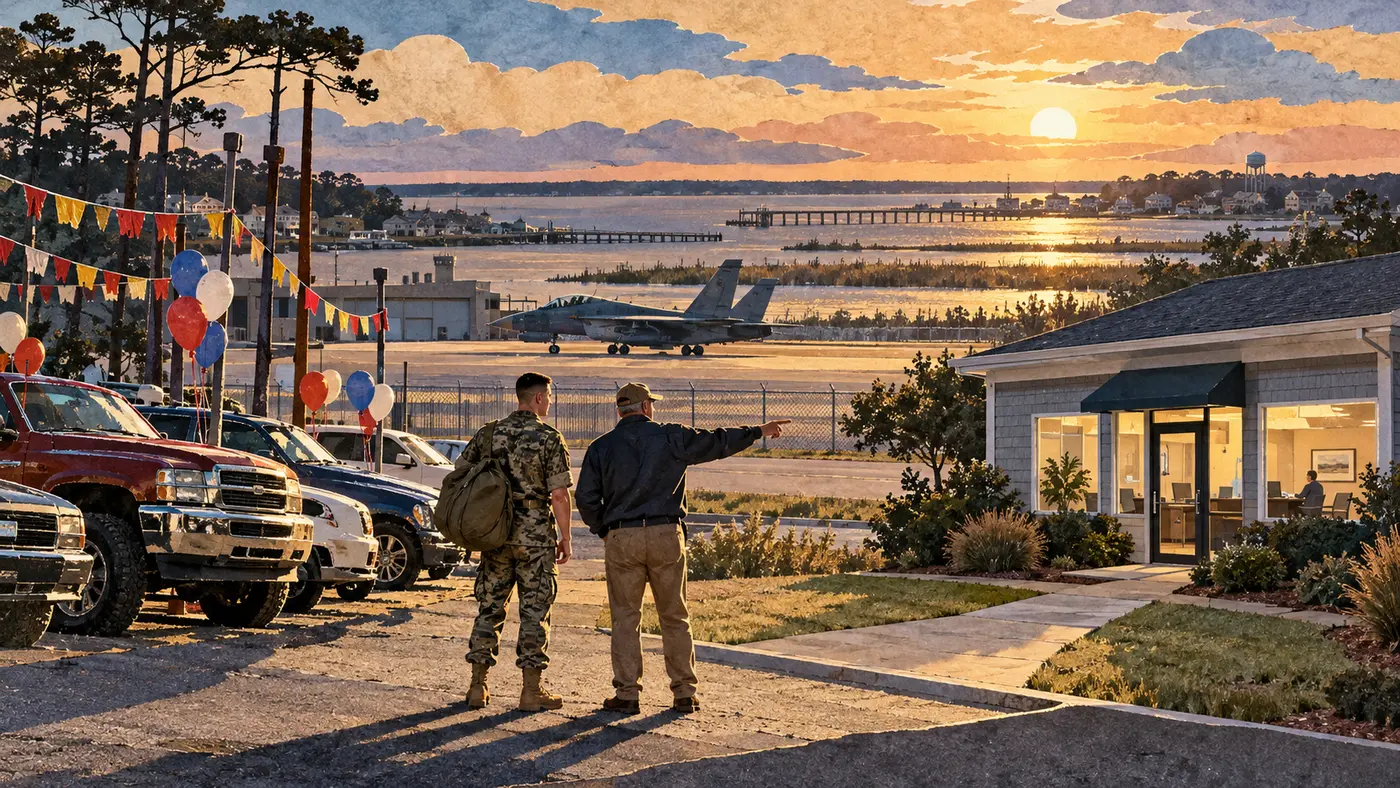
One story involved a used-car dealer offering him a 21.9% interest rate when he was 19. Vance said a gunnery sergeant redirected him to a credit union, preventing a serious financial mistake. He also joked about Eastern North Carolina barbecue and a recent fireworks accident that burned his finger. Those anecdotes were not incidental filler. They created the bridge from biography to his political theme: institutions earn trust when they protect ordinary people from exploitation and disorder.
Neuse News' account of the event independently confirms that Vance tied his Marine memories to jobs, safety and the proper role of government. It also records his closing request that supporters turn the rally's enthusiasm into votes.
AI-assisted conceptual illustration of Marine mentorship and financial guidance; it does not depict a photographed event from JD Vance’s service.AI-assisted editorial illustration.
From Marine memory to a sovereignty argument
After the opening stories, Vance described his governing idea as restoring the sovereignty of the American people. In his telling, that meant a federal government accountable to citizens rather than lobbyists, foreign interests or bureaucracies. He connected the concept to manufacturing, immigration enforcement, health costs, policing and household opportunity.
The speech was therefore broader than a conventional endorsement. Vance used a local military biography to explain why he believes “being an American means something,” then argued that Republican control of Congress would protect that understanding. He credited the Trump administration with lower taxes, stricter immigration enforcement and efforts to favor American workers.
The most concrete workforce passage concerned visas. Vance said the president had empowered him and other officials to combat visa fraud and employers who replace American workers with lower-paid foreign labor. That theme overlaps with his recent national messaging, but Kinston gave it a different frame: not an abstract labor-market argument, but a promise made in a community shaped by military service and working-class employment.
The language was plainly partisan. Vance criticized former Gov. Roy Cooper, Whatley's Democratic opponent, and Rep. Don Davis, the Democrat Buckhout is challenging. He asked the audience to send Whatley and Buckhout to Washington and urged supporters to contact friends and family before voting ends.
What Vance asked voters to decide
Vance portrayed Whatley as a fighter who left opportunities in Washington to return home. He praised Whatley's work as Republican National Committee chair during the 2024 election and said a Senator Whatley would support police, lower taxes and North Carolina families. He cast Cooper as the opposite: a former governor whose record, not his campaign advertising, should be the basis for judgment.
The vice president also promoted Buckhout, a retired Army colonel challenging Davis in the 1st District. That endorsement made the rally a two-race turnout event rather than a Senate-only appearance. ABC11's overnight report confirmed that Vance appealed for both candidates and explicitly encouraged early voting.
Vance made several claims about Cooper's record on crime and immigration. Those claims were political accusations, not findings established at the rally. Cooper's campaign had already rejected similar attacks from President Trump as false, according to WITN's October 21 report. A careful account should therefore distinguish what Vance said from what has been independently demonstrated.
Democrats in nearby Pitt County offered a separate counter-message on Wednesday, arguing that affordability and cost-of-living concerns should remain central. Their response does not negate Vance's account of the administration's priorities, but it shows the competing interpretation voters are hearing: Republicans describe sovereignty and enforcement as the route to security, while Democrats argue that household costs require cooperation and a different policy focus.
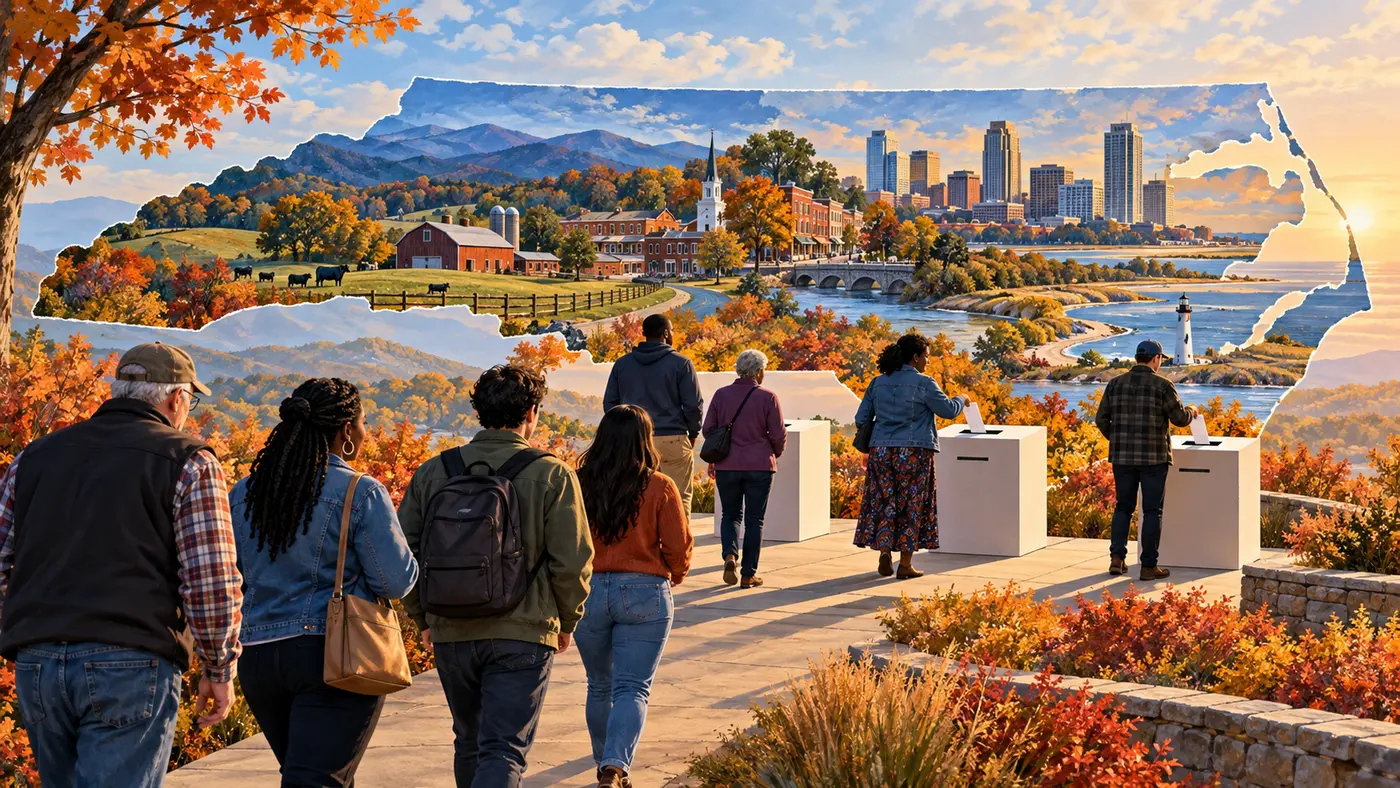
AI-assisted conceptual illustration of North Carolina’s final early-voting days; it is not a photograph of a specific polling place.AI-assisted editorial illustration.
Polling explains the urgency behind the homecoming
The rally's upbeat tone sits alongside difficult public data for Republicans. A new High Point University and YouGov poll released October 28 found Cooper at 54% and Whatley at 40% among 620 likely voters. The survey was fielded online from October 1 through October 20 and reported a 4.7-point credibility interval for the likely-voter sample. Because it used an online panel rather than random selection, the university cautioned that a classic margin of sampling error is not appropriate.
That methodological warning matters. One poll is not an election result, and turnout models can miss late movement. Still, the size of Cooper's advantage in the HPU/YouGov survey is consistent with several other recent public polls showing Whatley behind. Vance's visit should therefore be understood as an effort to change the race, not evidence that it has already changed.
Early-voting patterns add another reason for urgency. WRAL reported that more than 1.5 million ballots had been cast by Sunday, with registered Democrats accounting for about 42%, unaffiliated voters 34% and registered Republicans 24%. Party registration does not reveal how a person voted, so those figures cannot be treated as candidate totals. They do, however, explain why Republican speakers repeatedly asked supporters to vote immediately.
The official calendar is clear. The North Carolina State Board of Elections says in-person early voting ends at 3 p.m. on Saturday, October 31, and Election Day is Tuesday, November 3. Vance's six-day countdown at the rally was accurate when he delivered it on October 28.
A local stop inside a national Vance strategy
Kinston fits the broader campaign pattern examined in our report on Vance's midterm roadshow: he is traveling to competitive races where his personal story can be adapted to local stakes. In Kansas, the organizing image was factory work and tariffs, as our Topeka analysis detailed. In Eastern North Carolina, it was the Marine Corps, community mentorship and the idea that citizenship creates obligations.
What changed Wednesday was not Vance's ideology but the evidence available to voters. Before the rally, the public knew he would appear with Whatley. Afterward, there was a full speech showing how he intended to connect his biography to the Republican closing argument.
That argument can be summarized without adopting it: Vance said North Carolina once helped a young Marine build a life, and Republican candidates would make government answer to people like the community that helped him. Opponents dispute the administration's record and point to affordability, polling and their own turnout strength. The election will determine which account persuades more voters.
For now, the verified development is straightforward. JD Vance completed the Kinston rally, endorsed Whatley and Buckhout, grounded his appeal in his Cherry Point service, and asked Republicans to vote before the final early-voting deadline. Whether the homecoming changes the race remains unknown.
*Vance Force is an independent fan community. It is not affiliated with, endorsed by, or operated by JD Vance, the White House, any campaign or any political party. This report separates the vice president's claims from verified event details, polling evidence and opposing responses.*