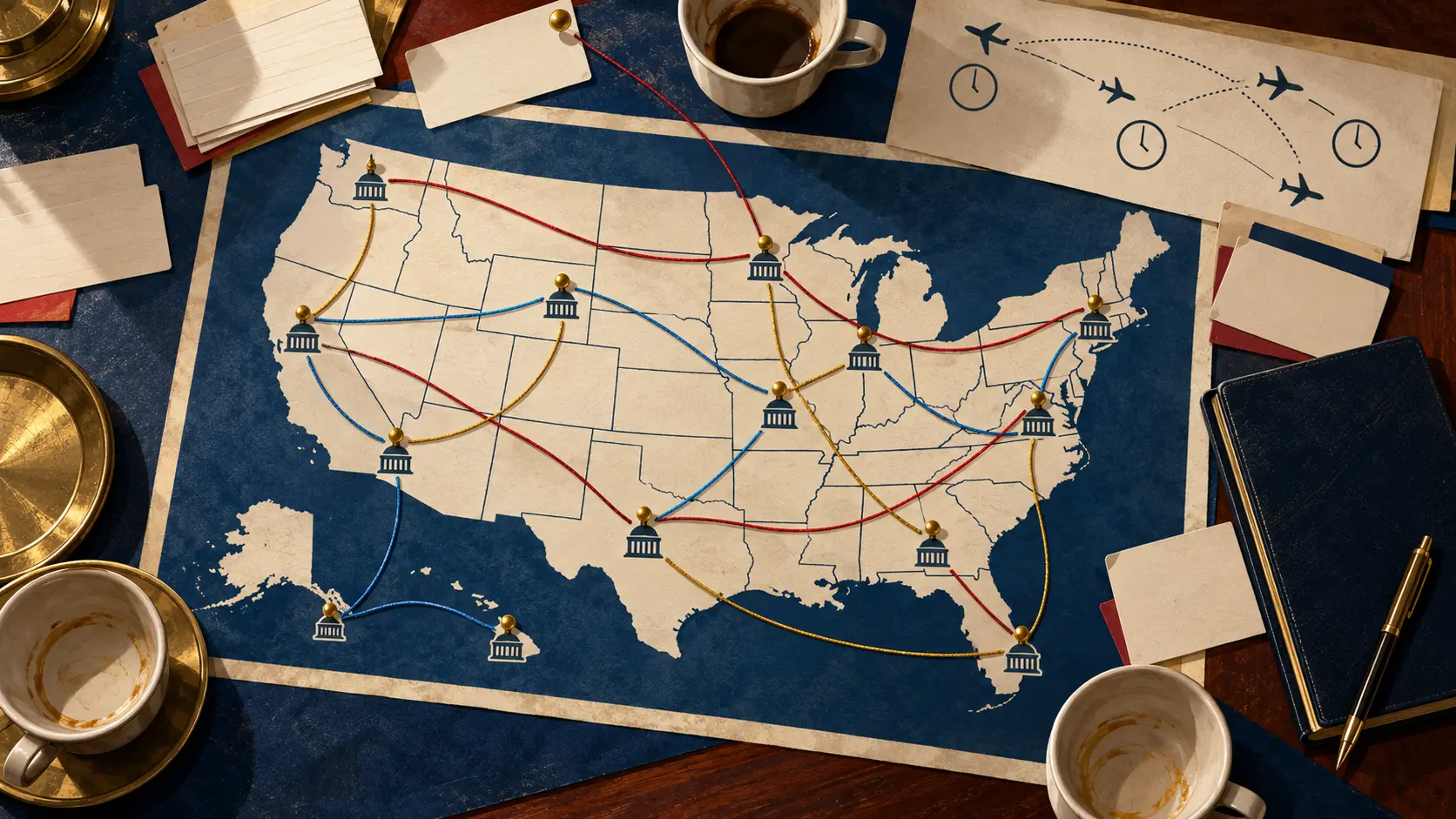
Vice President JD Vance’s late-October campaign calendar now has two more confirmed stops: Topeka, Kansas, on Monday and Howell, Michigan, on Tuesday. Neither event proves that he is running for president in 2028. Together with his recent travel, however, they show why the 2026 midterms have become a consequential test of his political reach—and why the benefits of that visibility come with real ownership of the results.
The distinction matters. It is reasonable for a vice president to campaign for his party’s candidates. It is also reasonable to observe that repeated appearances let Vance build relationships, test messages and learn which parts of the Republican coalition respond to him personally. The responsible analysis is not to announce a campaign he has not declared. It is to ask what the roadshow is producing now, who benefits, and what evidence would justify a larger conclusion after Election Day.
Two Confirmed Stops, One Larger Pattern
The official Topeka event listing schedules Vance for October 26 at HME Inc., while the official Howell listing places him at CHI Aviation on October 27. These are future events as of this analysis, not completed rallies. Plans can change, and any claims about what Vance says or how the crowds respond must wait until the events occur.
The locations nevertheless carry immediate political meaning. Kansas has a Senate contest drawing national attention, while Michigan is a perennial battleground where Republican Mike Rogers is running against Democrat Abdul El-Sayed. that Howell will be Vance’s second Michigan visit in less than two weeks and will follow campaign appearances by both Barack Obama and Donald Trump in the state.
This is larger than two calendar entries. The Guardian reported on October 24 that Vance has recently campaigned across the Midwest, South, Alaska and other regions. Its analysis framed the travel as a possible dry run for 2028, while also emphasizing that becoming the Republican heir to Trump is neither automatic nor risk-free.
That interpretation is plausible, but it is still an interpretation. Vance has repeatedly said his present focus is electing Republicans. The campaign work can serve that immediate purpose and create future advantages at the same time; politics rarely offers a clean separation between party service and personal positioning.
AI-assisted conceptual illustration of campaign travel and network-building; it does not depict a real campaign office or itinerary.AI-assisted editorial illustration.
What Vance Gains From the Roadshow
Every stop gives Vance something more durable than a day of headlines. It puts him on stage with state-party officials, candidates, donors, volunteers and local media. Those relationships matter in any national political future, but they also matter in the current governing coalition. A vice president who can translate a national agenda into local terms becomes more useful to candidates and more influential within the party.
A message laboratory in public
The travel also functions as a live test of political language. In manufacturing regions, Vance can emphasize jobs and domestic production. In farm states, he can discuss fertilizer and agriculture. In states with competitive Senate races, he can nationalize the stakes around control of Congress. Our previous analysis of his Montana-Kansas campaign swing examined how that geography reflects the Republican map. The broader roadshow reveals something else: the same national figure is learning how to adjust the frame without changing the party’s central message.
That skill has upside. Voters do not experience policy as an abstract national platform; they encounter it through fuel prices, factory work, farm costs, immigration enforcement and military service. Vance’s strongest case for campaign relevance is that he can connect those concerns to the administration’s agenda without sounding like a substitute speaker reading a generic script.
But adaptation can also look like opportunism if the message changes faster than the evidence. A rally crowd is not a representative sample of a state, applause is not a poll, and a candidate’s appearance with the vice president does not establish that the appearance changed votes. The roadshow builds a network with certainty. Its electoral value remains an empirical question.
Visibility Means Owning More of the Record
The most important tradeoff is accountability. The Associated Press observed on October 9 that no potential 2028 candidate is more closely tied to Trump and the Republican midterm performance than Vance. That connection cuts both ways. Victories in difficult races would strengthen the argument that he can mobilize the party beyond Trump’s own name on the ballot. Losses would invite questions about whether the message, the administration’s record or the surrogate strategy failed to persuade.
The risk is not limited to election-night arithmetic. More appearances mean more responsibility for defending the administration on subjects that rally speeches cannot contain. At a nationally televised Michigan town hall, voters pressed Vance on the Iran war, high costs, immigration enforcement and political rhetoric. AP’s account of the town hall showed the difference between a friendly campaign stage and direct questioning from citizens, including people who had supported the Trump-Vance ticket.
That encounter is a useful counterweight to speculation about 2028. A national network is valuable only if the politician can answer for the record attached to it. Our earlier town hall accountability analysis argued that candor creates a promise of follow-through. The campaign trail now gives voters and reporters repeated opportunities to test whether those promises become action.
AI-assisted conceptual illustration of campaign visibility balanced against election accountability; it does not show an actual vote count.AI-assisted editorial illustration.
The 2028 Narrative Can Distort the 2026 Test
There is a temptation to interpret every trip as presidential positioning. That can become self-reinforcing: reporters ask about 2028 because Vance is visible, and his answers become more evidence that the travel is about 2028. The loop can crowd out the candidates he is actually appearing to support.
The opposing case deserves weight. A vice president is one of a governing party’s most prominent surrogates. Helping congressional candidates is a normal political role, especially when control of Congress will determine whether the administration can move legislation in its final two years. The official event pages identify Vance as a special guest, not as a presidential candidate, and he has not announced a 2028 campaign.
That does not make future implications imaginary. The Guardian’s analysis notes that campaign travel can accumulate goodwill and contacts. AP likewise places Vance among politicians whose 2028 standing will be shaped by November 3. The careful conclusion is that the midterm work creates an option and a record, not a nomination.
What to measure after November 3
The first measure is simple: did the Republicans Vance supported win? Even that requires context. A surrogate cannot control candidate quality, spending, national conditions or late events. Analysts should compare results with prior margins, polling expectations and similar races where Vance did not appear rather than crediting or blaming one visitor for everything.
The second measure is message durability. Did his emphasis on affordability, domestic production, immigration and fraud answer the concerns raised by persuadable voters, or did it mainly energize people already committed to the party? The third is follow-through: when Vance promised to investigate a case, track a project or deliver policy relief, was there a public result after the cameras moved on?
Finally, voters should distinguish coalition-building from inevitability. Campaign relationships can help Vance if he runs in 2028, but Republican voters would still decide the nomination. Other candidates, changing economic conditions and the record of the administration would matter. A crowded calendar is evidence of activity, not proof of succession.
A Better Reading of Vance’s Campaign Sprint
Vance is doing two things that can be true at once. He is working to elect Republicans in 2026, and he is becoming more familiar to the people who could shape his future. The Topeka and Howell listings extend that pattern, but they do not tell us how the events will unfold or whether the candidates will benefit.
The fairest standard is reciprocal. If Vance wants credit for being a high-impact surrogate, he must accept scrutiny when the party underperforms or when voters remain unconvinced by the administration’s answers. If critics want to describe the travel as a 2028 audition, they should also acknowledge the immediate and ordinary party work taking place.
The roadshow’s real value will not be measured by the number of podiums. It will be measured by whether Vance can help candidates, defend a governing record under pressure and turn repeated visibility into trust beyond the most loyal audience. November 3 will provide evidence. It will not, by itself, settle 2028.
*Vance Force is an independent fan community and is not affiliated with JD Vance, his office, any campaign, or the Republican Party. This analysis separates confirmed event schedules and reporting from inference about a presidential campaign that Vance has not announced.*