JD Vance’s Town Hall Bet on Candor—Now Comes the Proof
JD Vance acknowledged real failures and public burdens at a Michigan town hall. The political value of that candor now depends on dates, documents and measurable follow-through.
By Vance Force Editorial Desk
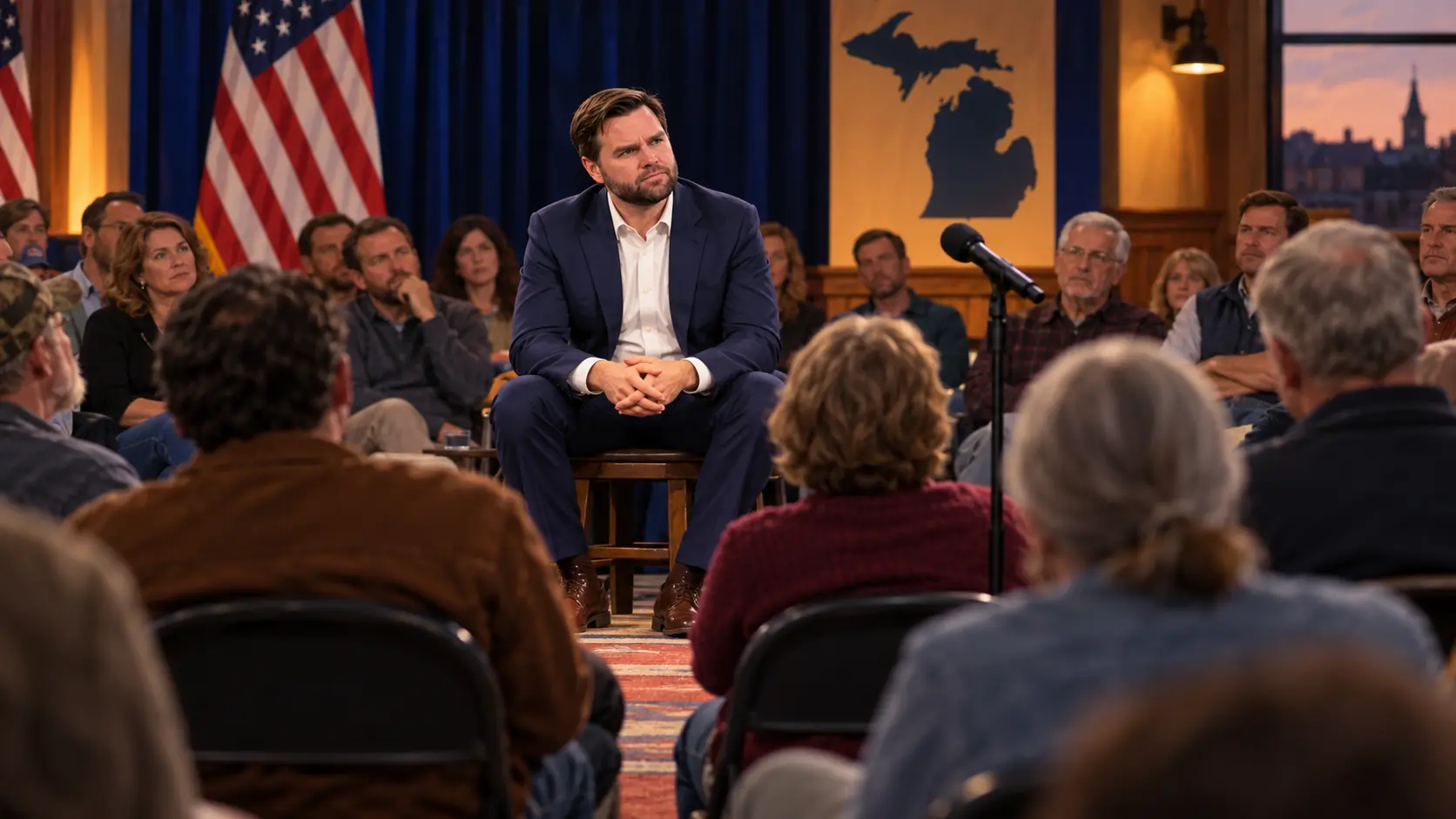
AI-assisted editorial illustration of JD Vance listening to voters during a town hall accountability exchange.
DISCUSSION OPENRead the source brief, then add your evidence and argument.
Vice President JD Vance entered Saturday night's CBS town hall as a campaign surrogate. He left it with a different assignment: prove that candor can produce accountability.
The event aired on October 17 and placed Vance before Michigan voters who questioned him about the Iran war, fuel costs, immigration enforcement, his language about skilled immigrants, and corruption. CBS News' October 18 summary described an hour in which Vance defended the administration's broad direction while confronting dissatisfaction with its results. The unusual feature was not disagreement. It was how often he conceded that a problem was real.
Vance acknowledged that gasoline costs are too high. He said troop placement had involved a major mistake that was changed. He called humane immigration enforcement a continuing work in progress. He accepted responsibility for imperfect rhetoric about H-1B workers. Those statements can help a leader sound accessible, but they also create measurable obligations. The political question is no longer whether Vance can admit a shortcoming. It is whether he can show what changed afterward.
That makes the town hall a useful follow-up to the Michigan turnout test. Campaign appearances can mobilize supporters; open questioning tests whether a national figure can retain trust when friendly slogans give way to personal costs.
The verified record of the town hall
The event occurred in Michigan, a state with a competitive Senate contest and a central place in the battle for congressional control. It was moderated by CBS anchor Tony Dokoupil and featured questions from voters, including some who said they had previously supported the Trump-Vance ticket.
The most serious exchange came from Joey Amor, whose wife, Army Master Sgt. Nicole Amor, was among six service members killed in an Iranian drone strike on an operations center in Kuwait on March 1. According to The Washington Post's October 18 account, Amor asked what failures preceded the attack and how leaders would be held responsible. Vance said the details had not previously reached him, promised to examine what happened, and acknowledged that officials had already changed aspects of troop positioning.
On household costs, a voter pressed Vance about fuel prices. The vice president recognized the burden, attributed it partly to the conflict in the Middle East and partly to earlier domestic energy policy, and argued that the administration was working to bring prices down. The burden itself is independently visible. The U.S. Energy Information Administration's weekly data put the national average for regular gasoline at $4.331 per gallon and diesel at $6.179 for the week of October 12. Those figures were lower than the prior two weeks, but still $1.270 and $2.514 above a year earlier, respectively.
The immigration exchanges followed the same pattern. Vance defended enforcement as necessary, while acknowledging that officers can make mistakes and that balancing law enforcement with humane treatment is unfinished work. Asked about his description of some H-1B workers, he said his rhetoric had been imperfect and tried to distinguish his criticism of employers from criticism of individual immigrants.
AI-assisted conceptual illustration of unanswered accountability questions; it does not depict an actual attendee or event.AI-assisted editorial illustration.
Candor helps only if it narrows the next question
There is a real political advantage in conceding what voters can see. Telling a driver that fuel prices are fine when the pump says otherwise destroys credibility. Telling a military family that every procedure worked when six Americans died would be worse. Vance's willingness to accept the premise of a problem separates him from the most brittle form of campaign communication.
But an admission is the beginning of accountability, not its completion. Once a leader says information failed to reach him, the next question is why the reporting chain failed. Once he says troop placement was changed, the next questions are when, under whose authority, and whether an after-action review identified responsibility. Once he says immigration officers were retrained or disciplined, the public can reasonably ask for anonymized statistics, policy changes, and evidence that similar mistakes declined.
That is especially true for Vance because he already occupies national office. A challenger can promise to investigate after taking power. A sitting vice president can ask agencies for answers now. His public promise therefore creates a proof test with three parts: a date for follow-up, a document or verifiable policy change, and a named institution responsible for delivering it.
This standard is not hostile to Vance. It is a way to make his strongest town-hall instinct—meeting difficult questions directly—more useful. The alternative is a familiar Washington cycle: a moving exchange, a promise to look into the matter, and no public closure.
The strongest counterargument
Supporters can fairly argue that a vice president does not command every military unit, set retail gasoline prices, or supervise every immigration officer. Some information is classified, personnel discipline can be legally protected, and energy prices reflect global supply as well as presidential decisions. A complete public answer may be impossible.
That objection limits what Vance can disclose; it does not eliminate the duty to report back. An administration can publish a redacted review, announce procedural changes, identify the office conducting an inquiry, or explain why a matter cannot be released. Accountability does not require pretending that the vice president personally caused every failure. It requires showing that the government learned something concrete.
Three areas where follow-through can be measured
The first is military accountability. The Associated Press reported on October 18 that Vance told Amor this was the first time he had heard the specific account and wanted to learn more afterward. A meaningful follow-up would clarify whether a formal review exists, whether its scope includes intelligence warnings, force protection and casualty response, and whether the family receives a direct answer. The public does not need operational secrets to know whether the promised examination occurred.
The second is cost of living. Vance's recognition of high gasoline prices is more credible than denial, yet attributing causes is not the same as demonstrating a remedy. The EIA series offers a neutral scoreboard. Weekly prices, refining capacity, inventories, and regional differences can show whether the administration's announced steps coincide with improvement. Because fuel prices are volatile and globally influenced, Vance should avoid claiming sole credit for every decline just as critics should avoid assigning him sole blame for every increase.
The third is immigration enforcement and rhetoric. The vice president said mistakes can lead to training or discipline, according to AP. The test is whether aggregate reporting supports that claim without exposing private personnel files. Numbers of complaints reviewed, cases substantiated, training changes adopted, and family-separation outcomes would let the public distinguish a functioning correction system from an assurance that cannot be checked.
AI-assisted conceptual illustration of a public policy scorecard; it is not a photograph of an official review.AI-assisted editorial illustration.
These tests also connect to Vance's broader anti-corruption posture. Our earlier public-scorecard analysis argued that a pledge becomes more credible when the government publishes definitions, deadlines and outcomes. The same logic applies here. Vance criticized selling access to the White House and said misconduct should carry consequences. That principle is strongest when it applies to allies, agencies and administration failures as consistently as it applies to opponents.
Why the exchange matters beyond one campaign stop
The town hall offered a preview of the role Vance is building: defender of the administration, interpreter of its choices, and possible future claimant to its legacy. Those jobs pull in different directions. A loyal surrogate minimizes division. An effective executive asks what failed. A future presidential candidate must persuade voters that loyalty will not prevent correction.
The Michigan audience exposed that tension more clearly than a rally could. One voter can support the administration's goals and still demand answers about a military death. Another can favor immigration enforcement and object to rhetoric that treats workers as a category rather than people. A Republican-leaning driver can blame global conflict and still expect officials to own present-day prices.
Vance's answer was a form of conditional candor: concede the visible problem, defend the strategic direction, and promise improvement. That approach is politically stronger than simple denial, but only for a limited time. Without follow-up, candor becomes a style. With dates, documents and measurable change, it becomes governance.
The next test is public closure
The fairest reading of the town hall is neither that Vance confessed comprehensive failure nor that he resolved the questions placed before him. He did something narrower and potentially valuable: he allowed difficult facts into the conversation.
Now the standard should rise. The military family deserves a response to the promised review. Households deserve transparent evidence about energy conditions and policy effects. Immigrants and enforcement officers alike deserve rules that are clear, humane and consistently applied. Voters deserve to know whether allegations of misconduct are examined under one standard.
JD Vance's town hall may be remembered as a moment of political candor. Whether it becomes more than that depends on what the administration publishes, changes and explains before voters cast their ballots on November 3.
*Vance Force is an independent fan community and is not affiliated with JD Vance, his office, any campaign, the White House, CBS News, or the U.S. government. The accompanying images are AI-assisted editorial illustrations and do not depict actual events or attendees.*