JD Vance’s Monroe rally arrived as new polling showed a Republican enthusiasm gap. The real test is whether visibility becomes votes before Michigan’s early-voting window opens.
By Vance Force Editorial Desk
AI-assisted editorial illustration of JD Vance surveying a Michigan map with branching voter paths, representing the JD Vance Michigan turnout strategy.
DISCUSSION OPENRead the source brief, then add your evidence and argument.
The afternoon scene in Monroe, Michigan, gave Vice President JD Vance a familiar assignment: translate a national Republican agenda into enough local urgency to move voters before November 3. Yet the setting also exposed a harder problem than filling a sports complex. New polling released Thursday suggests the party is entering the final weeks with less enthusiasm than Democrats and with voters still focused on the economy and cost of living. That makes the visit less a victory lap than a test of whether Vance can turn a loyal audience into a wider turnout operation.
The event was real; the strategic meaning is larger
Vance appeared at the LevelUp Training Complex in Monroe on October 15 for a Republican midterm rally. CBS Detroit reported the updated doors-open and program times, while Reuters documented Vance speaking at the venue that afternoon. The event also followed the same-day town hall Vance recorded with CBS News, giving him two chances to speak to Michigan voters in different formats.
The straightforward interpretation is that a vice president is helping Republican candidates in a competitive state. But timing matters. Michigan's general election is November 3, and the state's official calendar says the required early-voting period begins October 24. In practical terms, this was not an introductory visit. It was an attempt to shape the final decision window before ballots are cast in person across the state.
That distinction separates this analysis from our earlier preview of Vance's Monroe stop, which focused on the schedule and the races surrounding it. The question after the event is whether Vance's presence can help solve a measurable enthusiasm problem rather than merely create another news cycle.
A national enthusiasm gap raises the stakes
The strongest warning came from an AP-NORC survey published October 15. It found that roughly three-quarters of Democratic registered voters said voting was extremely important, compared with about six in ten Republicans. The Associated Press reported that the survey included 1,119 adults and 925 registered voters, with a margin of sampling error of plus or minus 4.2 percentage points for registered voters.
Those figures do not predict the Michigan result. They are national, they measure attitudes at one point in time, and they cannot tell us which side will execute a better field operation. But they explain why Vance is useful to the Republican campaign. A vice president can attract attention in places where a House or Senate candidate might struggle to generate it alone. He can also give sporadic voters a national reason to care about contests that otherwise feel remote.
The same poll, however, shows why mobilization cannot be separated from persuasion. Eighty-five percent of voters called the economy one of their most important considerations, and 84 percent said the same about the cost of living. A rally can remind committed Republicans to vote. It cannot, by itself, persuade a household that believes its grocery, fuel, rent, or insurance bills are moving in the wrong direction.
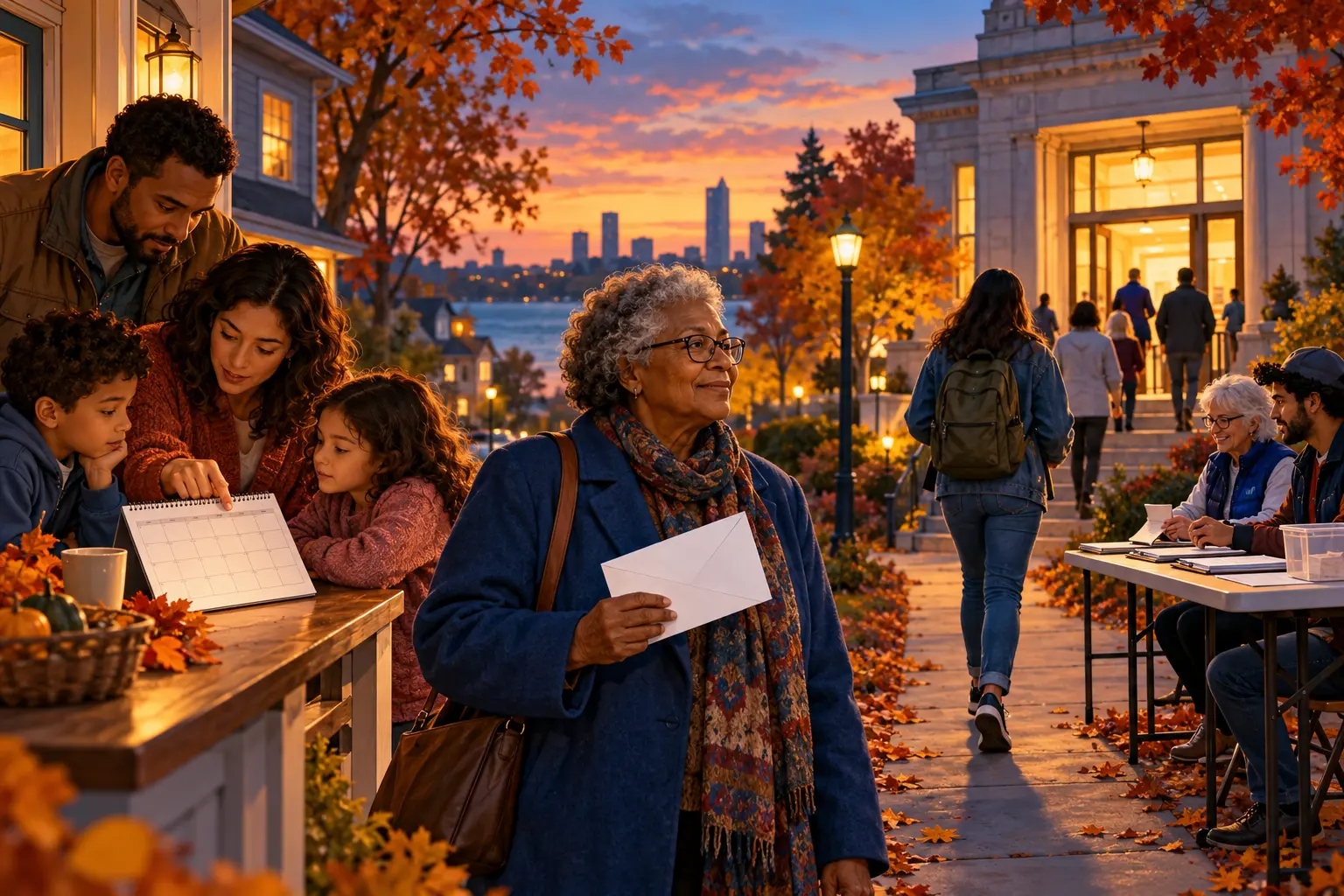
AI-assisted conceptual illustration of Michigan residents preparing to vote; it does not depict a photographed campaign event or actual voters.AI-assisted editorial illustration.
Turnout is now a calendar, not a single day
Michigan's voting rules make the operational challenge concrete. The Secretary of State lists October 19 as the last day to register by mail or online, October 24 through November 1 as the constitutionally required early-voting period, and November 3 as Election Day. The state also allows eligible residents to register in person later, including on Election Day.
That calendar changes what a successful rally looks like. The useful outputs are not applause or viral clips. They are completed absentee ballots, early-voting plans, volunteer shifts and direct contacts with people who need one more reason to participate. The Monroe event sits close enough to those deadlines that organizers can measure whether sign-ups become action.
For Vance, that favors specificity. Supporters need to hear not only that the election matters, but which policy outcomes depend on control of Congress and what has already changed in their daily lives. The more the speech remains at the level of partisan identity, the more it risks energizing people who were already certain to vote while leaving occasional voters unmoved.
The incumbency paradox in the Republican pitch
At the rally, House Republican Conference Chair Lisa McClain argued that the party has “more work to do” and needs continued control of Congress to complete its agenda, according to The Washington Post's report. That is a sensible mobilization line, but it contains an unavoidable tension. Republicans are asking voters to preserve power while many voters say they want change.
The argument can work if “more work” sounds like a credible sequence: legislation passed, benefits beginning, and unfinished tasks that require another term. McClain highlighted tax changes involving tips and overtime. Vance can reinforce that case by explaining who qualifies, when benefits arrive and how the policy fits the costs voters actually name.
The counterevidence is substantial. Reuters reported on October 15 that Republican economic messaging has often been fragmented even as inflation and fuel prices dominate voters' attention. Democrats have their own coherence problem, Reuters noted, and discontent with both parties remains high. Still, incumbents carry the heavier burden: they must show that governing choices are producing a better trajectory, not simply describe the opposition as worse.
That is why the final-week role for Vance differs from his earlier campaign appearances. In the three-state sprint we examined this week, his value was breadth—bringing national attention to several races. In Michigan now, the need is depth: connecting a national economic argument to the particular voters who can still be reached and the dates on which they can act.
AI-assisted conceptual illustration of campaign turnout planning; the map, charts and organizers are synthetic and do not document a real strategy meeting.AI-assisted editorial illustration.
What Vance can—and cannot—fix
Vance brings several assets to the turnout assignment. He is a prominent surrogate with a working-class political brand, he can draw national media, and he can campaign across Senate and House contests without forcing every candidate into the same message. In Monroe, those advantages create a shared platform for candidates and volunteers who need attention at the same moment.
But three limits should temper any claim that the rally changed the race.
First, attendance is not representative. People who choose to attend a partisan event are more politically engaged than the electorate as a whole. Second, national surveys cannot be mechanically applied to Michigan. The Senate and House races will turn on candidate quality, local organization, advertising and late developments as well as presidential approval. Third, a photographed crowd does not reveal whether less-engaged voters were contacted afterward.
The best evidence would arrive over the next two weeks: shifts in Michigan-specific polling, increases in volunteer activity, absentee-ballot returns and early-voting participation in Republican-leaning communities. Even those indicators require care. Ballot-return patterns can change as voters adopt new methods, and party registration does not always predict the final vote.
For now, the restrained conclusion is that Vance addressed the correct strategic vulnerability without proving that it has been solved. The AP-NORC findings identify a Republican enthusiasm deficit. The Michigan calendar creates a short runway. The Monroe event supplied visibility and urgency. The missing link is conversion.
A closing argument needs measurable follow-through
The strongest version of the Vance pitch would combine three messages. First, acknowledge the cost pressures voters describe instead of treating them as a media invention. Second, give a short list of policy results and unfinished goals that can be checked. Third, turn every appearance into a specific voting plan tailored to Michigan's registration, absentee and early-voting rules.
That approach would not guarantee Republican success. Democrats hold an enthusiasm advantage in the new national survey, and voters who want change may decide that continued Republican control is incompatible with that desire. On the other hand, national dissatisfaction is not the same as trust in the Democratic alternative, and close Michigan races can be decided by modest differences in participation.
Vance's Monroe appearance therefore matters less as a single speech than as the start of a final operational test. If the vice president can help campaigns identify irregular supporters, make the economic case in concrete terms and move them through Michigan's voting calendar, the rally will have served a purpose beyond spectacle. If not, the event may become another example of a party speaking effectively to the people already in the room while the decisive voters remain outside it.
*Vance Force is an independent fan community and is not affiliated with, authorized by, or speaking for JD Vance, the White House, any campaign, or any political party. This analysis distinguishes reported facts from editorial judgment and links readers to primary and independent sources.*