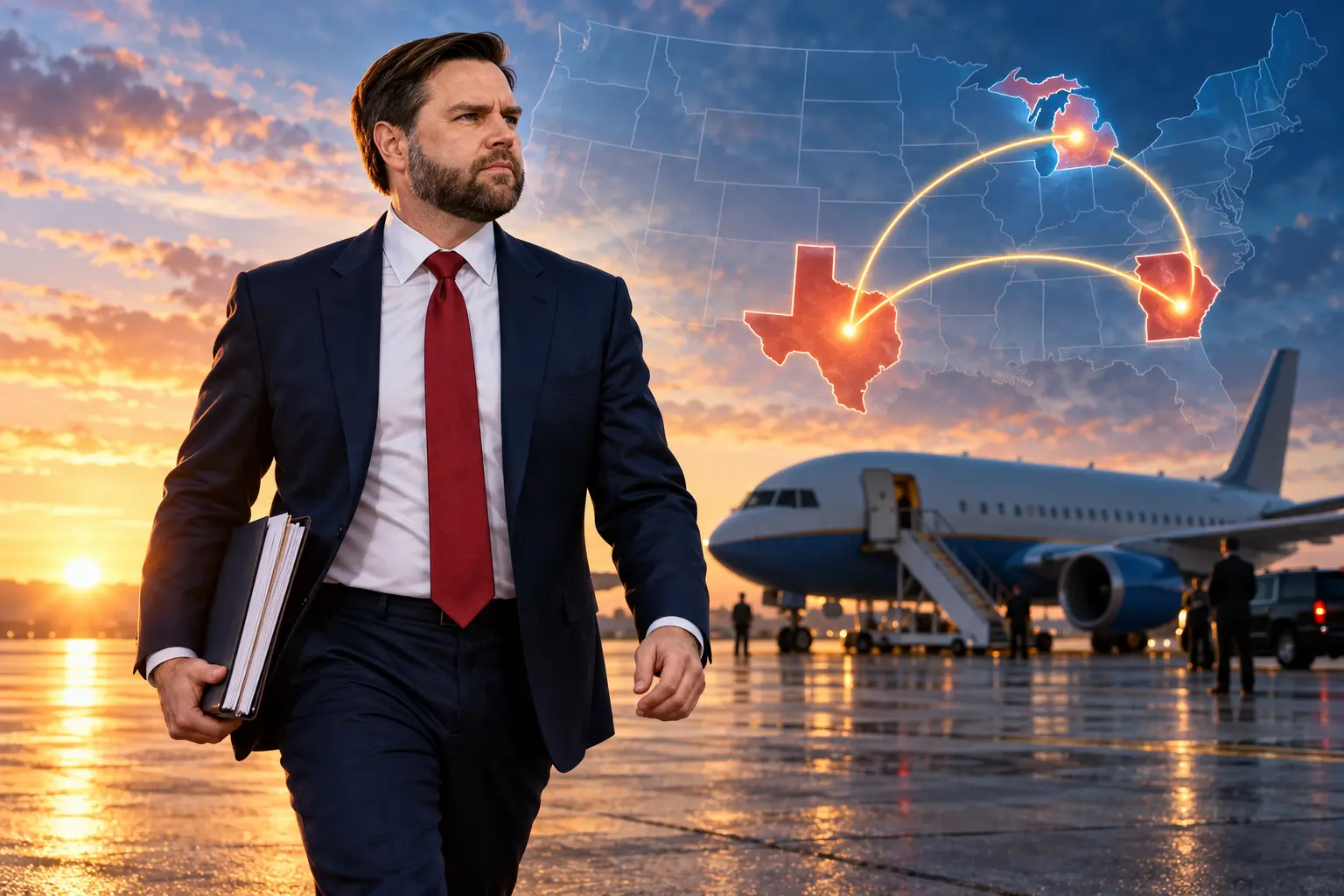
Vice President JD Vance is beginning a three-state campaign swing Tuesday with a morning rally in Tyler, Texas, followed by scheduled appearances in Georgia on Wednesday and Michigan on Thursday. The itinerary is verified; the political effect is not. That distinction matters because a packed travel schedule can show where a party wants help without proving that a speech will change a vote.
The immediate news is the route itself. Roll Call reported Tuesday morning that Vance will travel through Texas, Georgia and Michigan on consecutive days as national surrogates fan out before the November 3 midterms. Each stop presents a different version of the same problem for Republicans: mobilize voters who supported the Trump-Vance ticket in 2024 while addressing concerns that are making several normally favorable races unusually competitive.
For supporters, the swing tests whether Vance can turn the administration’s record into a disciplined closing argument. Skeptical readers can ask whether claims about prices, trade and immigration are supported by measurable results. The useful standard is not crowd size or a viral clip, but whether the message answers each state’s conditions.
What is confirmed about the three stops
The first event is scheduled for Tuesday at Tyler Pounds Regional Airport. KLTV reported on October 13 that the rally begins at 10 a.m. Central time, with Vance scheduled to speak at 11:35 a.m. and Representative Nathaniel Moran expected to attend. The station also noted that Texas early voting is less than a week away. Because this article was prepared before the speech, it does not describe remarks, attendance or reactions that had not yet occurred.
The Georgia stop is less fully detailed in the public record available Tuesday morning. WSB-TV reported on October 12 that Vance is scheduled to meet supporters at Hartsfield-Jackson Atlanta International Airport on Wednesday morning. The report did not provide a transcript, a complete speaker list or a final policy agenda. Those details should be treated as unknown until the event occurs or organizers publish more information.
In Michigan, CBS Detroit reported on October 12 that Vance will headline a Thursday rally at the LevelUp Training Complex in Monroe, with doors opening at 10 a.m. and the event beginning at noon. The same report says he will also sit for a Michigan voter town hall that airs Saturday, October 17. That gives the Michigan leg two different audiences: rally attendees and a broader television audience likely to include undecided and skeptical voters.
A travel route is a map of political pressure
Campaign travel is not a perfect guide to internal polling; fundraising, airport access and scheduling all matter. Still, three states in three days reveal where Republicans believe a national surrogate can help.
Texas is a defensive test in a state Republicans normally expect to hold. Georgia is a direct attempt to improve the party’s position in a Senate race where an incumbent Democrat has a financial advantage. Michigan is both a competitive open-seat contest and a laboratory for the administration’s argument about manufacturing, tariffs and household costs.
That broader context is visible in the latest independent reporting. Reuters’ October 12 Senate overview says Republicans hold a 53-47 majority. Democrats would have to win seats in states Donald Trump carried by double digits in 2024 to take control, but several such contests have tightened. The same report describes Texas polling from a tie to a six-point Democratic lead, a double-digit Democratic lead in recent Georgia surveys and a one-to-seven-point Democratic advantage in recent Michigan polling. Polls are estimates, not results, and individual surveys can be wrong. The point is that none of these stops should be treated as ceremonial.
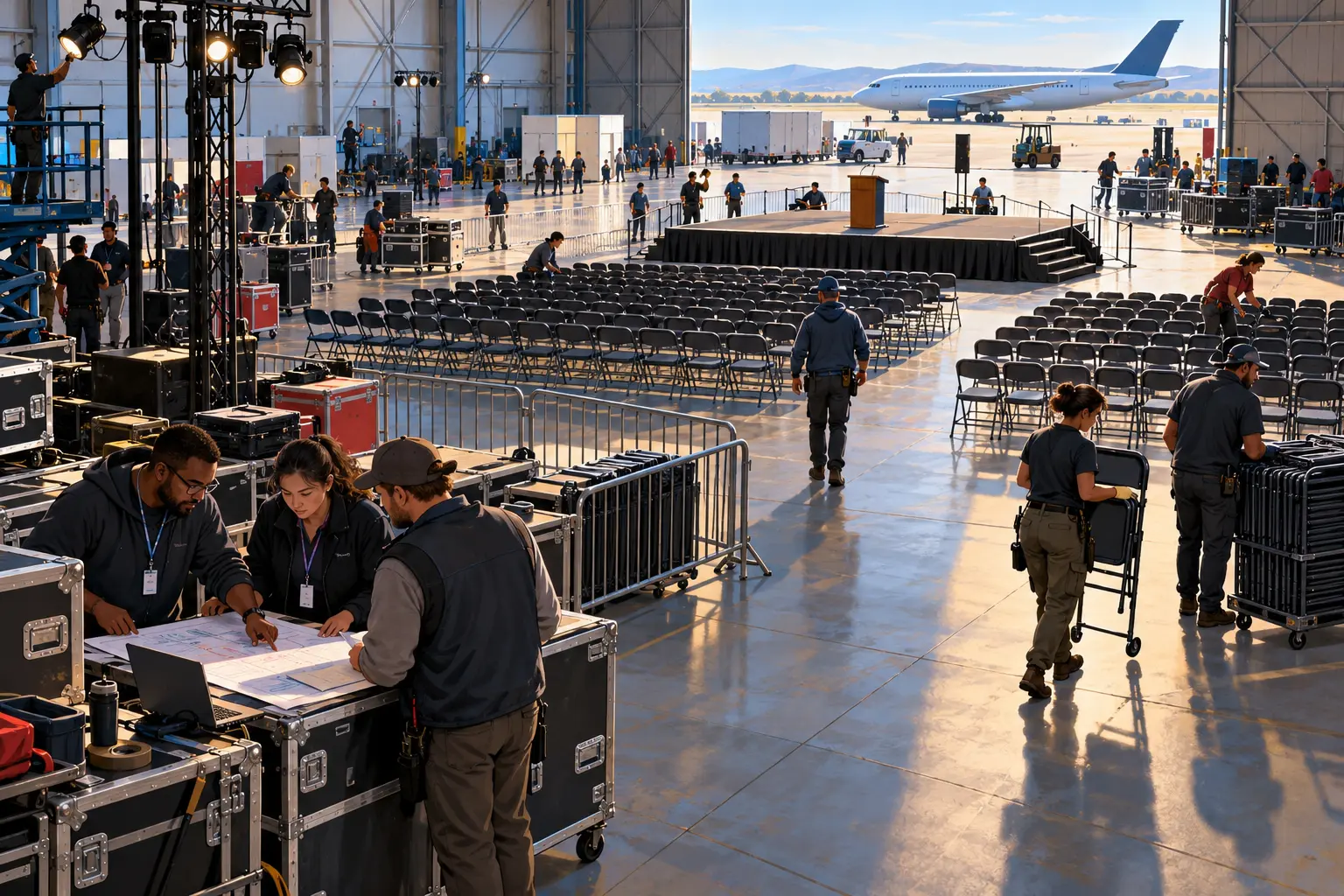
AI-assisted conceptual illustration of campaign staff preparing an airport-hangar rally; it does not depict a documented event.AI-assisted editorial illustration.
Texas tests whether a stronghold still behaves like one
Tyler sits in a reliably Republican part of Texas, but the statewide Senate contest is demanding unusual attention and spending. Reuters reported that Republicans had already spent about $210 million to defend the seat, while Democrat James Talarico had outraised Republican Ken Paxton by roughly $60 million and held nearly $20 million more cash on hand. Those figures do not determine the winner; Texas has not elected a Democrat statewide since 1994. They do explain why Vance is campaigning there rather than assuming the state will take care of itself.
The Tyler rally therefore has two possible functions. The first is turnout: remind habitual presidential voters that congressional control will be decided without Trump or Vance listed for the office at stake. The second is message repair: give Republican candidates a national argument that connects immigration, taxes, energy and public safety to local concerns.
Supporters may see Vance as suited to that job because he links cultural themes to work and family. Skeptics should ask for more than grievances. An affordability argument should identify what changed, what remains expensive and which policy would improve it. Immigration or trade claims should address costs and legal limits as well as enforcement goals.
The evidence after Tyler will be straightforward: a full video or transcript, the candidates who shared the stage, the claims they made and whether those claims can be checked against official data. A crowd photograph alone cannot establish movement among voters.
Georgia and Michigan demand different persuasion
Georgia gives Vance a harder Senate environment. Reuters reported that Democratic Senator Jon Ossoff had raised $98 million through June 30, compared with $7.4 million for Republican Representative Mike Collins, and that recent polling showed Ossoff with a double-digit lead. Outside spending had been closer, but the candidate-level cash gap matters because campaigns control their own message and field operations.
Vance’s airport meeting may attract coverage and volunteers, but cannot erase a fundraising or polling deficit by itself. A useful appearance would explain why voters who dislike parts of the administration should still support the Republican candidate while giving Collins room to define his own record.
Michigan is a different problem. Reuters described Democrat Abdul El-Sayed and Republican Mike Rogers as competing for an open seat in one of the cycle’s closest Democratic-held contests. Republicans had spent more than twice as much as Democrats in the race, yet recent surveys still showed El-Sayed ahead by between one and seven points. CBS Detroit notes that Thursday’s schedule combines a rally with a later voter town hall, where Vance is expected to face subjects including affordability, tariffs, immigration, health care, artificial intelligence, the war with Iran and democracy.
That format should be more revealing than a rally. A supportive crowd rewards clarity and energy; a mixed voter audience tests listening, specificity and the ability to answer a premise the speaker did not choose. Readers can follow the event through Vance Force’s news coverage and compare policy claims with the site’s topic archive.
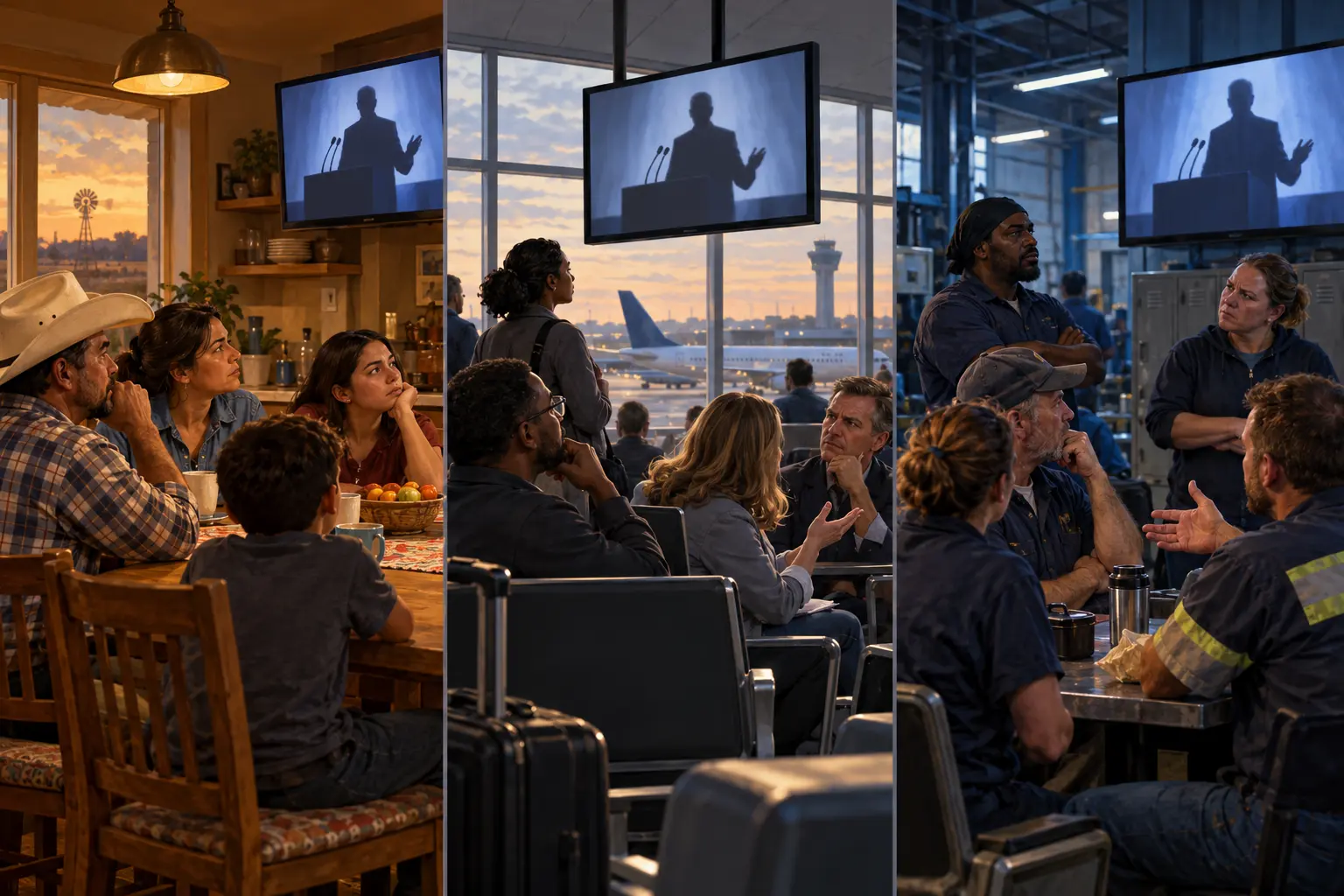
AI-assisted conceptual illustration of voters evaluating a national political message across different local settings.AI-assisted editorial illustration.
What supporters and skeptics should watch
The first test is consistency. Does Vance use one national script in all three states, or does he adapt the argument to the actual contest? Adaptation is not necessarily contradiction. Texas, Georgia and Michigan have different candidates and economic concerns. But factual claims should not change simply because the audience changes.
The second test is candidate fit. A successful surrogate visit should strengthen the local candidate’s case. If coverage focuses only on Vance, Trump or possible 2028 ambitions, the campaign may gain attention without transferring much benefit down the ballot. Nothing in this itinerary is evidence that Vance has declared a 2028 candidacy, and responsible coverage should not treat it as one.
The third test is evidence. Claims about prices can be compared with inflation, wage and energy data. Claims about manufacturing can be compared with employment and investment measures. Claims about border security or fraud should identify the legal action, the responsible agency and the measured outcome. Our JD Vance background page provides context, while the editorial policy explains how this independent fan community separates reporting from analysis.
The fourth test comes after the motorcade leaves. Volunteer sign-ups, fundraising, local coverage and early-voting participation are more informative than applause. Even these signals require caution: turnout does not reveal party preference, and money does not guarantee persuasion.
What the evidence can establish next
The next reliable record should include the Tyler speech, any official details released for the Georgia meeting, the Monroe rally and the full CBS town hall. Updated federal campaign-finance filings will clarify whether late money is narrowing candidate gaps. High-quality state polling may show whether movement occurs after the visits, although no single poll can isolate the effect of a rally from advertising, news events or normal sampling error.
Election results will provide the final test, but even they will not prove that one surrogate caused a win or loss. The fairest assessment will combine margins, turnout patterns, campaign spending and the substance of what Vance told voters.
For now, the verified conclusion is limited but important: JD Vance is being deployed as a lead Republican surrogate across three consequential states in three days. The open question is whether the sprint produces a state-specific, evidence-backed argument—or only more national attention.
*Vance Force is an independent fan community. It is not affiliated with, authorized by or speaking for JD Vance, the White House, any campaign, political party or political committee. The illustrations accompanying this article are AI-assisted conceptual images, not documentary photographs of the scheduled events.*