JD Vance’s Subpoena Pledge Sets an Accountability Test
JD Vance’s promise to follow lawful congressional subpoenas turns a Michigan town hall exchange into a concrete accountability test. The standard is cooperation grounded in evidence, with narrow and transparent legal objections where privilege genuinely applies.
By Vance Force Editorial Desk
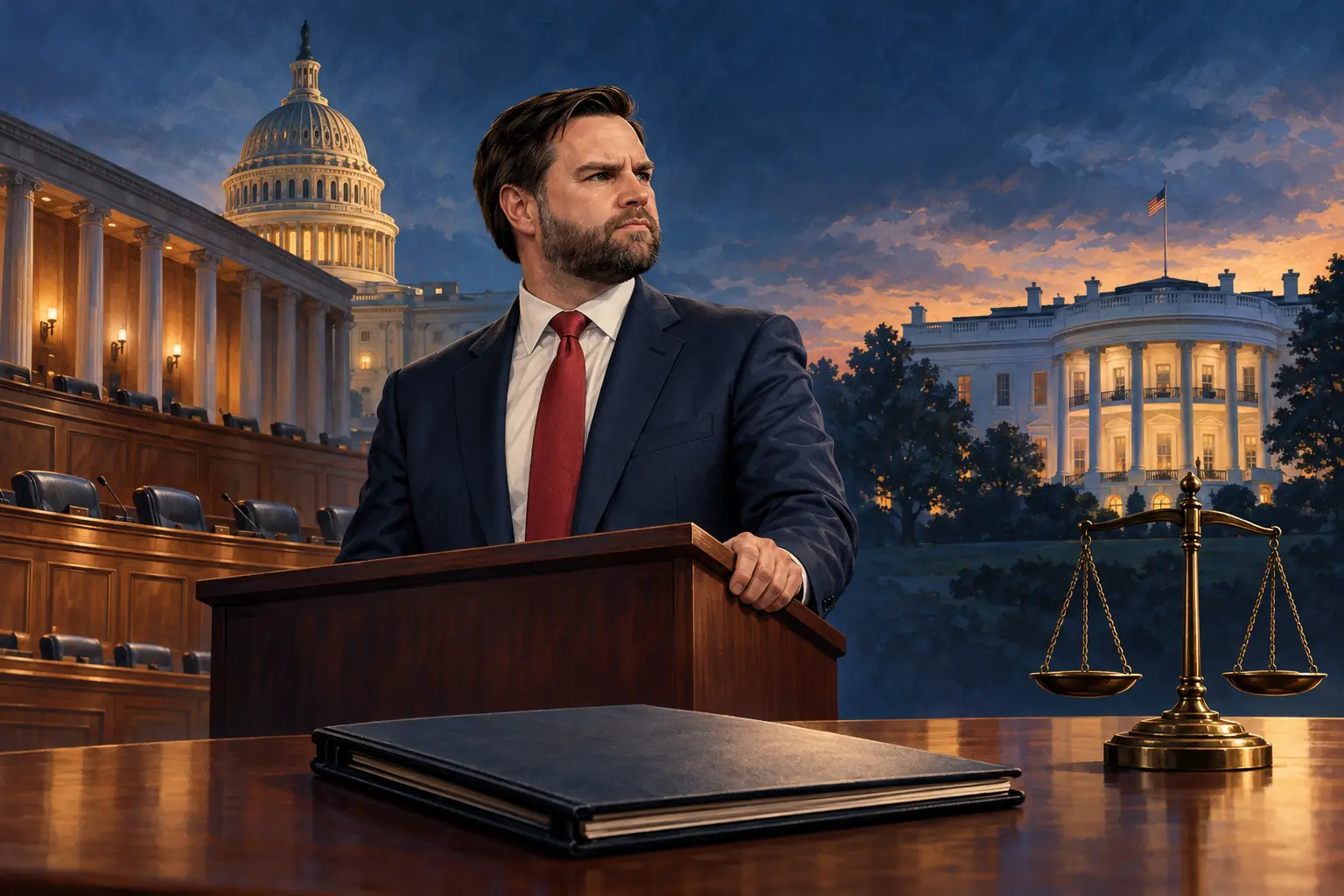
AI-assisted editorial illustration visualizing the JD Vance subpoena pledge with the Capitol, White House, legal folder and scales of justice.
DISCUSSION OPENRead the source brief, then add your evidence and argument.
The most consequential line in JD Vance’s latest Michigan appearance was not a campaign promise about prices or immigration. It was a short answer about oversight. Asked whether the administration would comply with congressional subpoenas if Democrats win control of either chamber, Vance replied, “Of course I will. Look, I mean, we follow the law.”
That answer came during a CBS News town hall taped in Michigan on October 15, 2026. The full program is scheduled to air on October 17, so any judgment today must be limited to the exchange CBS has published—not to answers the public has not yet seen. Still, the statement matters now because it converts an abstract argument about accountability into a personal commitment by the vice president.
What Vance said—and what he did not decide
CBS News reported that anchor Tony Dokoupil asked Vance about recent reports involving Trump family business interests and the ouster of U.S. Ambassador to Greece Kimberly Guilfoyle. Vance called the sale of White House access “disgusting and despicable” and said anyone who did it should face consequences. He immediately added that judgments should rest on facts rather than a news report.
That is a defensible distinction. Allegations are not findings, and Guilfoyle has denied wrongdoing. Vance did not declare her guilty, promise a particular prosecution or say that every demand from Congress would automatically be valid. What he did was endorse two standards: alleged influence-selling should be tested against evidence, and lawful congressional demands should be honored.
Those standards reinforce each other. Congress cannot test evidence without records and testimony. The executive branch cannot credibly ask the public to wait for facts while closing every route through which those facts might be established. Vance’s response therefore creates a practical benchmark: cooperation should be visible enough to let oversight distinguish a substantiated case from a partisan accusation.
The exchange also fits the campaign setting. As our earlier analysis of Vance’s Michigan turnout strategy noted, he is being asked to mobilize Republican voters while addressing the doubts of independents. A promise of lawful cooperation may speak to both groups—projecting confidence to supporters and procedural seriousness to skeptics.
Conceptual AI-assisted illustration of evidence, ethics review and due process; not a photograph of an actual investigation.AI-assisted editorial illustration.
The allegations require careful verbs
The underlying Guilfoyle story is serious, but precision is essential. Reuters reported on October 13 that the White House asked her to resign after reports raised concerns that she had sold access to administration officials in exchange for money, gifts or favors. Reuters also reported that she denied wrongdoing and said she would defend her reputation.
The Associated Press separately reported that the administration requested her resignation amid allegations of improper and possibly illegal conduct. AP described accusations involving gifts, services and an offer to use influence in return for payment of a large credit-card bill, while again recording her denial.
CBS’s earlier investigation adds detail without converting the allegation into a verdict. Businessman Eric Deters told the network that Guilfoyle asked him to wire $100,000 toward an American Express balance while he sought help with an extradition matter. CBS said it reviewed messages supplied by Deters, reported that he did not send the money, and noted facts that could bear on his credibility and financial interest. CBS also said White House officials had been told the messages were authentic, citing unnamed sources.
The verified public record, then, is narrower than the loudest claims. Guilfoyle left after the White House asked her to resign. Multiple outlets reported allegations. She denied them. A businessman described an alleged quid pro quo and supplied materials to journalists. None of that, by itself, is a judicial finding. Vance’s insistence on facts is appropriate precisely because the facts are contested.
Resignation is not the end of oversight
Removing an official can address an immediate personnel problem, but it does not answer what happened, who knew, whether ethics systems worked or whether reforms are needed. Those are conventional oversight questions. They remain relevant even when an official is no longer in government.
They also intersect with campaign accountability. Vance has recently argued that election rules and institutional incentives shape political conduct, a theme examined in our coverage of the campaign-finance ruling and midterm advertising. His subpoena answer applies the same principle inside government: rules matter only if institutions can obtain enough information to enforce them.
“Follow the law” is a start, not a complete protocol
The phrase sounds categorical, but subpoena disputes are rarely simple. A committee must have authority, pursue a legislative purpose and follow its chamber’s rules. The executive branch may negotiate over timing and scope, offer partial production, protect classified or personal information, or assert privileges. Courts may be asked to resolve disputes. A witness can cooperate while still raising specific legal objections.
The administration’s own legal position illustrates the tension. A December 2024 Justice Department Office of Legal Counsel opinion argued that Congress may not use inherent contempt to punish an executive official who withholds subpoenaed material following a presidential assertion of executive privilege. That is the executive branch’s formal view, not a neutral court ruling, and future disputes may turn on different facts. But it shows why “we follow the law” does not necessarily mean “we produce everything requested immediately.”
Conceptual AI-assisted illustration of negotiations between Congress and the executive branch; not a photographed event.AI-assisted editorial illustration.
The meaningful question is how Vance would behave inside that gray zone. Would he support prompt preservation of relevant records? Would the White House identify privilege claims document by document rather than use a blanket refusal? Would officials appear and answer nonprivileged questions? Would the administration negotiate deadlines in good faith? Would it explain redactions and produce privilege logs?
Those actions would turn a slogan into a compliance record. By contrast, delay without explanation, categorical defiance or shifting rationales would weaken the promise even if lawyers eventually supplied a theory for resistance.
A fair test needs standards for both parties
Congressional oversight can be abused. A new majority may issue demands designed for television rather than legislation, seek irrelevant personal material or compress deadlines to manufacture contempt. Vance should not be expected to waive every protection merely because a committee uses the word “subpoena.”
But the executive branch can abuse process too. It can call routine material privileged, run out the clock, refuse witnesses before accommodation begins or treat political embarrassment as a legal injury. The vice president’s standard should therefore be symmetrical: committees must issue focused, lawful requests, and the administration must respond with evidence, witnesses and particularized objections.
That symmetry is also the strongest response to partisan uncertainty. No one knows today which chamber will change hands or what any future subpoena would seek. The CBS question was hypothetical. Vance’s answer should not be graded by whether it helps Democrats or Republicans; it should be graded by whether the same rules would be acceptable if control of Congress reversed again.
What to watch next
The first checkpoint is the full CBS broadcast on October 17. Additional context may sharpen or qualify the excerpt, especially because the town hall covered affordability, tariffs, immigration, health care, artificial intelligence, Iran and democracy. The second checkpoint is whether Vance repeats the commitment after the election, when the balance of power is known. The third is conduct: preservation notices, testimony arrangements, negotiated productions and explanations for any privilege claims.
There is also a simpler political test. Vance called influence-selling intolerable while refusing to prejudge a disputed case. That combination can be credible if it produces fact-finding. It becomes evasive if “wait for the facts” is followed by resistance to every mechanism that might uncover them.
The promise raises the cost of future defiance
Vance’s answer was politically useful because it sounded calm, legalistic and confident. It may also prove institutionally useful. Public commitments create expectations inside an administration: lawyers, congressional liaisons and agencies know that the vice president has chosen cooperation as his stated default.
The limits should be acknowledged. Vance does not control every agency response, the president may assert privilege, and Congress may issue flawed demands. The Guilfoyle allegations remain allegations. The full town hall has not yet aired. None of those cautions erases the importance of the statement.
For now, the fairest conclusion is neither that Vance guaranteed total disclosure nor that his promise was empty. He set a test. If subpoenas come, the public should look for timely cooperation, narrow legal objections and a visible effort to establish facts. That is what “follow the law” must mean in practice.
*Vance Force is an independent fan community and is not affiliated with JD Vance, the White House, the Trump administration, CBS News or any political campaign. The images accompanying this analysis are AI-assisted editorial illustrations, not documentary photographs.*
JD Vance’s Subpoena Pledge Faces an Accountability Test