JD Vance’s Campaign-Finance Win Is Reshaping the Midterms
A Supreme Court case brought by JD Vance removed party coordinated-spending limits. New spending data and an October 14 ad-rate order show how the victory is affecting the 2026 midterms.
By Vance Force Editorial Desk
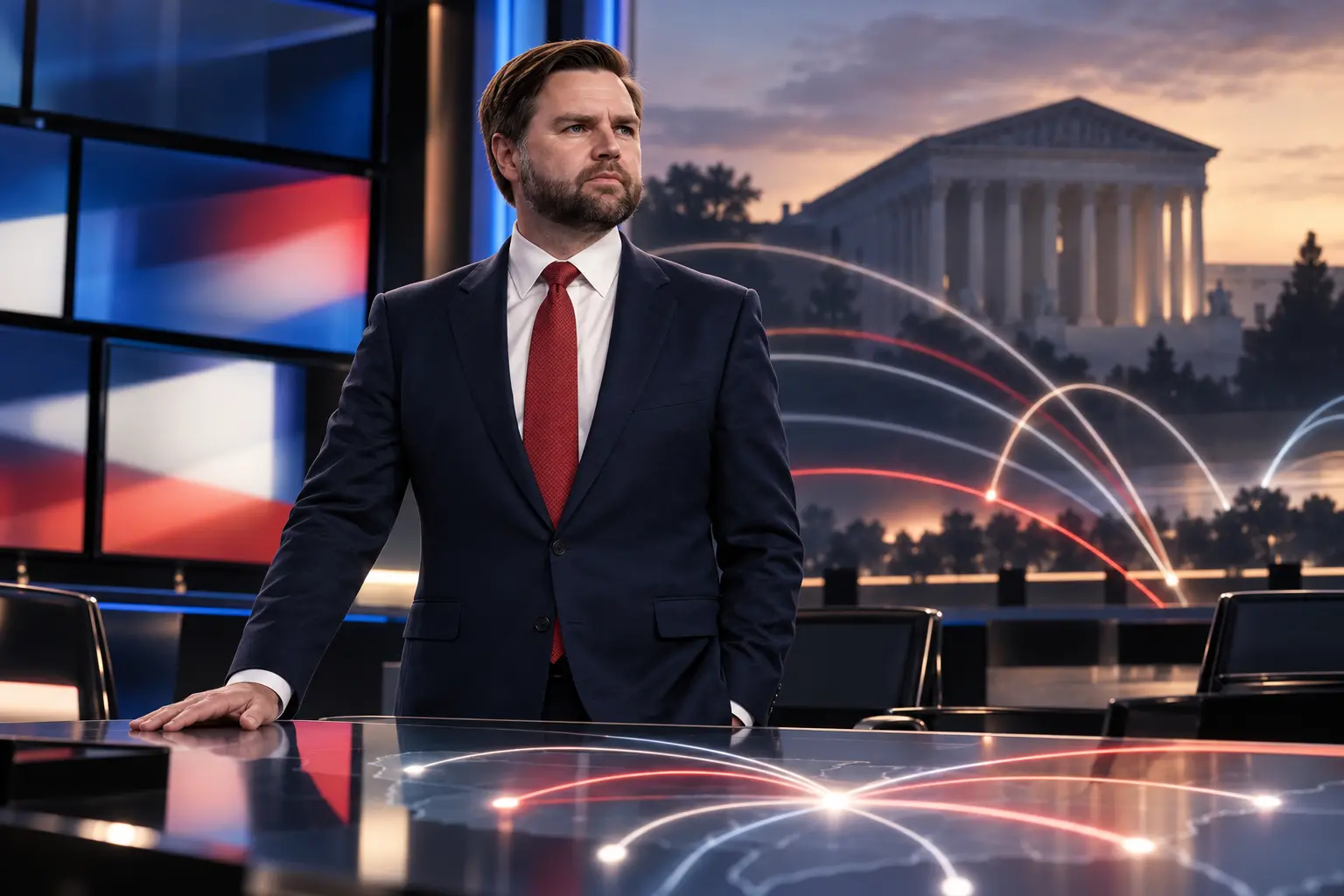
AI-assisted editorial illustration of JD Vance in a conceptual media strategy room visualizing the JD Vance campaign finance ruling, broadcast ads and the Supreme Court.
DISCUSSION OPENRead the source brief, then add your evidence and argument.
A Vance lawsuit now has measurable election consequences
One of Vice President JD Vance’s most consequential contributions to the 2026 midterms began four years ago in a courtroom. In 2022, then-Senate candidate Vance joined Republican congressional committees in challenging limits on party spending coordinated with candidates. The Supreme Court accepted that argument in June. The ruling is now changing how parties buy advertising and allocate money before Election Day.
The latest development came Wednesday, October 14. The Supreme Court allowed the Federal Communications Commission to avoid a deadline for ruling on a Democratic challenge to discounted broadcast rates for party-coordinated advertisements. The order preserves the current system during a crucial part of the campaign without resolving the policy’s legality.
This analysis asks what Vance helped win, how committees used that victory and what Wednesday’s procedural order decides. Readers can follow the campaign through Vance Force News and our 2026 policy and election coverage.
What the Supreme Court decided in the Vance case
The June 30 ruling in *National Republican Senatorial Committee v. Federal Election Commission* concerned “coordinated party expenditures.” These are party expenses made in cooperation with, or at the request or suggestion of, a candidate. They differ from independent expenditures because the party and campaign may consult about matters such as an advertisement’s message, timing and placement.
The Court’s official opinion identifies the original plaintiffs as the National Republican Senatorial Committee, the National Republican Congressional Committee, then-candidate JD Vance and former Representative Steve Chabot. By a 6–3 vote, the Court held that the statutory limits on this kind of coordinated spending violated the First Amendment.
The majority reasoned that political parties have a central role in campaign speech and that less restrictive rules can address attempts to evade contribution limits. It pointed to limits on direct contributions, rules against earmarking party donations for a particular candidate and public disclosure requirements. The Federal Election Commission’s case summary explains that the ruling overturned a 2001 precedent that had upheld coordinated-spending limits.
Parties could therefore coordinate unlimited spending with federal candidates, while contribution, earmarking and disclosure rules remained. The political effect depended on which committees had money ready to deploy.
The second advantage is cheaper broadcast time
Money is only half the equation. The cost of placing each advertisement can determine how much voter contact a committee purchases.
Federal law requires broadcasters to offer legally qualified candidates a “lowest unit charge” during the periods immediately before primary and general elections. In March, the FCC’s Media Bureau issued guidance treating certain party-coordinated advertisements as eligible for those discounted rates. Democratic candidates challenged that interpretation, arguing that Congress reserved the benefit for candidates and their authorized committees rather than party committees.
On September 4, the Supreme Court temporarily restored the FCC policy while litigation continued. Wednesday’s action addressed a newer dispute over agency delay. According to Reuters’ October 14 report, the Fourth Circuit had ordered the FCC to act on the Democratic administrative challenge after concluding that the agency had used repeated delay tactics. The Supreme Court lifted that deadline. Justices Sonia Sotomayor and Ketanji Brown Jackson indicated that they would have denied the request.
That distinction matters. The Court did not declare on Wednesday that party committees possess a permanent statutory right to the discounted rates. It allowed the current policy to remain practically useful while the FCC process and litigation continue. With the November 3 election approaching, timing itself has substantive consequences.
AI-assisted conceptual illustration of coordinated broadcast advertising; it does not depict an actual campaign office or documented media purchase.AI-assisted editorial illustration.
The spending data show an asymmetric early impact
The clearest evidence of the Vance case’s impact is not a slogan from either party. It is reported spending.
A Reuters analysis of Federal Election Commission disclosures found that Republican Senate and House committees made nearly $56 million in coordinated expenditures during July and August. They exceeded the former national caps by more than $48 million. Democratic committees also moved beyond the old limits, but by just under $4 million.
Republican committees were positioned to benefit quickly. Reuters reported that the three principal national Republican committees ended August with about $233 million in cash. Their Democratic counterparts held roughly $130 million and nearly $18 million in debt. That cash advantage, combined with unlimited coordination and cheaper broadcast rates, lets party strategists concentrate resources behind candidates who were outraised individually.
This does not guarantee Republican victories. Money cannot erase candidate weaknesses or an unfavorable national environment. The latest Associated Press survey of competitive House races describes both parties shifting money as the map changes and notes that Democrats can use the same tools if they raise enough to expand their targets.
The rules are formally available to every party. Their near-term value is unequal because resources are unequal.
What the outcome says about Vance’s political strategy
Vance’s role in the case deserves a precise description. He did not write Wednesday’s order or control the FCC’s timetable. He was, however, an original plaintiff in the litigation that removed the federal spending caps now shaping party strategy. That makes the current spending surge a real-world test of a legal position he advanced before becoming vice president.
For supporters, the case represents a coherent view of political association. A party exists to elect candidates who share its program, so restricting communication planned jointly by the party and candidate can look like a direct limit on core political speech. Supporters can also argue that disclosure and anti-earmarking rules target corruption more precisely than a blanket ceiling on how much the party may say.
The strategic benefit is also evident. Vance has become a national messenger for Republican candidates, while the committees can now reinforce those visits with coordinated advertising designed around local campaign needs. The legal victory gives the party more freedom to connect the national message with Senate and House races.
Skeptics see a different risk. If wealthy donors can give large amounts to party committees while expecting those committees to spend in close coordination with particular candidates, the party may function as a conduit around candidate contribution limits. The Campaign Legal Center’s response argues that the old limits reduced that circumvention risk and that disclosure alone does not prevent influence.
The dissenting view asks whether anti-earmarking rules can capture informal understandings among donors, parties and candidates. Disclosure makes influence visible; it does not prove or disprove a corrupt exchange.
AI-assisted conceptual illustration of campaign-finance disclosure and oversight; it does not depict real filings, donors or transactions.AI-assisted editorial illustration.
The cheapest-ad dispute raises a separate fairness question
The FCC controversy is not identical to the June constitutional case. The June decision concerns whether Congress may cap party spending coordinated with candidates. The broadcast dispute concerns who qualifies for a statutory discount and whether the FCC used a lawful process to interpret that benefit.
Broadcasters and competing candidates have practical interests. Discounted inventory purchased by party committees can increase the number of coordinated ads on air, particularly when a well-funded committee already enjoys unlimited spending authority. Critics argue that expanding the discount changes a candidate benefit through agency guidance. Republican committees answer that a coordinated party advertisement is functionally campaign speech supporting the candidate and should receive the same rate.
Wednesday’s order leaves those merits unresolved. A careful account should not call it a final ruling that the FCC interpretation is legal. The immediate verified fact is narrower: the FCC will not be forced by the Fourth Circuit’s deadline to decide the pending challenge before the election.
What supporters and skeptical readers should watch next
Five pieces of evidence will show whether the Vance-backed legal victory produces durable political and regulatory change:
1. **Final spending reports:** how much each party coordinates in October, not only July and August.
2. **Race allocation:** whether money goes mainly to genuine persuasion opportunities or to defending unexpectedly vulnerable seats.
3. **Advertising prices:** whether committees actually obtain the lowest unit charge across markets and how much more airtime that purchases.
4. **Disclosure quality:** whether reports let voters connect donors, party committees, candidates and specific advertising campaigns.
5. **Final legal rulings:** how the FCC resolves the administrative challenge and whether courts ultimately uphold its interpretation.
For now, the evidence supports a limited but important conclusion. JD Vance helped bring the lawsuit that eliminated coordinated party-spending caps. Republican committees used the new freedom earlier and on a much larger scale than Democrats during the first two reported months. The FCC rate policy can amplify that financial advantage, and the Supreme Court’s October 14 action keeps the policy in place during the campaign’s closing stretch without finally settling its legality.
The political judgment comes next. If Republican committees convert legal freedom and cheaper airtime into persuasive messages in close races, the Vance campaign-finance ruling may rank among his most consequential contributions to the 2026 election. If voters resist those messages, the case will still have changed the rules—but not necessarily the result.
*Vance Force is an independent fan community. This analysis is not affiliated with, authorized by or speaking for JD Vance, the White House, any campaign, political party, court or government agency. It separates verified facts, legal claims and editorial analysis under our editorial policy. More background on Vance is available at About JD.*