JD Vance’s Rome Rally Turns Relatability Into a Labor Test
JD Vance paired blunt relatability with an American-jobs frame in Rome, but North Country farm labor shows where the slogan meets a more complex record.
By Vance Force Editorial Desk
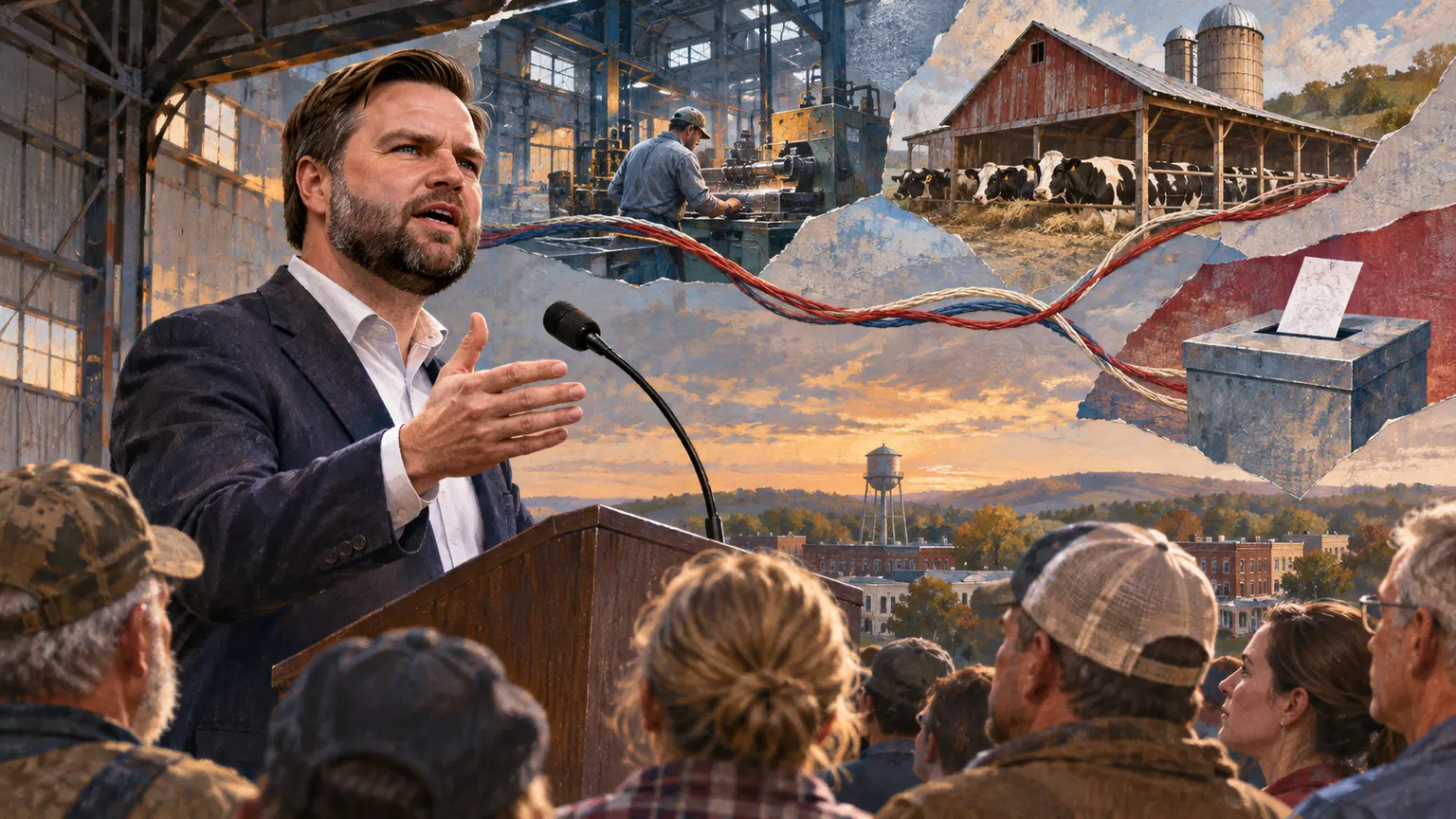
AI-assisted editorial illustration of JD Vance delivering Rome rally rhetoric before a symbolic factory, dairy farm and ballot box.
DISCUSSION OPENRead the source brief, then add your evidence and argument.
JD Vance’s election-eve rally in Rome, New York, offered a concentrated version of his political appeal: economic nationalism delivered with a working-class vocabulary, blunt humor and the confidence to acknowledge when a line crossed into family-unfriendly territory. It also exposed the point where that style becomes harder to sustain—when a vivid slogan about American labor meets the complicated legal and economic reality of North Country agriculture.
The rally happened Monday at the former Griffiss Air Force Base, one day before the midterm election. Vance appeared with Republican congressional candidate Anthony Constantino in the competitive 21st District. The verified news is the event, the language Vance used and the responses reported by journalists who were there. The effect on undecided voters remains unknown; no rally anecdote can substitute for results.
The more useful afternoon question is what Vance’s performance revealed. His approach made national politics sound local and personal. But it also asked the audience to accept a sharp moral contrast—American jobs and good wages on one side, exploitative foreign labor on the other—that becomes less tidy when the district’s dairy economy depends on lawful pathways for immigrant workers.
What Happened in Rome
Times Union reporting from the completed rally says Vance and Donald Trump Jr. spoke to hundreds of Republican supporters at the former air base. The vice president praised Constantino as a businessman who hired Americans and paid good wages. He tied that record to a sovereignty-first message, saying the movement believed in giving American jobs to American people.
The location strengthened the theme. Rome and the surrounding region have lived through military realignment, industrial change and repeated promises of revival. Vance could point to manufacturing, aviation and farming as parts of one story: communities that want productive work to remain close to home. That is a clearer argument than a generic appeal to party loyalty, and it explains why a national figure would spend the final day of the campaign in a district that had once looked safely Republican.
WWNY’s local account captured the other side of the performance. Vance called Democratic candidate Blake Gendebien “What an a**hole,” then apologized to a woman attending with four children and joked that her child should not talk like the vice president. The insult was crude. The immediate apology also mattered: Vance recognized the room, turned the correction into humor and kept the audience with him.
That sequence is a miniature of his broader style. He often treats roughness not as a mistake to hide but as an opportunity to display candor and self-awareness. It can make him sound less scripted than a conventional surrogate. It can also normalize language that many voters would not accept from a public official. Both readings are supported by the same moment.
Relatability Became Part of the Message
Vance’s strength in Rome was not a new policy announcement. It was the feeling that he could speak as someone familiar with frustration, jokes and social boundaries. The apology showed an instinct for recovery: he did not pretend the children were absent, and he did not deliver a formal statement after the event. He acknowledged the lapse in real time.
One first-time voter told WWNY that the rally helped him make a decision. That is a real observation about one person, not evidence that the room shifted or that the district moved. Rally crowds are self-selecting, local television interviews capture only a few voices, and late campaign events are designed as much to mobilize supporters as to persuade opponents.
The caution is especially important because Vance’s softer family presentation was already visible over the weekend. Our morning analysis of his Dumbledore Halloween post found that a family image could widen the emotional range of his online persona without proving voter conversion. In Rome, the register changed from whimsical to profane, yet the underlying skill was similar: Vance made himself the recognizable person at the center of the scene.
AI-assisted conceptual imagery of rough campaign language shifting toward a family-facing apology; it does not depict the Rome rally.AI-assisted editorial illustration.
The American-Jobs Frame Meets Farm Labor
Vance’s economic language was more consequential than the insult. Times Union quoted him contrasting Constantino’s domestic hiring with “slave labor in some foreign country.” The line was part of a broader praise of American production; the report does not establish a documented finding that Gendebien or his farm employed enslaved labor. That distinction matters.
The political contrast is easy to understand. Constantino runs a printing business that can be presented as domestic manufacturing. Gendebien runs a dairy farm in a region where farms have long struggled to recruit and retain enough workers. Vance’s frame compresses those differences into a moral choice between patriotic employers and exploitative ones. It is memorable because it removes ambiguity. It is vulnerable because the underlying labor markets are not interchangeable.
Gendebien’s Record Supplies Opposing Evidence
In an October 13 interview with North Country Public Radio, Gendebien supported tighter border security while also arguing for legal labor pathways and changes to the H-2A agricultural guest-worker program. He said North Country employers face a worker shortage and connected immigration reform to food prices and farm viability. Voters can reject that policy. It is still a different proposition from endorsing illegal or coerced labor.
The historical record is also more complicated than a campaign attack. A 2013 Library of Congress oral-history transcript documents Gendebien discussing immigrant farmworkers, a detained worker and his belief that the workers he knew were legally present. He also praised their practical independence and work ethic. The transcript does not settle every question about a farm’s compliance, but it supplies primary-source context that should not be replaced by a slogan.
Federal law likewise recognizes legal temporary agricultural labor. The U.S. Department of Labor’s agriculture compliance guidance describes written disclosures, wage rules, safe housing and transportation protections, including additional requirements for H-2A workers. Enforcement can fail, and documented abuse in agricultural labor is a serious concern. But a regulated guest-worker program is not accurately described as slavery merely because participating workers are foreign-born. Evidence of coercion would have to be shown, not presumed.
This is where Vance’s rhetoric faces its real test. His support for American wages can resonate with workers who feel globalization transferred both factories and bargaining power abroad. Yet North Country agriculture cannot be analyzed as if every needed worker were already available locally. A credible sovereignty agenda has to explain how food will be produced, how laws will be enforced and how employers can use legal labor without undercutting domestic wages.
AI-assisted conceptual imagery comparing manufacturing and agricultural labor systems; it is not a photograph of actual workers or a real workplace.AI-assisted editorial illustration.
What Vance Gained—and Risked
Vance gained a clean closing argument for Constantino. He turned a congressional race into a choice about who builds, hires and pays in America. That message fits his national profile and the administration’s broader effort to connect trade, immigration and industrial policy. It also gave the crowd a reason to see a local printing company as evidence for a national economic program.
He risked overstating the case. “American jobs” can be a policy goal; it is not, by itself, an answer to every sector’s labor needs. Dairy farms cannot relocate a milking shift to another country, and legal immigration reform can be designed to protect both guest workers and U.S. wages. Treating those facts as disloyalty leaves an opening for opponents to argue that the rhetoric is emotionally satisfying but operationally incomplete.
The profanity carried a parallel tradeoff. It helped Vance sound unfiltered and gave supporters a villain in a close race. His quick apology made the moment more human. But the recovery should not erase the original choice. A vice president modeling coarse personal attacks before children is part of the record, even if he wins laughter by acknowledging it.
Our earlier verified report on Vance’s New York and Ohio election-eve itinerary explained why the travel mattered before the speeches occurred. The completed Rome event sharpens that picture: Vance was not merely lending his title. He was testing a transferable formula—local employer praise, national sovereignty language, a hard attack and an improvised human correction.
What the Rally Cannot Prove
The event cannot prove that Vance changed the race. The Times Union reported a recent Siena poll showing Gendebien with a slight lead, but a poll is a snapshot and the rally occurred after most of its persuasive value could be measured. Attendance figures, applause and a single interview do not reveal how the district will vote.
It also cannot prove that Vance’s labor argument is false in every application. Offshoring, wage suppression and abusive labor practices are real. Constantino’s domestic employment record can be relevant. The narrower conclusion is that the Rome rhetoric moved faster than the evidence when it blurred overseas exploitation, legal agricultural migration and an opponent’s own employment history.
That tension may be central to Vance’s next phase as a national political figure. His best messages translate policy into moral language that people remember. His hardest task is preserving that clarity without stripping away facts that rural employers and workers live with every day.
Sources, Method and Community Disclosure
This analysis uses completed-event reports from Times Union and WWNY, Gendebien’s October NCPR interview, a 2013 Library of Congress oral history and current Department of Labor guidance. Event dates are distinguished from publication dates, direct observations are separated from inference, and one voter’s reaction is not treated as polling.
*Vance Force is an independent fan community. It is not affiliated with JD Vance, the Office of the Vice President, any campaign, or any political party. The illustrations accompanying this article are AI-assisted conceptual imagery, not photographs of the Rome rally, real workers or actual workplaces.*