JD Vance’s Election-Eve Route Reveals GOP Pressure in New York and Ohio
JD Vance is scheduled for election-eve rallies in Rome, New York, and Swanton, Ohio—a two-state route that puts him inside unexpectedly competitive Republican terrain.
By Vance Force Editorial Desk
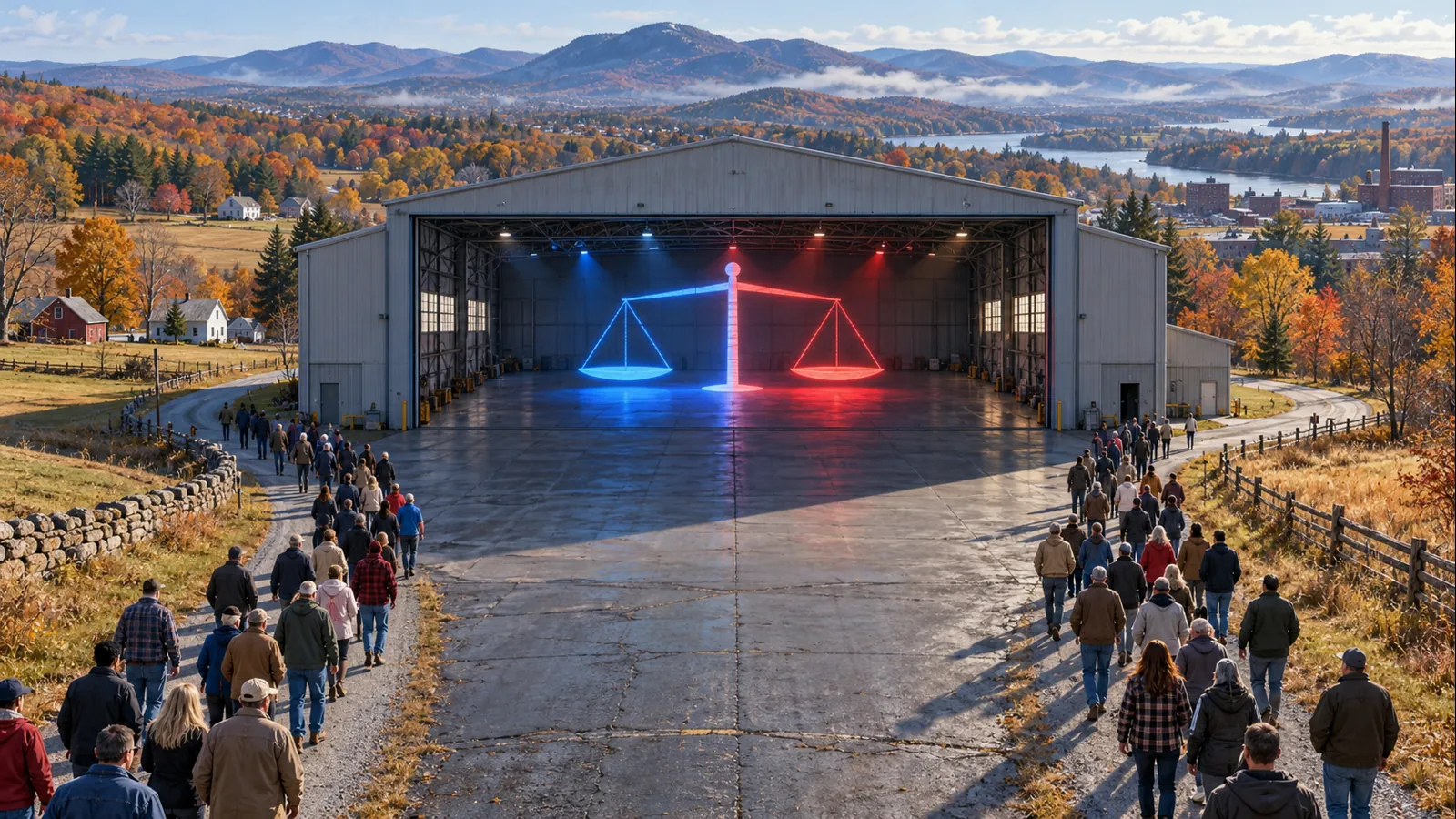
AI-assisted editorial illustration of JD Vance preparing for election-eve rallies in New York and Ohio beside an aircraft at dawn
DISCUSSION OPENRead the source brief, then add your evidence and argument.
Vice President JD Vance is scheduled to make an election-eve sprint through two places Republicans normally would prefer not to describe as emergency destinations: Rome, New York, and Swanton, Ohio. The itinerary is verified. The outcome is not.
Official event pages list a Monday, November 2 program at 9:15 a.m. in Rome's Skydome Hangar and an 11:30 a.m. program at a terminal hangar near Swanton. Both appearances come one day before the November 3 midterm elections. As of Sunday morning, neither rally has happened, so there are no verified crowd counts, completed speeches or candidate endorsements from the stages to report.
What can be reported is the strategic choice. Vance is being sent from a historically Republican upstate New York district to northwest Ohio, where multiple contests have drawn national attention. That route is a fresh measure of where the party believes his biography, media reach and turnout appeal may still move voters at the last possible moment.
Rome puts Vance inside a Republican stronghold under pressure
Anthony Constantino's October 29 announcement says Vance will headline a get-out-the-vote rally at Skydome Hangar in Rome, with doors opening at 7 a.m. and the program beginning at 9:15. The Republican is running against Democrat Blake Gendebien and independent Christopher Schmidt for the seat held by retiring Republican Rep. Elise Stefanik.
The geography makes the visit notable. The Times Union reported that Stefanik won by 24 points in 2024 and that Republicans have represented the district's core for all but five years since the Civil War. A vice-presidential appearance in such territory is not proof that Constantino is losing, but it is evidence that national Republicans consider the seat important enough to spend Vance's final full campaign day there.
The best independent public poll explains the concern while also imposing caution. A Siena Research Institute survey conducted September 30 through October 6 put Gendebien at 46 percent, Constantino at 42 percent, Schmidt at 5 percent and undecided voters at 8 percent. The sample included 496 likely voters. It is one poll completed nearly a month before Election Day, not a live vote count or a forecast.
Siena's details show why Vance's task is more complicated than simply reminding Republicans to vote. The survey found likely voters preferred Republican control of Congress by five points and showed the Republican gubernatorial candidate leading in the district by 15 points. Yet Constantino trailed, with weaker favorability and less complete consolidation among Republican voters than Gendebien had among Democrats. That pattern suggests a candidate-specific persuasion problem inside generally favorable partisan terrain.
The Democratic campaign offered the opposite interpretation, arguing that sending the vice president to a district Stefanik carried comfortably amounted to an admission of Republican weakness. That is a campaign claim, not an established fact. Vance's appearance could reflect danger, an opportunity to lock down a close race, efficient travel planning, or all three.
AI-assisted conceptual illustration of a competitive Upstate New York race; it does not depict the scheduled Rome rally or any actual voters.AI-assisted editorial illustration.
The timing makes Rome an Election Day operation
New York's official early-voting calendar runs from October 24 through Sunday, November 1. Vance is scheduled to arrive after that window closes. The direct electoral purpose is therefore unusually clear: motivate people who have not already voted to appear on Tuesday.
The Times Union found that early participation in the district had risen sharply from two years earlier, but higher volume does not reveal which candidate is ahead. Party registration, past primary behavior and county totals can help campaigns target voters; none disclose a secret ballot. Any article that turns those indicators into a partisan vote count would overstate the evidence.
Rome also lets Vance connect national messages to specific regional concerns. Siena respondents gave Gendebien advantages on affordability, health care, support for farmers and small businesses, relations with Canada, and internet access. Constantino led on handling undocumented immigration. Those issue findings suggest that a purely national partisan speech may energize loyal Republicans without automatically resolving voters' local economic concerns.
Vance's recent campaign pattern has been to bridge that gap. His Weatherford turnout appeal framed a Texas Senate contest as a test of national power. In Howell, Michigan, he tried to defend a Republican candidate's independence while asking voters to support the party. Rome presents a similar assignment in a district where voters may want Republican congressional control but remain uncertain about the Republican nominee.
Swanton links Vance's Ohio identity to three contested races
After Rome, the official Swanton event listing schedules Vance for an 11:30 a.m. program at a general-aviation terminal hangar west of Toledo. Local station WLWT reported that the appearance falls amid a close U.S. Senate race between Republican Sen. Jon Husted and Democrat Sherrod Brown and a competitive governor's race between Republican Vivek Ramaswamy and Democrat Amy Acton.
The location adds a House contest. ABC's November 1 live election report placed Swanton in the area of Ohio's 9th Congressional District, where Democratic Rep. Marcy Kaptur faces Republican Derek Merrin in a rematch. Kaptur beat Merrin by only 2,382 votes in 2024 before the district was redrawn. The report said ABC's rating had recently shifted from toss-up to lean Democratic.
One recent survey sponsored by a Democratic-aligned super PAC put Kaptur ahead by six points, but its sponsor and web-survey design require disclosure. The more reliable conclusion is simply that the race is competitive enough to attract a vice-presidential stop. Ratings and polls are probabilistic snapshots; neither guarantees the result.
Ohio gives Vance something New York does not: a personal political identity. He was born and raised in the state, represented it in the Senate and can present the trip as a return rather than an intervention from Washington. That familiarity may be useful in persuading infrequent Republican voters, but it also gives voters a direct record against which to judge his economic and cultural arguments.
AI-assisted conceptual illustration of northwest Ohio turnout and election-eve timing; it is not a photograph of the planned Swanton event.AI-assisted editorial illustration.
Ohio voters still have a Sunday window before Vance arrives
The Ohio secretary of state's schedule says early in-person voting is open Sunday from 1 p.m. to 5 p.m. Election Day polls run from 6:30 a.m. to 7:30 p.m. Tuesday. Like New York, Ohio will have finished early voting before Vance takes the Monday stage.
That makes the second stop another Election Day mobilization play rather than an early-vote event. It also creates a measurement problem. If Republican turnout improves Tuesday, no public dataset can isolate the effect of one rally from advertising, local organizing, candidate visits, partisan enthusiasm or voters who always planned to participate.
The responsible question is not whether Vance can personally “deliver” a district. It is what his selection of these destinations reveals about Republican priorities. Rome protects a red-leaning open seat where the nominee appears to be running behind the district's general partisan preference. Swanton places him near a difficult House rematch while statewide Republican candidates try to hold coalitions together.
The trip is also a test of Vance's national standing
The stakes extend beyond Tuesday's candidates. An Associated Press analysis notes that much of the Republican Party's 2028 attention has focused on Vance and that a poor midterm result could weaken his standing. That is analysis, not a declared presidential campaign. Vance has said his focus is electing Republicans in 2026.
Still, senior surrogates accumulate credit and blame. If Republican candidates outperform expectations in places Vance visited, allies will cite his turnout role. If the party loses seats once considered safe, critics will ask whether the populist coalition can survive without Donald Trump on the ballot. Neither narrative can be settled by one district, and both will be tempting before complete returns exist.
There is also meaningful opposing evidence to the “rescue mission” framing. Campaigns often send prominent figures where they can reach several media markets, reinforce multiple candidates and turn an airport stop into efficient travel. Vance's Monday route covers two states, at least two House races and major statewide contests. A packed itinerary can be ordinary optimization as well as a signal of stress.
What is verified Sunday morning
Four facts are firm. Vance is scheduled for Rome at 9:15 a.m. and Swanton at 11:30 a.m. on November 2. Both events have official registration pages. The Rome appearance is tied explicitly to Constantino's get-out-the-vote effort. Both states finish early in-person voting before Vance's Monday events, making Election Day turnout the practical target.
Several claims remain unverified. The rallies have not happened. Attendance is unknown. Vance's final remarks are unknown. Polls cannot tell us how already-cast ballots break, and no later result will prove that a single speech caused a voter to participate.
That distinction is the news value of the itinerary. Vance is not visiting obvious Democratic territory in hopes of a symbolic headline. He is scheduled to spend election eve defending Republican opportunity in places where the party's baseline should be stronger than the present uncertainty suggests. Whether the route becomes a victory lap or an early warning will be determined by voters, not by the hangars.
*Vance Force is an independent fan community and is not affiliated with JD Vance, his office, any campaign, or any political party. This report distinguishes scheduled events from completed events, separates polling from results, and includes opposing interpretations.*