JD Vance's Qatar Meeting Tests Whether Quiet Iran Diplomacy Still Has a Mandate
JD Vance's contact with Qatar confirms an Iran diplomatic channel remains open, but conflicting dates and a limited U.S. record leave his mandate uncertain.
By Vance Force Editorial Desk
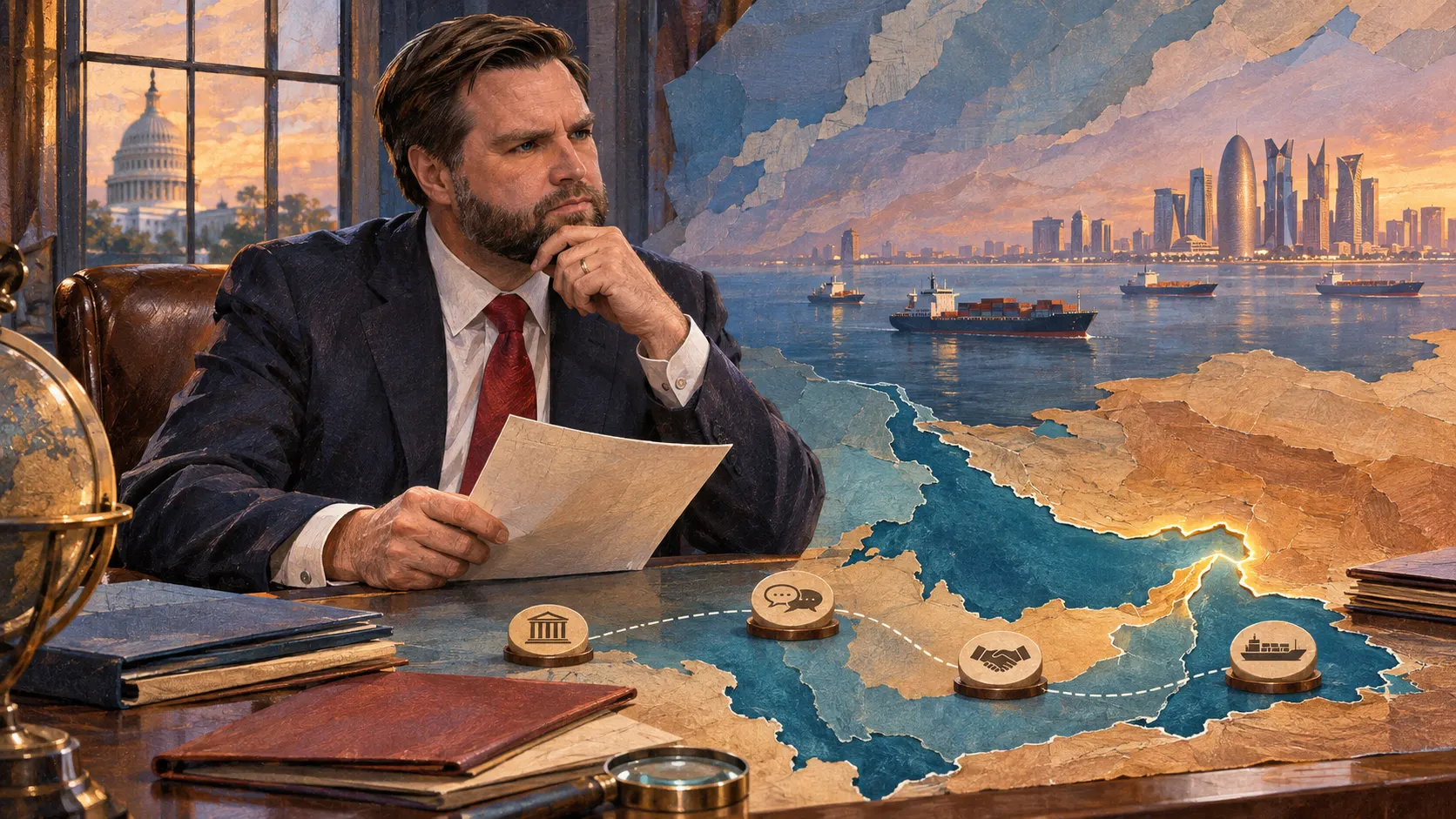
AI-assisted editorial illustration of JD Vance considering Iran diplomacy options beside a conceptual Persian Gulf map and civilian shipping
DISCUSSION OPENRead the source brief, then add your evidence and argument.
Vice President JD Vance's quiet contact with Qatar's prime minister has reopened a question the White House has not answered clearly: does Vance still have an active mandate to pursue an end to the U.S.-Iran conflict, or was this a courtesy meeting inside a diplomatic channel now led elsewhere?
The distinction matters because the public record points in two directions. Qatar says Vance discussed de-escalation, regional stability and freedom of maritime navigation with Prime Minister and Foreign Minister Sheikh Mohammed bin Abdulrahman bin Jassim Al-Thani. Independent reporting, however, describes the encounter as brief and places it against President Donald Trump's reported instruction that Vance shift his attention toward domestic priorities.
The evidence supports a limited conclusion. JD Vance remains connected to the Qatari channel and therefore to Iran diplomacy. It does not yet show that negotiations have restarted, that Tehran has accepted a proposal or that Vance has authority to settle the administration's unresolved terms.
What the public record actually establishes
Qatar's Ministry of Foreign Affairs published the strongest official account. Its November 24 release says Vance and Sheikh Mohammed addressed strategic cooperation, regional developments and coordination aimed at reducing tensions. Qatar also restated support for an agreement that protects maritime navigation and produces lasting regional peace.
That language is significant but broad. It identifies subjects, not commitments. The release announces no resumption date for U.S.-Iran talks, no sanctions formula, no change to the American naval posture and no Iranian response.
The Associated Press reported that Vance met the Qatari leader at the White House while Secretary of State Marco Rubio held separate talks. AP linked the visit to Qatari efforts to revive negotiations over the conflict, sanctions, the nuclear program and shipping through the Strait of Hormuz. The vice president's office did not provide AP with a detailed readout.
A date discrepancy worth preserving
The event date is not perfectly settled by the available releases. AP and the Times of Israel place Vance's meeting on Monday, November 23. Qatar's official page, published November 24, says the two met “on Tuesday.” The U.S.-Qatar Strategic Dialogue led by Rubio is clearly dated November 23 in the joint statement carried by Qatar News Agency.
This may reflect a publication or translation error, a second contact, or simple confusion between the vice-presidential meeting and the broader dialogue. Without a White House schedule entry or readout resolving it, the responsible course is to report the disagreement rather than manufacture precision. What is verified is that the contact occurred during the Washington visit and was publicly acknowledged on November 24.
AI-assisted conceptual illustration of maritime navigation and diplomatic signaling in the Strait of Hormuz, not a documented event.AI-assisted editorial illustration.
Why a short meeting can still carry political weight
The Times of Israel reported that the encounter lasted about ten minutes and that Qatar's annual strategic dialogue with Rubio was the delegation's primary purpose. If accurate, that undercuts any claim that Vance conducted a full negotiating session.
It does not make the meeting meaningless. Diplomatic channels are often maintained through short contacts that test whether a message is authorized, whether a proposal remains alive or whether principals should invest more time. Vance's value to Qatar is partly continuity: Axios reported on November 6 that he had been speaking frequently with Qatari and Pakistani mediators while seeking a ceasefire and renewed nuclear negotiations.
The mandate question
AP says Trump had told Vance the administration did not need an Iran deal and directed him toward fraud and crime in Democratic-led cities. That account creates genuine uncertainty, but it is not the same as a published presidential order terminating Vance's diplomatic role. The new Qatari contact suggests at least some access survived.
Three explanations fit the known facts. Vance may retain a narrow back-channel function while Rubio owns formal diplomacy. He may have taken a courtesy meeting without authority to negotiate. Or the administration may be using deliberate ambiguity, allowing Qatar to explore terms while Trump preserves freedom to reject them. The record does not yet select among those possibilities.
Our earlier analysis of Vance's role inside the White House emphasized the difference between internal influence and public policy. The same distinction applies here. Access to a mediator proves relevance; it does not prove control of the file.
The substance is bigger than a personality contest
Coverage can reduce the episode to whether Trump sidelined Vance. The more consequential issue is whether Washington has a coherent path from military pressure to a stable agreement.
The joint U.S.-Qatar statement reaffirmed freedom of navigation through the Strait of Hormuz and described safe passage as essential to energy supplies and the global economy. Qatar's framing aligns maritime relief with a comprehensive regional deal. AP reported that mediators have explored lifting disruptions in the strait in exchange for limited sanctions relief and a path back to broader nuclear negotiations.
That is a plausible negotiating architecture, not an agreement. Each component contains difficult verification and sequencing questions. Who certifies restored navigation? Which sanctions move first? What happens after another attack on shipping? How does a temporary maritime arrangement connect to inspections or nuclear limits? Neither the Qatari release nor the strategic-dialogue statement answers those questions.
Qatar's leverage and its limits
Qatar has access to Washington and Tehran and has repeatedly presented itself as a mediator. Earlier Reuters reporting described Doha as a conduit for proposals while noting that U.S. officials saw no imminent breakthrough. Its leverage lies in communication and trust, not in the power to compel either side.
The same caution applies to Vance. His skepticism about a prolonged conflict and his previous participation in talks could make him credible to mediators. Yet credibility with an intermediary cannot substitute for a unified American position. If the president, vice president and secretary of state are signaling different thresholds, Qatar can carry messages but cannot decide which one governs.
AI-assisted conceptual illustration of an uncertain diplomatic mandate and competing policy priorities, not an actual government interior.AI-assisted editorial illustration.
Two competing readings of Vance's continued involvement
Supporters can reasonably argue that maintaining the Vance-Qatar channel is pragmatic. A vice president who has invested time in the file can preserve institutional memory, clarify American red lines and prevent a period of political turbulence from closing an avenue to de-escalation. Quiet contact can be valuable precisely when a public summit would be premature.
That reading gains strength from the official Qatari statement, which links the meeting to de-escalation and navigation rather than ceremony alone. It also fits a broader pattern: in the Nvidia reinstatement episode, reporting likewise placed Vance in a behind-the-scenes emissary role where his personal background was part of the administration's case.
Critics can respond that opacity is especially risky when policy appears contested. A ten-minute meeting with no American readout can let every side project its preferred story. Qatar can signal that diplomacy remains viable; Vance can remain relevant; the White House can retain deniability. None of those political benefits guarantees progress toward an enforceable settlement.
There is also an accountability problem. If Vance is authorized to convey terms, Congress, allies and markets need some confidence that his message represents the president. If he is not authorized, foreign governments should not be left guessing whether a vice-presidential conversation carries operational weight.
What would turn contact into evidence of progress
The next useful signals are concrete and observable.
First, the White House or vice president's office could publish a dated readout that identifies the meeting's participants and Vance's role without exposing sensitive negotiating details. That would also resolve the November 23 versus November 24 discrepancy.
Second, Qatar, the United States or Iran could announce a working-level session with a defined agenda. Even a limited maritime mechanism would be more meaningful than another general endorsement of dialogue.
Third, the administration could state how maritime access, sanctions relief and nuclear discussions are sequenced. A durable process needs verifiable steps and consequences for noncompliance, not only shared language about stability.
Finally, observers should watch actions in the Strait of Hormuz. Reduced attacks, changes to the blockade or a monitoring arrangement would be stronger evidence than diplomatic atmospherics. Renewed escalation would show that the channel has not yet constrained behavior.
The afternoon judgment
JD Vance's meeting with Qatar's prime minister is evidence that he has not disappeared from Iran diplomacy. It is not evidence that he has regained command of it or that a deal is near. The official record confirms continued contact and a shared interest in de-escalation; independent reporting supplies important context about the meeting's brevity and Vance's uncertain mandate.
That combination deserves neither dismissal nor triumphalism. Keeping a channel open can prevent miscalculation, but ambiguity about who speaks for the United States can also weaken the channel. Vance's influence will be measurable when a private contact produces an authorized process, a verifiable proposal or a change in conduct—not merely another round of competing interpretations.
*Vance Force is an independent English-language fan community. This analysis is not affiliated with JD Vance, the White House, the government of Qatar, Iran or any political party. The illustrations are AI-assisted conceptual editorial art and do not depict verified private meetings.*