JD Vance Helped Press Nvidia to Restore Jensen Huang: What Is Confirmed
JD Vance reportedly helped the White House persuade Nvidia's board to restore Jensen Huang. Company filings confirm government input while key details remain undisclosed.
By Vance Force Editorial Desk
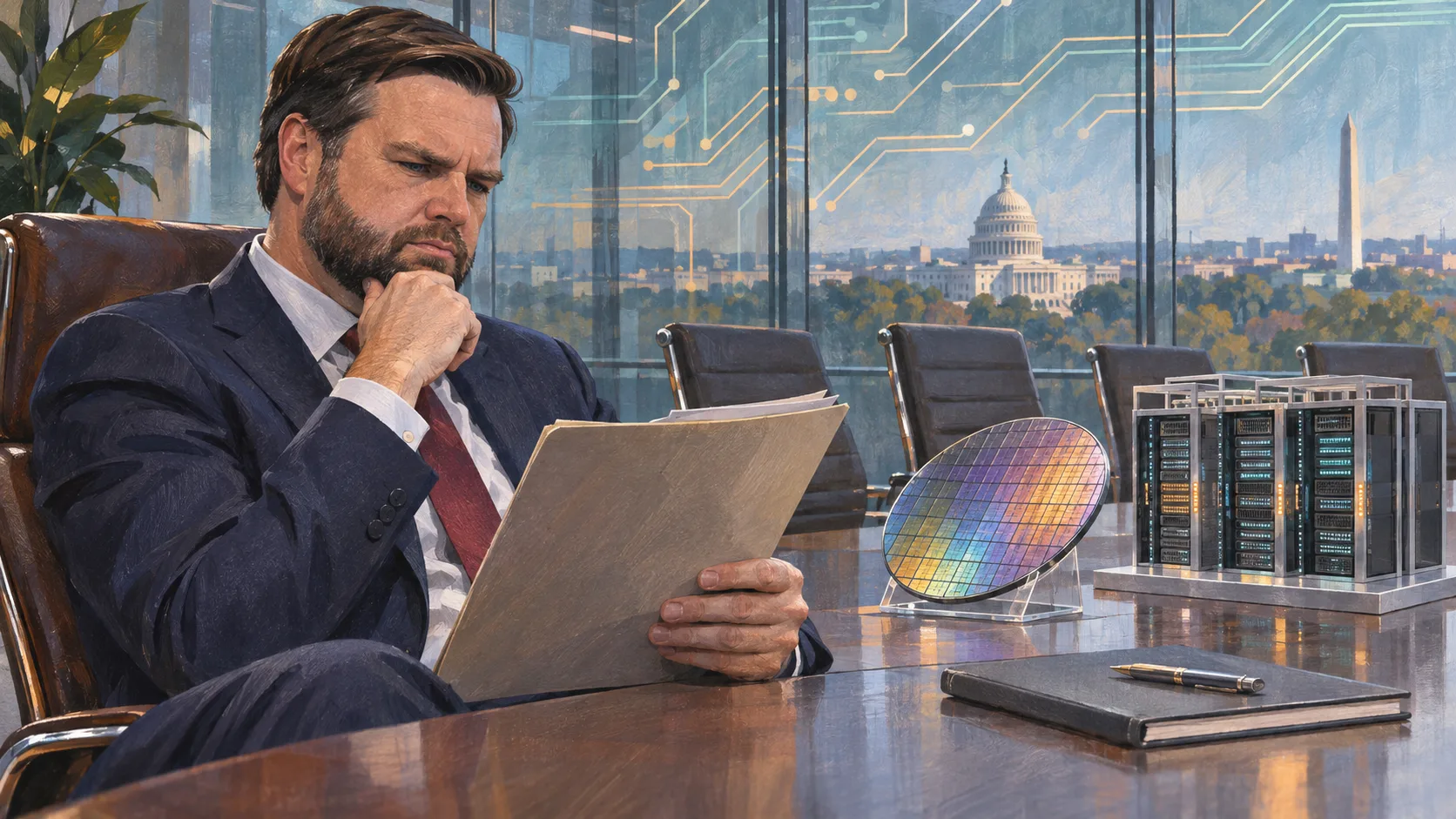
AI-assisted editorial illustration of JD Vance reviewing technology records in a conceptual scene about the JD Vance Nvidia intervention
DISCUSSION OPENRead the source brief, then add your evidence and argument.
Vice President JD Vance helped the White House press Nvidia's board to return Jensen Huang to the chief executive's office, according to multiple reports published after the company announced Huang's reinstatement. The intervention places Vance at the center of an unusual collision between national technology strategy and the independence of a public company's board.
The verified record is narrower than some of the early commentary. Nvidia says its directors received input from senior levels of the United States government and unanimously voted to restore Huang. Independent reporting identifies Vance as one of the officials who made the administration's case. Neither the company nor the White House has released a transcript, participant list or detailed account of Vance's contacts with the board.
That makes this a consequential development with open questions—not proof that the government ordered a private company to act, and not proof that the board's process was insulated from political pressure.
What Nvidia and the SEC have confirmed
Nvidia's November 23 announcement says Huang returned immediately as president, chief executive and a director. The board said it acted unanimously after discussions with Huang and concluded that his leadership and candor justified reinstatement. It also said that input from senior U.S. government officials left directors confident his return posed no national-security risk.
The company's Form 8-K filed with the Securities and Exchange Commission supplies the cleanest date distinction. Nvidia's board took the action on November 22; the company filed and announced it on November 23. That separates the event date from the publication date and confirms that the decision was a formal board action, not merely a presidential statement.
Nvidia also said its independent investigation will continue. The company has created a board committee focused on national security and export controls and is beginning a search for a chief compliance officer. Those steps matter because reinstatement did not resolve the underlying questions about China ties, export compliance or what Huang knew.
The reported role of JD Vance
The Associated Press reported that President Donald Trump enlisted Vance and other senior advisers to help persuade Nvidia's directors. According to a person familiar with the effort, Vance intensified his involvement over the weekend. The White House viewed his Silicon Valley background and political stature as useful in addressing the board's reservations.
Reuters separately reported that Trump and Vance personally intervened because administration officials believed Huang was unusually important to American open-weight artificial intelligence. That rationale goes beyond stock prices. Open-weight systems make core model components available for others to adapt, and Nvidia benefits when a larger universe of developers needs its computing hardware.
These accounts are mutually reinforcing, but they rely in part on unnamed people familiar with private conversations. Nvidia's statement confirms senior government input without naming Vance. Until one side releases a fuller record, it is safest to say Vance reportedly served as a White House emissary—not that he dictated the outcome.
AI-assisted conceptual illustration of corporate board independence and government influence, not an actual meeting.AI-assisted editorial illustration.
The distinction is important for both supporters and critics. An emissary can communicate an official national-security assessment and argue for a result. The legal responsibility to evaluate the chief executive, protect shareholders and oversee risk still belongs to the board.
Why the administration says Huang matters
The administration's strongest case is strategic. Nvidia supplies the advanced processors and software ecosystem behind much of the artificial-intelligence economy. A leadership vacuum at the company could unsettle markets, slow investment and weaken a major American competitor while China advances its own AI infrastructure.
AP reported that Trump feared Huang could be recruited by a Chinese company and believed Nvidia's decline after the resignation posed a wider economic threat. Reuters reported a more specific policy concern: officials saw Huang as a defender of U.S.-made open-weight models at a moment when Chinese systems were gaining users.
Those concerns are not frivolous. Government routinely communicates threat information to companies, particularly in defense, telecommunications and critical technology. If U.S. agencies possessed relevant intelligence about whether Huang posed a security risk, providing an accurate assessment to Nvidia could help directors make a better-informed decision.
The harder question is where information-sharing ended and advocacy began. National importance does not erase a board's duty to scrutinize executive conduct, conflicts and compliance. A government assurance about national security also does not settle unrelated corporate-governance questions.
What remains unresolved
Several facts should not be blended together.
The board's independence
Nvidia says its board voted unanimously after its own discussions with Huang. Yet Trump publicly took credit for persuading directors, and news organizations report that Vance participated in that effort. Both can be true: directors may have exercised formal authority while responding to extraordinary pressure from the executive branch.
The useful next disclosure would identify the officials who contacted the company, the subjects they addressed and whether directors received a written national-security assessment. It need not expose classified information. A dated description of the process would allow investors to distinguish intelligence-sharing from political leverage.
The scope of continuing investigations
Huang's restoration did not close the independent board inquiry. It also did not end outside scrutiny. Reuters reported that California Attorney General Rob Bonta's office continues examining whether Nvidia misled investors or the public about China-related matters and whether confidential information or advanced chips reached China.
The Washington Post likewise reported that lawmakers want explanations about export controls and the input given by the administration. Those investigations may ultimately clear Huang and Nvidia, identify compliance failures or produce mixed findings. The public record does not yet support a confident prediction.
The policy standard for future interventions
If Nvidia is strategically important enough to justify presidential and vice-presidential pressure on its board, other companies will ask where that standard begins and ends. Is the trigger market value, defense relevance, a unique executive, an immediate security risk or some combination?
Without a stated rule, an exceptional case can become a precedent shaped by personal access. A transparent standard would protect the administration as much as the companies involved.
AI-assisted conceptual illustration of open-weight AI competition and continuing oversight, not a documented event.AI-assisted editorial illustration.
Vance's expanding technology portfolio
For Vance, the episode demonstrates influence. He was not merely commenting on AI policy in public; reporting places him inside a time-sensitive effort involving one of the world's most important technology companies. His earlier venture-capital experience gave the White House a plausible reason to deploy him.
Influence, however, creates an accountability burden. Our recent examination of Vance's White House role and loyal dissent argued that internal advocacy gains credibility when the public can see the principle behind it. The same applies to corporate intervention. Was the principle national security, open-weight AI, market stability or confidence in Huang personally?
The evidentiary discipline discussed in our review of Vance's anti-fraud task-force mandate is relevant here too. A strong case should identify what is confirmed, what is reported and what remains unknown. Vance's participation is supported by multiple reputable accounts; the precise content and intensity of his contacts remain undisclosed.
What to watch next
First, watch for a White House or Vance-office account of his role. A simple timeline would clarify whether he spoke directly with directors, with Huang or through other officials.
Second, follow Nvidia's independent investigation and new national-security committee. The company has explicitly said those processes continue, so Huang's return should not be treated as a final clearance of every issue.
Third, monitor congressional and state inquiries. Their credibility will depend on whether they seek documents and consistent standards rather than treating the political intervention itself as proof of wrongdoing.
The morning conclusion is appropriately limited. Nvidia formally restored Huang after receiving senior government input. AP and Reuters place JD Vance in the persuasion effort. The administration offers a recognizable strategic rationale centered on American AI capacity. At the same time, the board's independence, the content of the government's assurances and the underlying compliance questions remain unresolved.
Vance's intervention may prove to have stabilized a critical company. It may also become a case study in how much influence Washington should exercise over corporate governance. The documents and standards disclosed next will determine which interpretation is stronger.
*Vance Force is an independent English-language fan community. This report is not affiliated with JD Vance, the White House, Nvidia, Jensen Huang or any political party. The illustrations are AI-assisted conceptual editorial art and do not depict verified private meetings.*