New Turnout Evidence Challenges JD Vance's Midterm Diagnosis
A new post-election survey puts abstention—not just voter defection—at the center of the Republican loss, challenging JD Vance's first diagnosis while final voter-file evidence remains incomplete.
By Vance Force Editorial Desk
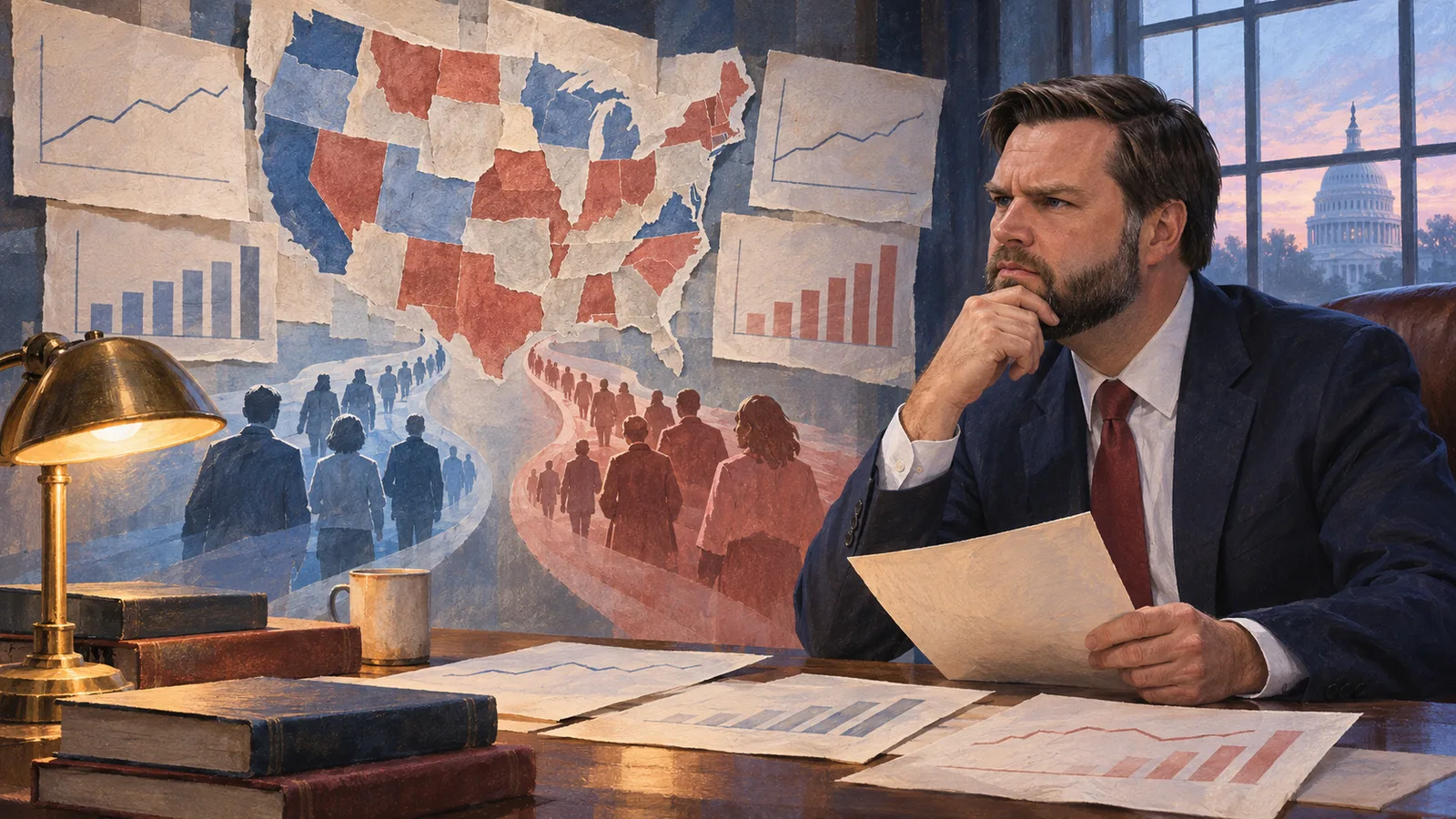
AI-assisted editorial illustration of JD Vance studying conflicting voter paths and charts for his JD Vance midterm diagnosis.
DISCUSSION OPENRead the source brief, then add your evidence and argument.
A new post-election survey released Monday complicates Vice President JD Vance's first explanation for the Republican midterm defeat. Vance argued on November 4 that Republican voters did turn out and that the main problem was 2024 Trump-Vance voters crossing over to Democrats. The new analysis from J.L. Partners reaches almost the reverse conclusion: it estimates that staying home accounted for a larger share of the movement than switching sides.
That does not make the new study the final word. Its central estimates rely on survey respondents' recalled behavior, while official voter files are still being updated and several states have not certified complete turnout totals. But the finding matters because it joins other evidence that Vance's confident distinction between turnout and persuasion was drawn too early. The more defensible morning-news conclusion is that both mechanisms operated—and that the balance between them remains an empirical question.
Monday's New Evidence Puts Turnout Back at the Center
The New York Post reported on November 16 that J.L. Partners surveyed 1,000 registered voters on Election Day and checked the results against more than 30,000 interviews conducted during the campaign. The firm's analysis found that 35 percent of people who said they had voted for Donald Trump in 2024 did not vote on November 3, while 8 percent said they supported a Democratic House candidate.
J.L. Partners then attributed roughly 10 points of a 15-point movement toward Democrats to abstention and five points to voters changing sides. The Post reported an overall margin of error of 3.4 percentage points. Those figures directly challenge Vance's assertion that “the main problem is not turnout.” They also fit a familiar midterm pattern: presidential coalitions often shrink when their president is not on the ballot.
The practical implication is larger than a dispute over political blame. If Republican losses were driven mostly by defectors, Vance would need to change the administration's appeal to voters who showed up and chose the opposition. If they were driven mostly by abstention, the priority would be rebuilding enthusiasm, organization and trust among people who declined to participate. A party that misdiagnoses that split can spend two years solving the wrong problem.
The New Survey Is a Signal, Not a Certified Count
J.L. Partners' estimate deserves attention, but it should not be treated like an audited voter file. Respondents can misremember whether they voted, misreport their earlier choice or overstate socially desirable behavior. A national sample of 1,000 can identify broad patterns, yet it becomes less reliable when divided into age, education, geography and party subgroups. The firm's state-level extrapolations, as described in the Post, are necessarily rough.
There is also a denominator problem. A survey of registered voters must model who actually cast a ballot, while an exit or voter poll begins with people who say they voted. Each design answers a different question. The survey of registered voters is better positioned to detect abstention, but it is more exposed to errors in self-reported turnout. A voter-only survey describes choices among participants well, but cannot directly count the people who stayed home.
AI-assisted conceptual imagery of a turnout gap; it does not depict an actual polling place, election precinct or photographed event.AI-assisted editorial illustration.
That is why the University of Florida Election Lab's turnout page is an important check rather than a verdict. Updated November 14, it assembles total-ballot estimates and voting-eligible-population rates from state election reporting. The lab explicitly warns that some figures remain estimates, especially in states still processing mailed ballots, and says final federal reporting may not arrive until 2027. National turnout can be high while one party's previous supporters participate at a lower rate than the other party's supporters. The aggregate rate alone cannot resolve Vance's coalition-level claim.
Larger Voter Polls Show a Mixed Coalition Failure
The AP Voter Poll offers another view. Conducted by SSRS across all 50 states from late October through Election Day, it surveyed tens of thousands of voters and reports a 0.6-point margin of sampling error for the full sample. Its reporting found that economic frustration, the cost of living, the Iran war and concern about corruption all weighed on Republican candidates. Those are persuasion signals: people who voted evaluated the administration and many rejected its record.
Yet the AP design is built to describe the electorate, not the missing electorate. It can show which participating groups moved and why. It cannot, by itself, prove that all of the 2024 coalition showed up in the same proportions. That distinction is easy to lose when percentages of “voters” are discussed as though they represent every prior supporter.
Preliminary NORC survey results added a similar warning. The Washington Post's November 4 live analysis reported that only 7 percent of Trump voters in the preliminary data backed Democrats in 2026, while the composition of the electorate shifted. A later Post presentation of the NORC project said more than 90,000 voters were interviewed and cautioned that estimates would change as weights were matched to final vote totals.
Taken together, these studies do not say that crossover voting was trivial. In a close district, a few points of switching can decide the race even if abstention is numerically larger. They say only that Vance's “not turnout” formulation is too categorical for the evidence now available.
Pollsters Themselves Are Warning Against Early Certainty
The methodological debate is not confined to one partisan pollster. In a November 12 review of the polling miss, The Washington Post quoted YouGov's chief scientist saying the firm's likely-voter models overestimated Republican turnout and underestimated turnout among younger and minority voters, while its estimate of net switching was closer. Other pollsters pointed to unusual Democratic and Latino mobilization and the difficulty of predicting a surge electorate from past voting behavior.
Those assessments are preliminary, too. They are explanations for why pre-election surveys underestimated Democratic strength, not certified individual-level histories. Still, they reinforce the case for separating three distinct processes: Republicans who stayed home, former Republican voters who chose Democrats, and new or low-propensity voters who entered the electorate on the Democratic side.
AI-assisted conceptual imagery comparing voter switching with abstention; the map and figures are illustrative, not measured election data.AI-assisted editorial illustration.
Our earlier report on the young-men vote shift focused on one visible part of that third and second process: a group that had helped Trump in 2024 moved sharply in the 2026 electorate. Monday's turnout analysis asks a different question—how many previous supporters never entered the 2026 electorate at all. Both can be true. A coalition may lose some members to the opposition and fail to mobilize many more.
What JD Vance Should Demand Before Locking In a Strategy
For Vance, the prudent next step is not choosing the survey that best fits his political argument. It is asking for a reproducible coalition audit once state voter files mature. That audit should match validated 2024 and 2026 participation, distinguish verified abstention from recalled abstention, compare competitive and noncompetitive states, and publish subgroup uncertainty rather than just headline percentages.
It should also separate issue attribution from voting behavior. Vance may be right that the Iran war and affordability pushed some previous supporters toward Democrats. The AP findings supply evidence for voter discontent. But dissatisfaction can also cause a voter to stay home. The same issue can therefore produce both persuasion and turnout effects, making a single-cause narrative especially risky.
The political stakes extend beyond the midterm autopsy. Vance remains central to Republican discussions about 2028, and our earlier analysis of his early polling strength stressed that name recognition and hypothetical primary leads are not settled voter commitments. A data-driven account of who left, who stayed and who switched would tell far more about the durability of his coalition than another early horse-race poll.
A Narrower Conclusion Is Stronger Than a Slogan
Monday's survey does not prove that turnout alone caused the Republican defeat. It does provide new evidence against Vance's claim that turnout was not the main problem. The AP poll documents real dissatisfaction among voters who participated. NORC's preliminary results and pollsters' post-election reviews point to a changed electorate. The Florida Election Lab shows why final turnout figures remain provisional. J.L. Partners puts a concrete, contestable estimate on the abstention side of the ledger.
The honest conclusion is therefore narrower: Republican losses appear to combine demobilization, defection and opposition mobilization, and the exact shares are not yet settled. JD Vance can still argue that policy failures persuaded some 2024 supporters to vote Democratic. He cannot responsibly exclude turnout until validated records test that claim.
Independent fan-community disclosure
Vance Force is an independent fan community and is not affiliated with, authorized by or speaking for JD Vance, the White House, any campaign or the Republican Party. This morning report separates documented survey findings and published statements from our editorial analysis, and it identifies where the evidence remains provisional.