JD Vance's Reported Iran Letter Tests Diplomacy Under Pressure
A reported letter from JD Vance to Iran's security chief opens a possible diplomatic channel, but the enrichment dispute, military pressure and absent official confirmation leave its prospects uncertain.
By Vance Force Editorial Desk
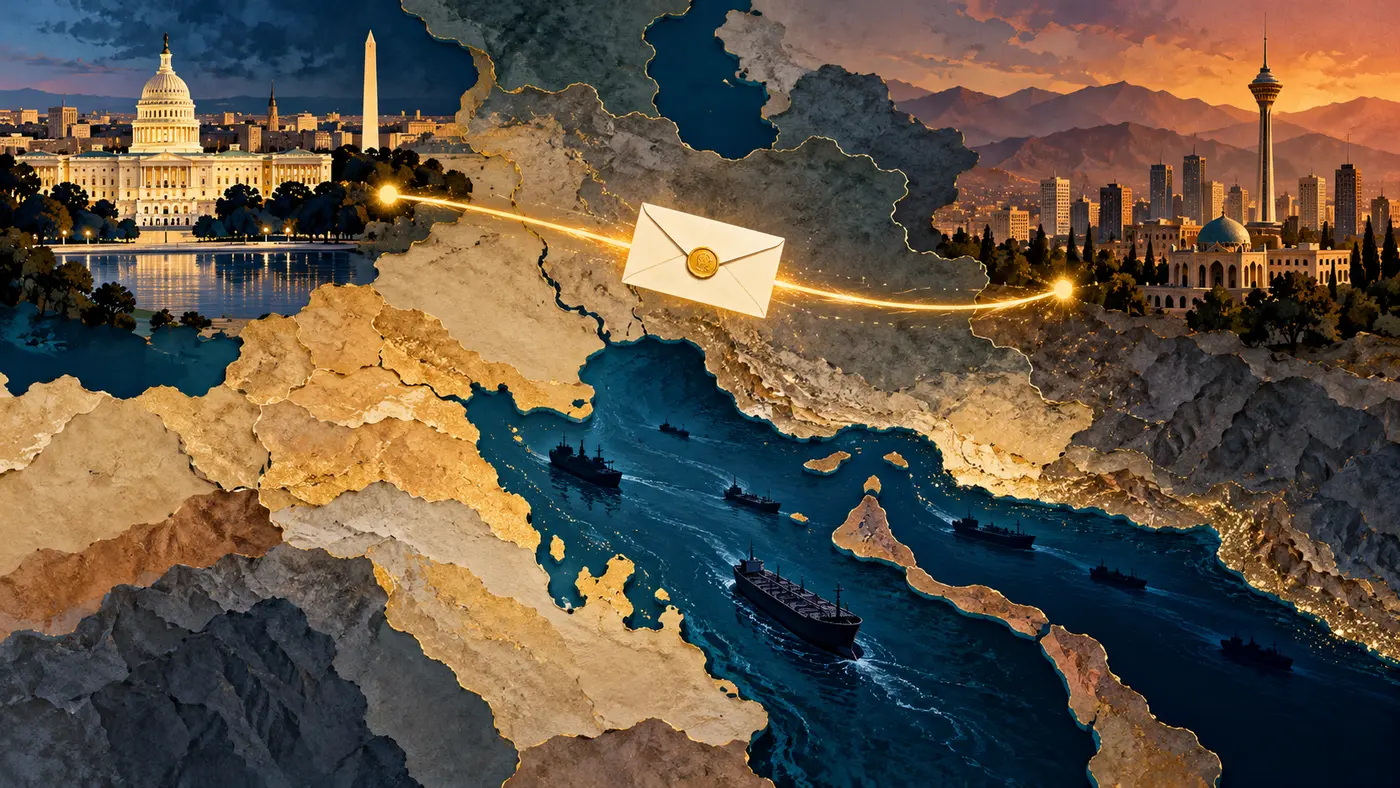
AI-assisted editorial illustration of JD Vance writing a diplomatic letter as a Persian Gulf map evokes JD Vance Iran diplomacy under military pressure
DISCUSSION OPENRead the source brief, then add your evidence and argument.
A reported private letter from Vice President JD Vance to one of Iran's most powerful security officials has created a revealing test of the Trump administration's strategy: can military pressure produce a negotiating channel without making compromise politically impossible?
The Wall Street Journal reported on October 28 that Vance sent a letter to Mohsen Rezaei, secretary of Iran's Supreme National Security Council and a former longtime commander of the Islamic Revolutionary Guard Corps. The Journal attributed the disclosure to U.S. officials and people familiar with the matter. It said the letter was sent at President Donald Trump's direction, but the publicly accessible report did not specify when it was sent.
That limitation matters. Neither the White House nor Vance's office has publicly authenticated the text, described its terms or announced a new negotiation. Iran's Foreign Ministry reportedly said it had no information about the outreach. The safest conclusion is therefore narrow: a credible news organization says Vance opened a high-level channel, while the substance, timing and Iranian response remain unconfirmed.
Even with those caveats, the report is significant. Vance has already been a central American negotiator in the effort to end the U.S.-Iran war. If the reported channel is genuine, it places him between a president threatening renewed strikes and an Iranian security establishment insisting that Washington meet its conditions first.
What the reported letter changes—and what it does not
The letter would change the diplomatic map, not the underlying bargaining positions. A direct message to Rezaei could give Washington access to an official with authority inside Iran's security system at a moment when outside mediators have struggled to move either side. It could also help Vance learn whether Tehran's public demands are opening positions or immovable red lines.
But a channel is not a deal. Reporting about the outreach says the contacts concern a possible framework for negotiations rather than detailed peace terms. No ceasefire, inspection schedule, sanctions package or timetable for reopening the Strait of Hormuz has been announced. There is also no public evidence that Rezaei has accepted Vance's premise for talks.
The distinction is especially important because the administration has paired private diplomacy with visible preparations for force. A separate Journal report on October 28 said the United States had warned several Gulf countries to prepare for a possible short, intense campaign after the midterm elections. President Trump has not announced a final decision. The military signal may be intended to strengthen Vance's leverage, but it also gives Tehran reason to suspect that talks are cover for coercion.
AI-assisted conceptual illustration of a reported Washington-Tehran diplomatic channel; it does not depict an actual transmitted letter.AI-assisted editorial illustration.
Why Vance would approach a hard-liner
At first glance, choosing Rezaei looks counterintuitive. He is not a neutral intermediary. He once led the Revolutionary Guard and now heads Iran's top security body. His recent public posture has emphasized Iranian conditions and the country's ability to retaliate.
Yet that is precisely why the channel could matter. An agreement endorsed only by Iranian moderates would be vulnerable if security institutions opposed it. Talking to a hard-liner can test whether the officials most capable of blocking a deal might also be able to enforce one. The logic resembles a familiar diplomatic principle: an adversary's most powerful skeptic may have more capacity to deliver compliance than a friendly but weaker interlocutor.
There is also a practical reason. Reuters reported on October 27 that Rezaei met Iran's supreme leader after discussions with security representatives from Saudi Arabia, Turkey and Pakistan. Those meetings addressed regional security and the Strait of Hormuz. They do not prove that Rezaei favors a U.S. deal, but they show that he occupies a hub through which de-escalation proposals are already moving.
The risk is that access may be mistaken for agreement. Rezaei's institution can receive a message without accepting American conditions. Tehran can also use contact to delay a military decision, divide U.S. officials or seek economic relief without making the nuclear concessions Washington demands. The same possibilities apply in reverse: Iran may fear that Washington wants negotiations mainly to demonstrate that diplomacy failed before launching strikes.
The enrichment dispute remains the central obstacle
Vance's own public terms leave little room for ambiguity. In an October 6 Reuters interview, he said Iran must make a meaningful and verifiable reduction in its nuclear enrichment capacity. He rejected exchanging Iranian promises for American action and argued that Washington needs concrete steps.
Iran, by contrast, has treated domestic enrichment and relief from the U.S. blockade and sanctions as core interests. The June understanding briefly appeared to bridge parts of that divide. A White House statement on June 19 celebrated a memorandum of understanding that it said would prevent an Iranian nuclear weapon and reopen the Strait of Hormuz. That arrangement unraveled within weeks amid conflicting interpretations of sequencing and obligations.
The failure supplies the strongest argument against assuming that another channel will succeed. Washington wants nuclear concessions before major relief; Tehran wants credible relief before surrendering leverage. Each side fears moving first. A private letter can clarify sequencing, but it cannot remove the political cost of compromise or guarantee that every institution will honor the result.
There is nevertheless a small opening. The Associated Press reported on October 25 that Iran said messages were still passing to the United States through intermediaries and that it had not closed the diplomatic window. That statement does not confirm the Vance letter, and Iran also accused Washington of making unilateral demands. Still, it contradicts the idea that all communication has stopped.
AI-assisted conceptual illustration contrasting negotiation with military pressure; it is not a photograph of an actual meeting or deployment.AI-assisted editorial illustration.
Pressure can create leverage—or destroy the off-ramp
Supporters of the administration's approach will see a coherent sequence. Military deployments and economic pressure establish consequences; Vance offers a private route to avoid them; Iran's security chief can carry a serious proposal to the people who make final decisions. From that perspective, public toughness and private contact are complementary.
Critics will see a more unstable design. Threats can make Iranian leaders less willing to appear flexible, particularly when they doubt that U.S. relief would survive the next dispute. A countdown tied to American elections may also compress the time needed to verify nuclear steps, reopen shipping and coordinate sanctions changes. If each side believes the other is negotiating only to buy time, the channel could accelerate rather than prevent escalation.
Evidence exists for both readings. Axios reported in late September that Qatari-mediated talks produced little movement even though officials had briefly described them as constructive. Vance participated in part of those discussions. The episode showed that access to senior officials and positive early descriptions do not necessarily resolve the gap between American nuclear demands and Iranian demands for sanctions and blockade relief.
The reported Rezaei channel could improve on that process if it establishes three things: who can authorize concessions, what each side must do first, and how compliance would be verified. Without those elements, it risks becoming another exchange of messages that both governments interpret differently.
The questions that now require answers
Several verifiable developments would distinguish substantive diplomacy from signaling. Does either government acknowledge the channel? Does Iran authorize Rezaei or another official to negotiate? Do mediators receive a written framework? Does the United States identify a reversible relief step in exchange for a measurable reduction in enrichment? And do military preparations slow while talks proceed?
Until those answers emerge, claims of a breakthrough would be premature. The letter's reported existence is newsworthy because of who sent it and who received it, not because it has already changed policy.
What this means for Vance's political role
The episode also broadens the picture of Vance in the final week before the midterms. He has been a relentless campaign surrogate, a role examined in our analysis of his national roadshow. His economic appearances have tested how administration policy lands with voters, including the tariff message discussed in our Kansas factory analysis. Iran presents a higher-stakes version of the same challenge: translate “America First” restraint into an agreement without appearing to reward an adversary.
For Vance, diplomacy with a hard-liner is not necessarily a departure from skepticism about prolonged war. It may be the operational expression of it. But restraint is meaningful only if the channel can produce terms the president will accept and Iran can implement. If talks fail and strikes resume, Vance will be judged not simply on whether he reached out, but on whether the administration's pressure strategy left a realistic off-ramp.
The most defensible reading today is therefore neither triumph nor failure. The reported letter suggests that JD Vance Iran diplomacy remains active behind the administration's public threats. It also exposes how little margin remains between negotiation and escalation. The channel deserves close attention precisely because its outcome is uncertain.
*Vance Force is an independent fan community. It is not affiliated with, endorsed by, or operated by JD Vance, the White House, any campaign, or any political party. This analysis distinguishes verified facts from reported but unconfirmed claims and links readers to the underlying reporting.*