JD Vance Draws an ICE Accountability Line—Now Comes the Proof
JD Vance says immigration officers who seriously fail must be investigated and, when warranted, prosecuted. A disputed Houston operation now gives that standard an immediate, evidence-based test.
By Vance Force Editorial Desk
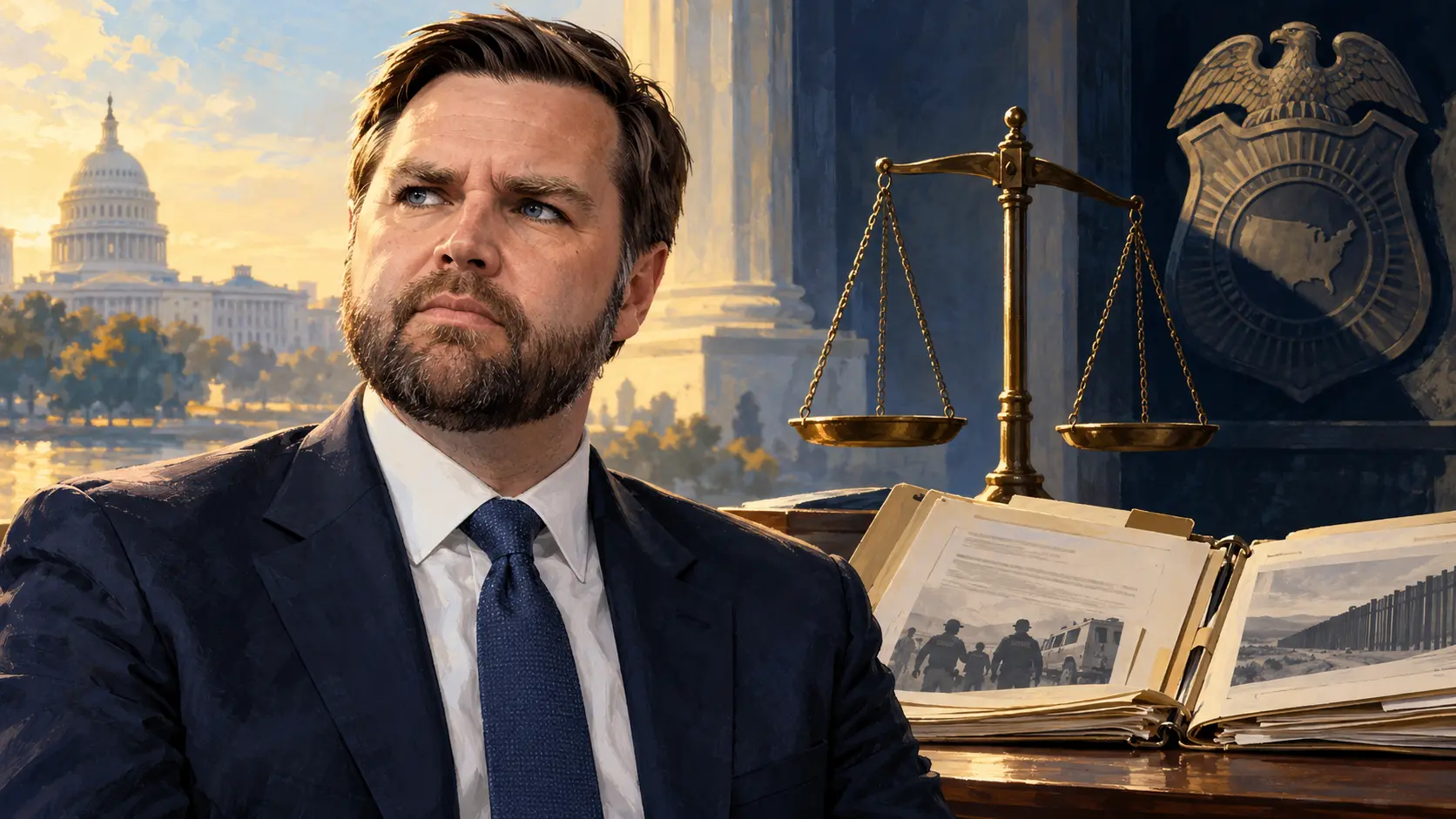
AI-assisted editorial illustration of JD Vance beside scales, case files and federal enforcement symbols representing JD Vance ICE accountability.
DISCUSSION OPENRead the source brief, then add your evidence and argument.
Vice President JD Vance has put a clear standard on the record for immigration enforcement: support the officers doing difficult work, but investigate, discipline and—when the evidence warrants it—prosecute those who abuse their authority. That is more specific than a generic call to “back the blue.” It is also a promise the administration can be judged against.
The statement came during a CBS News town hall taped in Michigan on Thursday, October 15, 2026. The full hour is scheduled to air Saturday night, so this morning’s assessment is limited to the excerpt CBS released on October 16. In that exchange, Vance said most Immigration and Customs Enforcement officers are patriotic people trying to protect the country, while acknowledging that some make mistakes and some “really screw up.” He added that the government has a responsibility to investigate and prosecute wrongdoing.
That combination—defense of the institution and acceptance of individual accountability—deserves attention. It also arrives at an unusually demanding moment. A fresh dispute over a Houston enforcement operation, plus unresolved questions from earlier shootings, means the public will measure JD Vance ICE accountability by disclosed processes and verifiable results rather than by the strength of either side’s rhetoric.
What Vance actually committed to
CBS News reported that anchor Tony Dokoupil pressed Vance to identify serious mistakes in recent immigration operations. Vance did not single out a case. He said the administration had investigated allegations and, in some instances, provided more training or imposed discipline. He also argued that officials do not publicize every personnel action because officers should be judged through normal investigations and courts.
The distinction is important. A fair system cannot declare an officer guilty from a viral clip, an advocacy-group statement or an initial agency account. Witness interviews, physical evidence, video and legal standards all matter. The same caution applies to civilians accused of interfering with an operation. Due process is not a favor extended only to the side one supports.
But privacy and due process are not the same as total opacity. Vance’s formulation creates at least three testable commitments: credible allegations should be examined; proven violations should produce proportionate consequences; and potential crimes should reach prosecutors rather than remain only internal personnel matters. Those commitments can be honored without publishing private employee files or prejudicing an open case.
The setting also matters. Vance made the comment while campaigning in Michigan, where immigration, public safety and institutional trust are live midterm issues. Our recent coverage of Vance’s Michigan turnout strategy described his effort to energize Republicans while answering questions from voters outside the party base. An accountability standard can serve both goals, but only if it survives the pressure of a disputed incident.
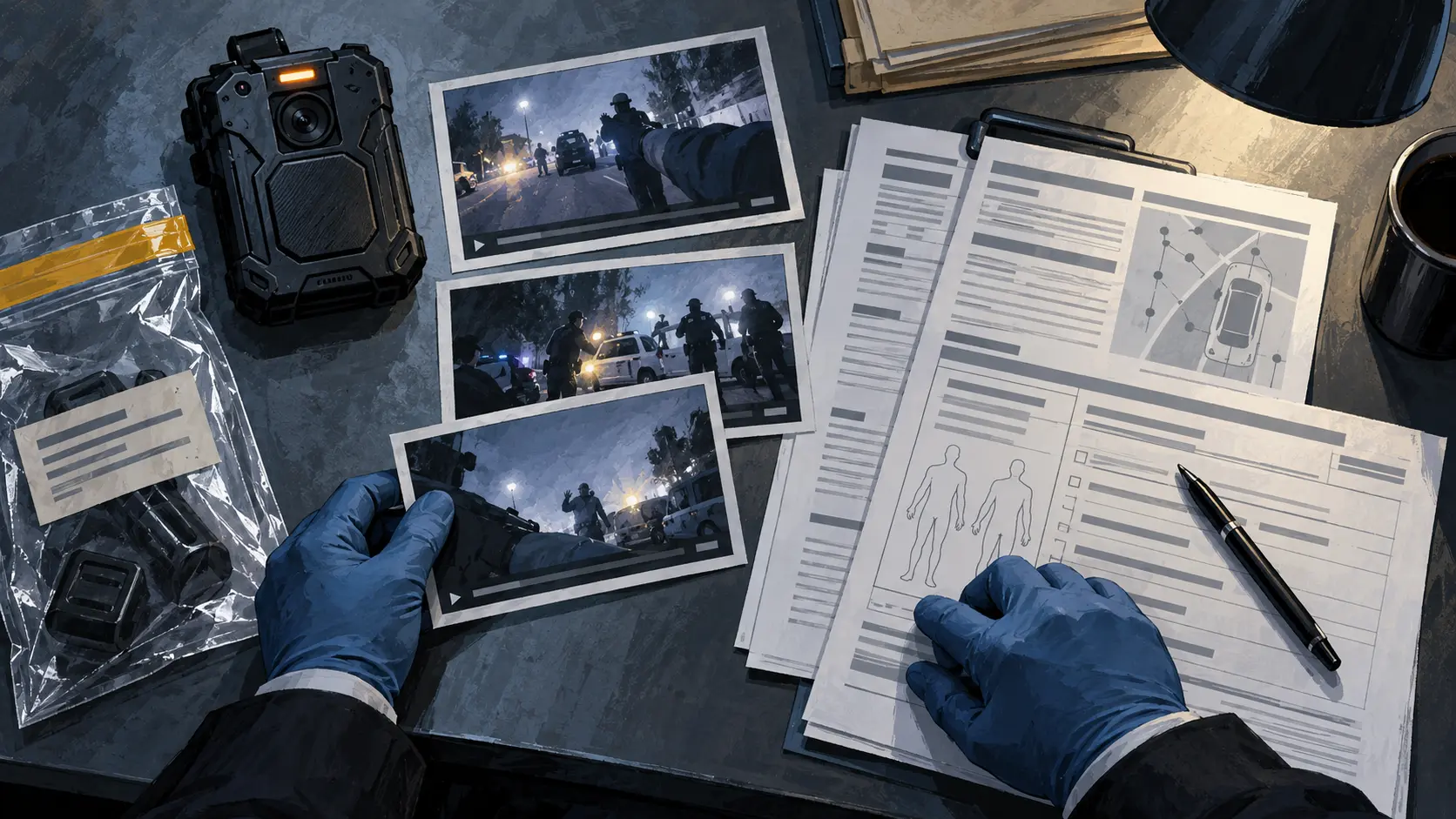
Conceptual AI-assisted illustration of evidence review and body-camera oversight; not a photographed incident.AI-assisted editorial illustration.
A current case shows why evidence must come first
The most immediate test is in Houston. The Associated Press reported on October 17 that a federal immigration vehicle struck construction worker Miguel Parra Hernandez during an October 10 operation, leaving him with multiple leg fractures. ICE said officers were pursuing a target and that Parra Hernandez stepped in front of the vehicle.
AP also reported significant contrary evidence. Surveillance video reviewed by the outlet appeared inconsistent with the agency’s description, and the Harris County District Attorney’s Office said the person ICE identified was not in Parra Hernandez’s vehicle. An advocacy organization said the man shown in an ICE-released image was a different person who had died years earlier; a relative confirmed the death to AP. ICE did not respond to AP’s request for comment, and local prosecutors were considering possible charges against the driver.
Those are allegations and reported facts, not final findings. The video view was partly obstructed. AP said the daughter who supplied death documentation did not respond to its request for comment. The officer has not been adjudicated responsible, and there may be evidence not yet public. A responsible account must preserve those uncertainties.
Still, the discrepancies are substantial enough to demand the process Vance described. Investigators should establish who the intended target was, what information officers had, why the vehicle crossed the median, whether body-camera or vehicle footage exists, and whether public statements accurately reflected the evidence available at the time. A conclusion that simply repeats the first account would not meet Vance’s own standard.
ICE already has an internal accountability structure
This is not a question of inventing a new office. ICE says its Office of Professional Responsibility is charged with maintaining professional standards through security, inspections and investigations. The agency’s public contact page provides a hotline for allegations of criminal or serious misconduct by employees or contractors. Its fiscal 2024 annual report said OPR reviewed more than 16,000 allegations of potential misconduct, evidence that the machinery exists and handles a large caseload.
ICE has also adopted a body-worn-camera directive, signed February 18, 2025, that governs recording during covered enforcement activity and bars unauthorized deletion or editing. The policy’s reach has depended on implementation and resources, so it would be premature to assume every officer in every operation was recording. That uncertainty is itself a useful question for oversight: was the Houston team covered, were cameras activated, and is the footage preserved?
The answer matters beyond one case. Video does not automatically resolve intent, but it can test timelines, corroborate reports and protect both officers and civilians from false claims. Transparent confirmation that evidence was secured—and later, a reasoned account of the outcome—would give substance to Vance’s promise without turning an investigation into political theater.
The administration’s record supplies both support and tension
There is evidence that misconduct can produce consequences. In September, AP reported that ICE officer Christian Castro faced state assault and false-reporting charges, along with a separate federal case alleging he lied to investigators about a nonfatal shooting in Minneapolis. The charges are accusations, and Castro is entitled to the presumption of innocence. Yet the case shows that referral outside the agency is possible when investigators believe the evidence justifies it.
There is also reason for skepticism about consistency. During a January 22 visit to Minneapolis, Reuters reported that Vance strongly defended federal operations and blamed unrest on activists and uncooperative local officials. Reuters’ review of video raised questions about the administration’s initial account of the fatal shooting of Renee Good, while Minnesota officials disputed Vance’s description. No single earlier dispute decides what Vance means now, but the contrast shows why a forward-looking promise needs observable follow-through.
Supporters can reasonably argue that an enforcement workforce conducting thousands of difficult encounters should not be defined by a handful of contested cases. Officers face real danger, rushed decisions and organized resistance. Critics can reasonably answer that the power to detain and use force makes rigorous review more—not less—important. Both points can be true. The honest standard is neither automatic condemnation nor automatic exoneration.
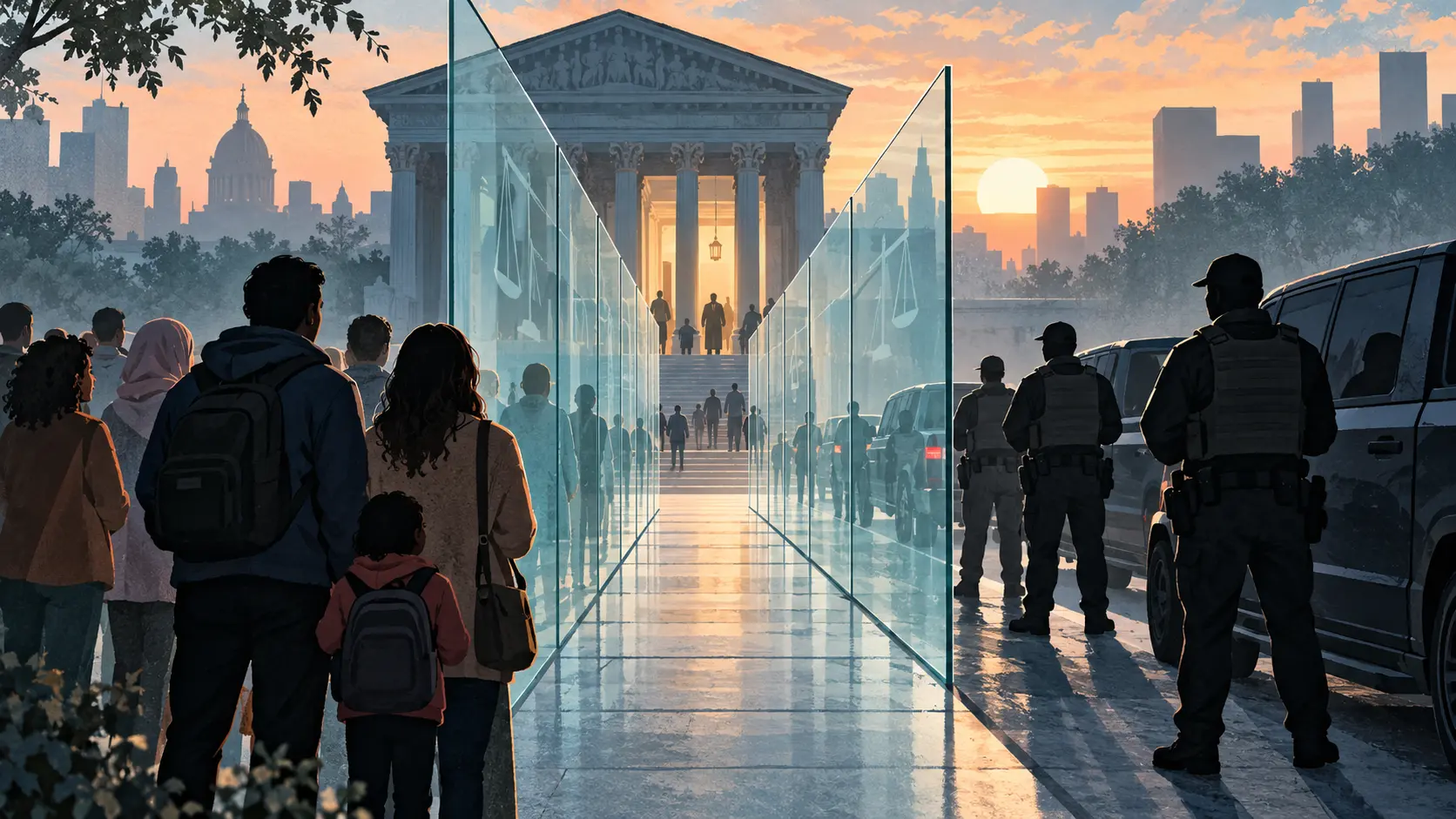
Conceptual AI-assisted illustration of public trust, enforcement and due process; not a photographed event.AI-assisted editorial illustration.
What a credible accountability test would look like
Vance does not need to announce conclusions before investigators finish. He can, however, make the system legible. The administration could publicly confirm when a serious incident has been referred to OPR, the DHS inspector general or prosecutors; state whether relevant video has been preserved; release aggregate outcomes; and explain when training, suspension, dismissal or criminal referral is appropriate. Redactions can protect witnesses and due process while still showing that the process is real.
It would also help to separate three categories that political debate often collapses. A tactical mistake may call for retraining. A policy violation may warrant discipline. An intentional crime belongs with prosecutors and courts. Vance’s own words recognized those different pathways. Applying them consistently would protect competent officers from guilt by association and protect the public from institutional self-protection.
That is the larger significance of this excerpt. Vance is not abandoning the administration’s immigration agenda, and nothing in his answer suggests he intends to reduce lawful enforcement. He is arguing that vigorous enforcement and accountability can coexist. The same procedural seriousness appeared in a different context when he recently committed to legal oversight, examined in our analysis of Vance’s subpoena pledge.
The coming days will supply a practical measure. If the Houston contradictions are examined independently, the evidence is preserved, and the result is explained with appropriate limits, Vance’s line will look like governing doctrine. If serious discrepancies disappear behind broad praise for the agency, it will look like a television answer. The fairest course now is to demand the investigation he promised—and to reserve final judgment until the evidence is complete.
*Disclosure: Vance Force is an independent JD Vance fan community. It is not an official campaign, government or White House publication. The illustrations in this article are AI-assisted conceptual artwork, not photographs of actual events.*