JD Vance Admits a GOP Housing Blind Spot—Then Blurs the Evidence
JD Vance acknowledged that Republicans underplay young Americans' housing pressures, but his Fort Worth answer mixed valid concerns about payments and investors with overstated price and immigration claims.
By Vance Force Editorial Desk
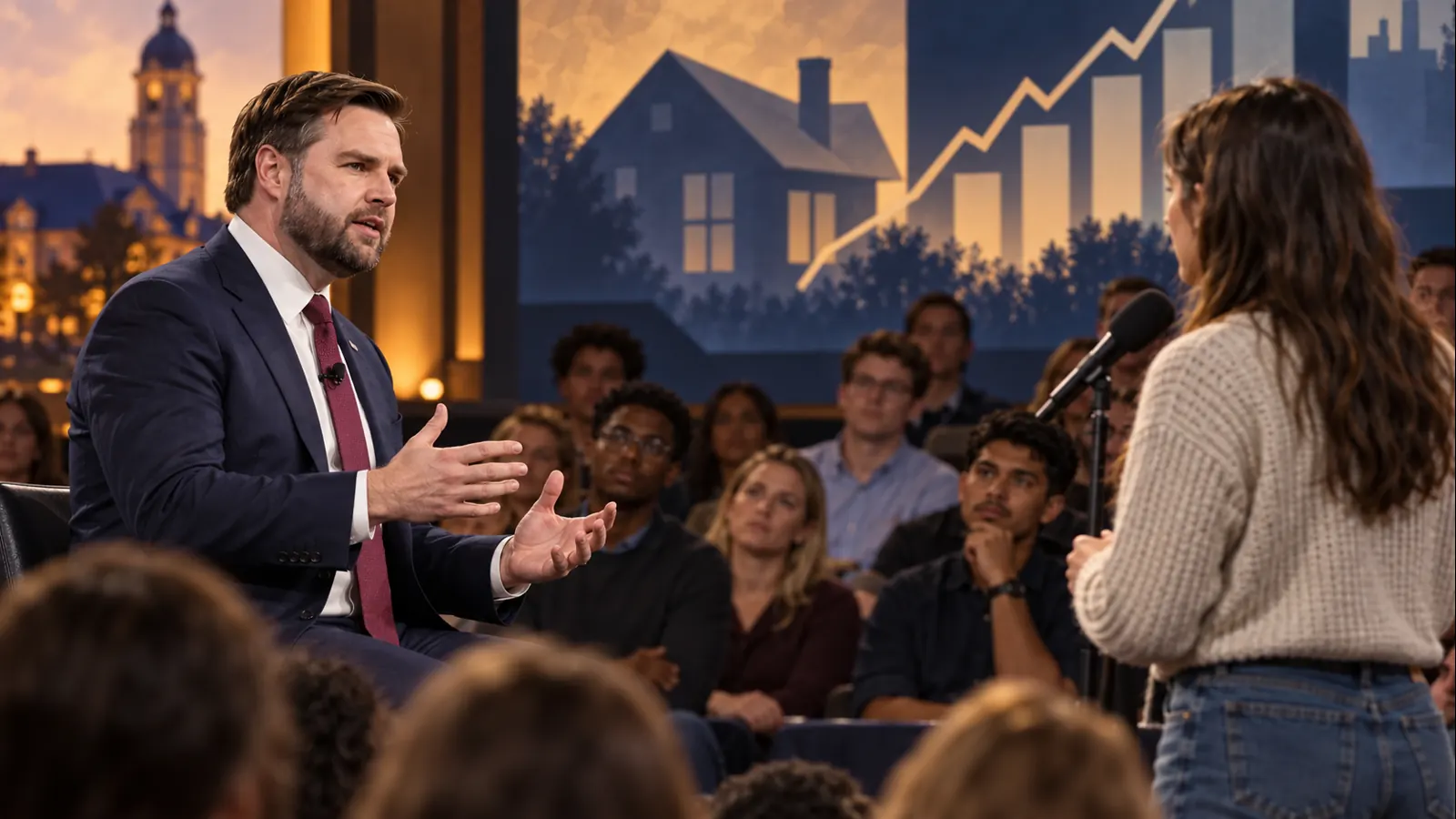
AI-assisted editorial illustration of JD Vance discussing housing affordability with a young voter at a university town hall
DISCUSSION OPENRead the source brief, then add your evidence and argument.
Vice President JD Vance gave a young Texas voter two different answers about housing on Thursday night. The first was political: he said most Republicans do not pay enough attention to the affordability pressures facing young adults, while presenting himself as an exception. The second was economic: he blamed undocumented immigration and large investors, pointed to falling Texas listing prices, and repeated a claim that home prices had doubled under the Biden administration.
The admission deserves more attention than the joke that preceded it. So do the limits of the explanation that followed. The town hall at Texas Christian University in Fort Worth took place on October 29; Fox News posted the full affordability segment on October 30. Student Kate White asked how conservatives could expect young people to marry and start families when a typical home costs more than $415,000. Vance eventually engaged that question directly, but only after an unrelated campaign joke that generated a wave of criticism.
This afternoon analysis separates three things that were compressed together on television: the price of a house, the monthly cost of financing it, and the competing explanations for why both remain hard for first-time buyers.
The Republican blind spot Vance acknowledged
Vance's most useful sentence was his concession that most Republicans do not focus enough on younger Americans' affordability problems. It was an unusually direct diagnosis of a political vulnerability. The National Association of Realtors reported that the median existing-home sales price was $417,500 in September, close to the figure in White's question. First-time buyers accounted for 31 percent of sales. Those buyers are not reacting to an abstract index; they are trying to combine a down payment, mortgage qualification, insurance, taxes and other household costs.
The admission also fits Vance's broader 2026 campaign role. At his Weatherford turnout stop, he tried to translate national Republican themes into a reason for Texans to vote. At his Kansas factory speech, he tested whether an economic-nationalist argument could survive contact with local prices and payrolls. Fort Worth put the same challenge in personal terms: if the movement praises early marriage and family formation, what material conditions is it willing to change?
Critics understandably concentrated on Vance's opening joke about Senator Jon Husted. Mediaite's account documents the backlash and the rest of his answer. The joke was a political mistake because it made a serious voter sound like a setup for a viral aside. Yet stopping the analysis there would miss the policy claims voters were asking him to defend.
AI-assisted conceptual illustration of a young household weighing home price and mortgage-payment pressure; it does not depict an actual couple or property.AI-assisted editorial illustration.
A lower listing price is not the same as an affordable payment
Vance cited a 2.5 percent decline in Texas listing prices as evidence of movement in the right direction. That narrow claim is consistent with September market data showing lower asking prices across the South. Realtor.com's September report put the national median list price at $419,250, down 1.4 percent from a year earlier, and the South down 2.4 percent. Austin was among the weakest major markets by price per square foot.
That is real relief at the margin. It is not a restoration of pre-pandemic affordability. Realtor.com's national asking price remained roughly one-third above 2019, while inventory was still below its typical pre-pandemic level. A small annual decline from a much higher base can coexist with severe buyer frustration.
Financing sharpens the problem. Freddie Mac's weekly survey put the average 30-year fixed mortgage rate at 7.24 percent on October 29, down eight basis points for the week but still high enough to make a given purchase price far more expensive each month than it would have been at the unusually low rates of 2020 and 2021. NAR's September affordability index slipped to 105.4 from 106.7 a year earlier even as inventory rose 4.6 percent. In other words, more listings and softer asking prices have not yet solved the payment problem.
What the “doubled” claim blurs
Vance has repeatedly said home prices doubled under President Joe Biden. That is not supported by the main sales-price series. FactCheck.org's examination found that measures of sale prices rose at most 37 percent over the period it analyzed. The figure that came close to doubling was the monthly cost of buying a new home once higher mortgage rates were included.
That distinction does not make the affordability complaint less serious. It makes the diagnosis more accurate. A family experiences the monthly payment, not just the sticker price. But a politician who calls the payment a price risks prescribing the wrong cure. Policies that add housing supply may restrain prices over time; policies that affect credit conditions, inflation and rates work through a different channel; down-payment help addresses still another constraint. A credible housing agenda must say which problem it is trying to solve.
Immigration affects demand, but the size of the effect is disputed
Vance also argued that undocumented immigration pushed Americans out of the housing market. Population growth can increase demand for shelter, so it would be wrong to claim immigration has no housing effect. Local markets with fast household growth and slow construction can feel that pressure acutely.
The harder question is magnitude. FactCheck.org consulted housing economists who described low supply, earlier low interest rates and the later rate shock as the primary recent drivers. It also noted that immigrants in the country illegally are more likely to rent than buy. One expert estimated an effect of less than 1 percent on the current median sales price. Those estimates are not revealed truth, and immigration can affect rents, construction labor and regional demand in ways a national median obscures. But they are substantial opposing evidence to the claim that illegal immigration is the central cause of purchase-price inflation.
The best version of Vance's argument is therefore narrower: rapid population growth can worsen scarcity where builders cannot respond, and immigration policy belongs in a complete demand analysis. The weakest version treats one group as a substitute for examining zoning, permitting, land, materials, labor, interest rates and years of underbuilding.
AI-assisted conceptual illustration of housing supply, family demand and institutional investment; it is not a photograph of a specific development.AI-assisted editorial illustration.
The investor crackdown is real, but narrower than a national ban
Vance's criticism of Wall Street buyers has a firmer policy anchor. President Trump's January executive order on institutional investors directs agencies and government-sponsored enterprises, to the maximum extent permitted by law, to stop facilitating certain single-family acquisitions by large institutional investors. It also orders antitrust review, ownership disclosure in specified federal programs and a legislative recommendation.
That matters, especially in neighborhoods where large buyers are concentrated. It still is not a comprehensive statutory ban on every corporate purchase. The order requires definitions, agency guidance and implementation within existing legal authority; it includes tailored exceptions for build-to-rent communities and asks Congress for legislation to codify the broader policy. Describing it as a completed nationwide prohibition would overstate the text.
Another measurement caution is essential. NAR reported that individual investors or second-home buyers represented 20 percent of September transactions. That category is not synonymous with Wall Street institutions. It can include a household buying one rental or vacation property. Policymakers should distinguish a large fund assembling hundreds of houses from a small investor, then measure whether restrictions actually increase owner-occupant purchases rather than merely shifting inventory among other buyers.
Family advice is not a housing program
Vance closed with personal advice: young adults should not wait for financially perfect conditions before marrying and having children. As biography and encouragement, that message will resonate with supporters who believe family life can precede material certainty. It is also responsive to the values embedded in White's question.
But it cannot substitute for policy. A household can reject perfectionism and still rationally conclude that a 7.24 percent mortgage, limited starter-home supply and high childcare costs require caution. Telling people to accept uncertainty speaks to courage; reducing the cost of formation requires measurable changes in supply, financing, wages and family expenses.
This is where Vance's admission should become a standard for his own coalition. If Republicans have under-attended to affordability, the remedy is not simply better empathy or sharper blame. It is a transparent scorecard: how many starter homes are added, where permitting times fall, whether institutional-purchase rules change owner occupancy, how monthly payments move, and which families benefit.
The serious answer is still unfinished
Vance deserves credit for recognizing that a movement centered on family cannot treat housing as a secondary issue. Texas list prices have softened, the administration has acted against some institutional acquisitions, and a tight border can reduce one source of demand growth. Those are legitimate components of his case.
The counterevidence is just as important. National sale prices did not literally double under Biden. Monthly financing costs explain much of the near-doubling experienced by buyers. Immigration is one demand factor, not a consensus explanation for most of the increase. And an executive order operating through federal channels is narrower than a congressionally enacted market-wide ban.
The political lesson is simple. The opening joke consumed attention because it suggested distance from the voter's anxiety. The substantive answer recovered some ground because Vance acknowledged a Republican blind spot. To turn that admission into leadership, he will need to describe housing with more precision than a television segment allows—and accept that the hardest facts do not fit neatly inside a single partisan cause.
*Vance Force is an independent fan community and is not affiliated with JD Vance, his office, any campaign, or any political party. This editorial distinguishes verified reporting from analysis and presents material opposing evidence.*