JD Vance Says the Economy Needs Time. Here Is the Test.
JD Vance says factory investment will take time to reach workers. The latest inflation, jobs and polling data show what an honest economic timeline must measure next.
By Vance Force Editorial Desk
AI-assisted editorial illustration of JD Vance beside a ship's wheel and abstract gauges representing the JD Vance economic timeline.
DISCUSSION OPENRead the source brief, then add your evidence and argument.
Vice President JD Vance has offered a candid answer to an uncomfortable economic question: when will Americans actually feel the improvement the administration says it is building? In a CBS News town-hall excerpt published Saturday, Vance said a country that was not “broken in one presidential term” would take longer than 18 months to repair. He pointed to factory investment and described the administration as “turning the ship around.”
That argument is more defensible than pretending every household is already prospering. Large factories do take years to permit, build, equip and staff. But patience is not a substitute for a scoreboard. A credible JD Vance economic timeline needs interim measures that voters can see before the long-term projects are complete: inflation cooling, real pay rising, hiring broadening and announced investments becoming operating plants.
This afternoon’s analysis is necessarily limited. CBS published the excerpt on October 17 from a town hall taped in Michigan earlier in the week; the full program is scheduled to air at 8 p.m. Eastern. We should not infer answers that have not yet been broadcast. The released exchange is still substantial enough to reveal the core case Vance is making—and the evidence that both supports and challenges it.
Vance’s argument has a real economic logic
CBS News reported that Vance was responding to a Michigan small-business owner who said she was struggling. Asked how his answer fit President Donald Trump’s “A+” assessment of the economy, Vance said the president was emphasizing major new investment. “You gotta build the factories first,” he explained, before workers can be employed in them.
The underlying point is valid. An investment announcement is a leading indicator, not a paycheck. A company must choose a site, secure approvals, order equipment and construct a facility before most production jobs appear. Supply chains and nearby service businesses can take longer still. Any administration promising an industrial revival should be judged over more than a news cycle.
There is evidence for Vance’s optimistic side. The Bureau of Labor Statistics said manufacturing employment was up 72,000 from its December 2025 low, including 9,000 jobs in September. The White House’s Council of Economic Advisers published an October 10 review arguing that factory construction and reshoring are accelerating, while the administration’s investment tracker lists factories, chip plants, shipyards and steel projects around the country.
Those claims deserve credit, but they are not the same thing as a finished turnaround. White House investment totals include announcements with different timelines and degrees of certainty. BLS also reported that total payroll growth was only 29,000 in September, well below the prior 12-month average of 45,000. Manufacturing’s recent gain is encouraging; the broader labor market is not yet sending an unambiguous boom signal.
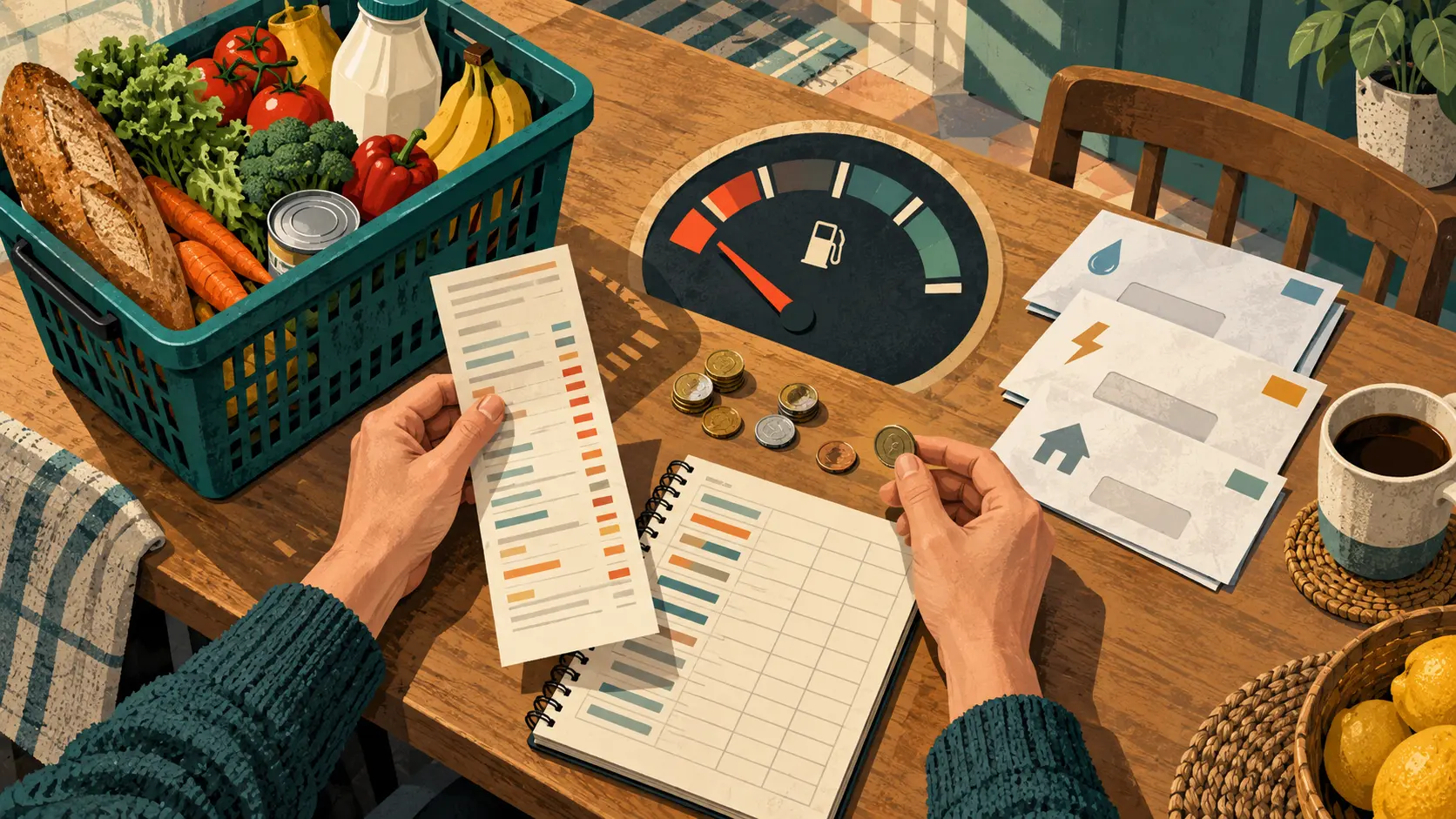
Conceptual AI-assisted illustration of household costs and monthly budget pressure; not a photographed event.AI-assisted editorial illustration.
Household time runs faster than factory time
The political vulnerability in Vance’s answer is not that factories take time. It is that rent, groceries, insurance and fuel are due every month. Voters can acknowledge long construction schedules while still demanding near-term relief.
The latest official price report makes that tension concrete. On October 14, BLS said the consumer price index rose 0.6% in September and 3.7% over the previous year. Core inflation, excluding food and energy, was 2.6%. Gasoline prices were 34.2% higher than a year earlier. The Associated Press noted that inflation-adjusted average weekly pay fell year over year in September, the first such decline since May.
That does not prove the administration’s investment strategy will fail. September’s gasoline shock reflects geopolitical disruption as well as domestic policy, and grocery prices actually declined 0.1% for the month. The same AP report said food-at-home prices were up a relatively modest 1.8% over the year. A fair analysis has to preserve those countervailing facts.
But voters experience the total bill, not a debate over which component counts most. An AP-NORC poll conducted October 8–12 found about eight in ten registered voters disapproved of Trump’s handling of the cost of living, while about three-quarters disapproved of his economic performance. The same survey found only about one-third viewed Vance positively, compared with roughly half who viewed him negatively. The poll’s 4.2-point margin of error for registered voters matters, but it cannot erase the scale of the dissatisfaction.
Our October 12 analysis of Vance’s affordability argument focused on interest rates and the immediate price test. Today’s excerpt shifts the question from policy direction to time. That makes it a distinct challenge: what should count as adequate progress while Americans wait for the long-run payoff?
The next checkpoint is already on the calendar
Vance does not need to promise an arbitrary date when every household will feel better. He can identify checkpoints. The Bureau of Economic Analysis says its first estimate of third-quarter GDP and its September personal-income report are both scheduled for October 29. BLS plans to release October employment data on November 6 and October inflation data on November 10.
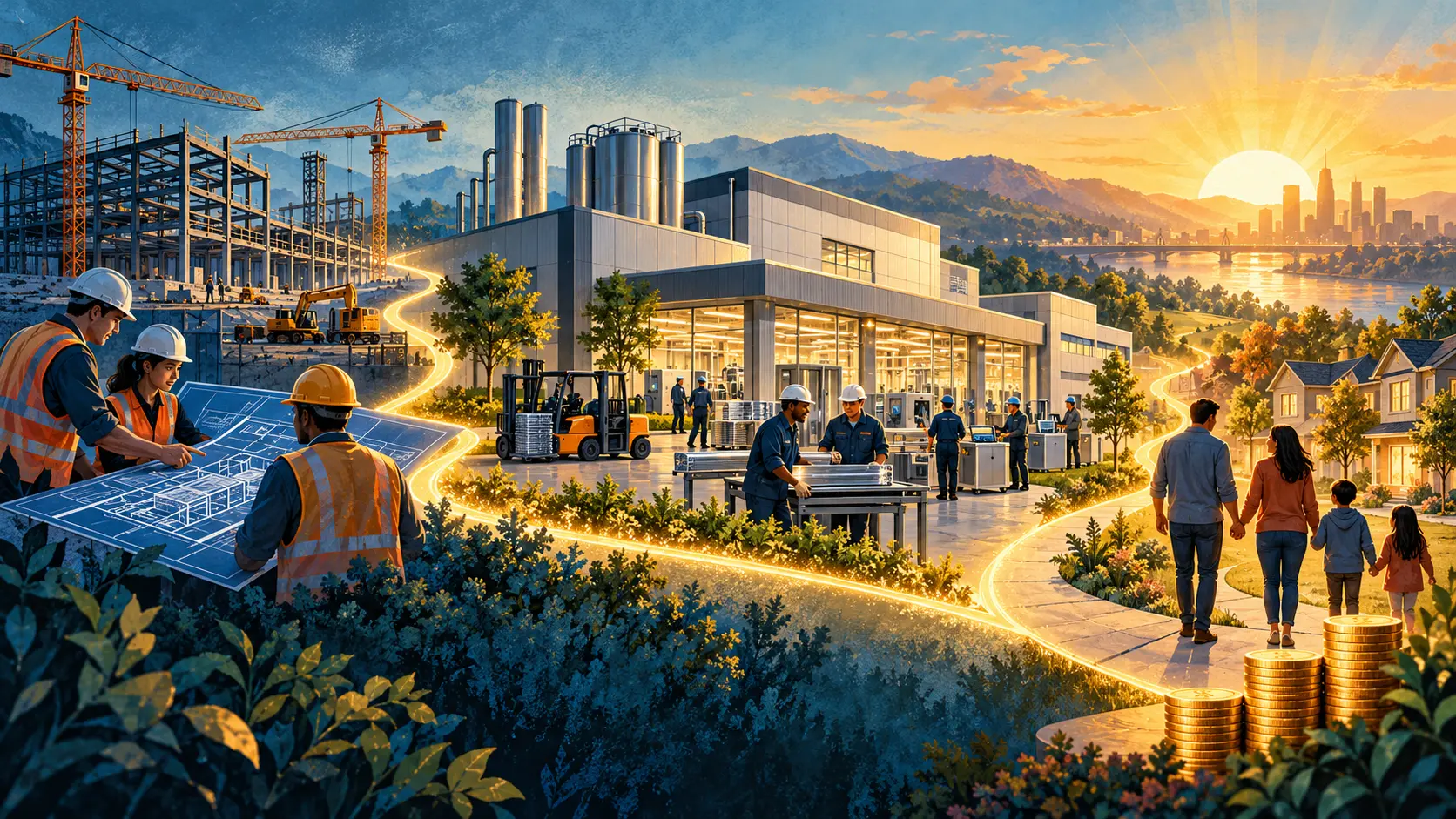
No single release will settle the case. GDP can rise while household purchasing power falls; payrolls can grow while job gains are concentrated; inflation can slow even though the overall price level remains painfully high. A useful dashboard would therefore combine four measures: real disposable income per person, real weekly earnings, broad payroll growth and the rate at which announced industrial projects begin construction and hiring.
Conceptual AI-assisted illustration of investment milestones becoming jobs and income; not a photographed event.AI-assisted editorial illustration.
A timeline should include responsibility, not just patience
The strongest version of Vance’s case is that industrial policy works with a lag and that voters should look for accumulating evidence. The weakest version is an endlessly movable horizon: good news proves success, while bad news merely shows that more time is required. The difference is whether the administration defines what would change its own assessment.
For example, Vance could say that factory announcements are encouraging but incomplete until capital spending and payroll data confirm them. He could acknowledge that 3.7% inflation is inconsistent with an “A+” household economy, even while arguing that manufacturing investment will strengthen future wages and supply. And he could explain which policies are meant to reduce current energy and transportation costs rather than asking a worker to wait for a plant scheduled to open years from now.
Opponents also owe voters more than disbelief. Democrats can point to elevated prices, slow hiring and weak approval ratings, but criticism is not a complete affordability program. The latest AP-NORC survey found frustration with both parties and little confidence that either is focused on people like the respondent. Vance’s timeline should be tested rigorously, but the alternative should be tested too.
The administration’s messaging problem is sharper because Trump’s economic grade and Vance’s request for time pull in different directions. Reuters reported on October 15 that Trump’s recent rallies offered no single detailed cost-of-living message, even as he highlighted manufacturing investments and energy promises. Vance’s answer is more sober. It concedes that the job is unfinished. That candor can help—if it becomes the basis for measurable accountability rather than a rhetorical escape hatch.
What would make the “ship” visibly turn
A fair test through the end of 2026 would look for a sequence, not a miracle. First, monthly inflation should stop accelerating and real weekly earnings should return to growth. Second, payroll gains should widen beyond a few sectors. Third, the administration should publish project-level milestones for its largest manufacturing claims: announced, financed, under construction, hiring or producing. Fourth, Vance should keep separating long-term capacity building from immediate household relief instead of presenting one as proof of the other.
This framework is supportive without being credulous. It recognizes that the 72,000-job manufacturing rebound is meaningful and that a factory cannot employ workers before it exists. It also recognizes that a 0.6% monthly price increase and a 29,000-job national payroll gain are warning lights. The evidence is mixed, and serious supporters should be willing to say so.
Vance’s Michigan campaign work has repeatedly put him in front of voters who will help decide whether the administration earns more time; our coverage of his Michigan turnout test explains that political setting. His latest answer may be more realistic than an instant-victory claim. The next step is to turn realism into a public timeline with checkpoints, tradeoffs and consequences.
The “turning the ship around” metaphor works only if Americans can see the change in direction. Announcements are the wheel moving. Jobs, purchasing power and lower inflation are the wake. Vance has asked for patience; now he should make clear what evidence will show that patience is paying off.
*Disclosure: Vance Force is an independent JD Vance fan community. It is not an official campaign, government or White House publication. The illustrations in this article are AI-assisted conceptual artwork, not photographs of actual events.*