JD Vance says inflation has improved but the work is unfinished. New Fed warnings and pending CPI data make household affordability the harder test.
By Vance Force Editorial Desk
AI-assisted editorial illustration of JD Vance in an affordability debate at a kitchen table, with the Federal Reserve and a gas station in the background
DISCUSSION OPENRead the source brief, then add your evidence and argument.
The affordability argument has reached its hardest stage
JD Vance has a politically useful sentence for the final weeks of the midterm campaign: inflation is lower than the peak that preceded the Trump administration, but the work is not finished. The first half asks voters to compare rates of change. The second acknowledges what they experience at the grocery store, the gas pump and the mortgage desk. On October 9, Vance told reporters in Ohio that inflation was lower than when the administration took office while conceding that “there’s still a lot of work to do,” according to the published Roll Call transcript.
That formulation now faces a sharper economic test. On October 12, Cleveland Federal Reserve President Beth Hammack argued that inflation pressure had broadened beyond energy and that monetary policy should become restrictive relatively quickly. The latest official Consumer Price Index available today showed prices 3.4% higher in August than a year earlier. The September report will not arrive until October 14. Vance is therefore campaigning in a narrow window: voters are judging the price level they see now, while the most current nationwide inflation reading is still two days away.
This is not a forecast of that report and not a claim that one data release will decide an election. It is an analysis of the standard Vance has chosen. If affordability is the administration’s closing economic argument, the evidence must show more than inflation being below an earlier peak. It must show that wages, housing, energy and borrowing costs are moving in a direction households can recognize.
What is verified as of October 12
The Bureau of Labor Statistics’ August CPI release reported a 0.4% seasonally adjusted monthly increase and a 3.4% increase over 12 months. BLS also said the September CPI would be published at 8:30 a.m. Eastern on October 14. Any claim about September inflation before that release is an estimate, not an official result.
The Federal Reserve’s position has also changed. The minutes of the September 15–16 Federal Open Market Committee meeting, released October 7, document the information available when policymakers made their decision. AP reported that the Fed raised its key rate by a quarter point to roughly 3.9%, its first increase in three years, and that many officials expected another increase could be needed this year. Higher policy rates are intended to reduce demand and inflation, but they can also keep mortgages, auto loans and other borrowing expensive.
On October 12, Hammack added a more immediate warning. Reuters reported that she sees underlying inflation in the mid-to-high 2% range and price pressure spreading beyond oil, gasoline and diesel. She also identified demand for computer and electrical components from the artificial-intelligence buildout as a source of higher costs for data centers, aviation, electricity production and construction.
Those facts do not prove that the administration’s policies caused every increase. Energy disruptions, tariffs, investment demand, wage growth, housing supply and global conditions overlap. They do establish that the affordability debate cannot be reduced to a single gasoline sign or stock-market index.
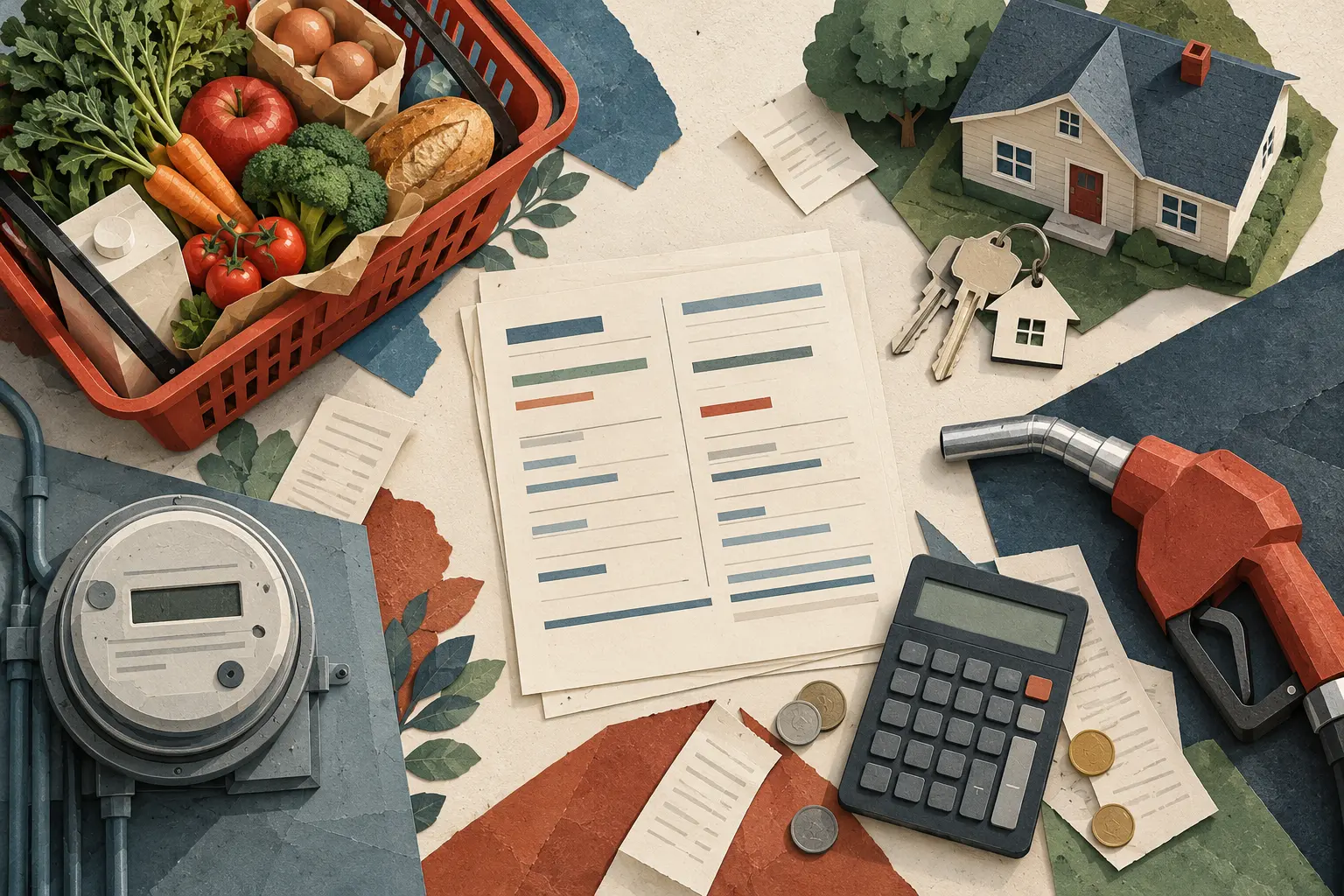
AI-assisted conceptual illustration of the household costs shaping the affordability debate.AI-assisted editorial illustration.
Falling inflation is not the same as falling prices
The distinction at the center of Vance’s message is simple but often blurred. Inflation measures how quickly prices are changing. When inflation slows, prices generally continue rising, only more slowly. A household can therefore hear that inflation has improved and still face a grocery bill, rent payment or insurance premium that is much higher than several years ago.
Vance’s October 9 answer recognized part of this reality by avoiding a claim that the job was complete. His argument is comparative: the administration inherited a worse inflation environment and has moved the economy in a better direction. Supporters can fairly point out that policy results take time, factory investment does not become wages overnight, and a president or vice president does not set every market price.
The skeptical response is equally concrete. A voter does not pay a rate of change; the voter pays the current price. If wages rise at roughly the same pace as inflation, a household may prevent further erosion without recovering the purchasing power already lost. If interest rates rise while prices remain elevated, the same family can face both a costly home and a costly loan.
That tension appears in a Reuters analysis published October 12. Household wealth increased substantially through mid-2026, but the gains were distributed unevenly. Strong asset values can support spending for households that own more investments, while workers who rely mainly on wages remain more exposed to food, fuel and housing costs. The economy can look resilient in aggregate and still feel punishing in a monthly budget.
Vance must connect policy to the household ledger
The political challenge is not merely to repeat that inflation was once worse. Vance needs to explain which policies should reduce which costs, over what period, and what tradeoffs they carry. Energy policy can affect fuel and electricity. Trade policy can support domestic production but may raise prices for imported inputs. Tax policy can lift take-home pay without changing the sticker price. Housing supply can improve affordability over years, while interest rates affect buyers immediately.
For supporters, this creates a stronger case than a blanket claim that everything is already affordable. Vance can argue that rebuilding industrial capacity, increasing energy supply and improving wages are durable answers, while acknowledging that the transition is incomplete. That approach treats voters as capable of distinguishing a long-term production strategy from short-term relief.
For skeptical readers, the test should be measurable. Which household costs have slowed? Are real wages rising across the income distribution? Are first-time buyers gaining access to homes? Are energy interventions lowering costs without transferring them elsewhere? Are manufacturing announcements producing permanent jobs rather than temporary construction? Our JD Vance background page provides context for his governing role, while the news archive preserves the claims that should be checked against later results.
The administration also has to separate fiscal and monetary responsibilities. Vance can advocate an economic program, but the Federal Reserve sets short-term interest-rate policy independently. Public pressure on the Fed may be politically attractive, yet a rate cut unsupported by inflation data could risk renewed price pressure. Conversely, a rate increase can restrain inflation while worsening borrowing conditions. Honest analysis must hold both effects at once.
AI-assisted conceptual illustration of the tension between tighter monetary policy and industrial investment.AI-assisted editorial illustration.
The next CPI release is evidence, not a verdict
The September CPI report on October 14 will be the next major national checkpoint. AP noted that affordability is already a leading midterm issue and that households face high costs for groceries, gasoline and housing. The AP report on the September Fed meeting also described pressure from oil and gas, tariffs, and demand for technology infrastructure.
One report can change the direction of the debate, but it cannot settle every question. A lower headline number could reflect a temporary move in energy while shelter or services remain persistent. A higher number could be noisy rather than the start of a trend. Revisions, seasonal adjustment and the difference between headline and core measures all matter.
Vance’s safest evidence-based argument is therefore conditional. If inflation continues easing, he can claim progress while identifying the costs that remain high. If it accelerates, he should explain which pressures are temporary and which require a policy response. Declaring victory before the data arrive would turn an economic case into a credibility risk.
This also matters for the Federal Reserve. Hammack’s October 12 remarks favor a quicker restrictive stance, but investors cited by Reuters expected no change at the October meeting. Policymakers are debating pace and persistence, not operating from unanimous certainty about the next move. Vance’s campaign language should reflect that uncertainty rather than treating any one official’s view as a settled institutional decision.
What supporters and skeptics should watch next
Five indicators will show whether JD Vance’s affordability argument is becoming stronger or weaker.
1. **The September CPI details:** headline inflation matters, but shelter, food, energy and core services will reveal whether pressure is broad or concentrated.
2. **Real wage growth:** households need pay gains that exceed inflation consistently, not only in a single month.
3. **Mortgage and consumer borrowing costs:** lower inflation offers limited relief if financing a home, car or small business remains out of reach.
4. **Energy pass-through:** voters should look for evidence that changes in oil, gasoline, diesel and electricity are reaching household budgets.
5. **Policy specificity:** Vance should connect each proposed remedy to a cost category and a credible time horizon.
The fairest conclusion on October 12 is neither that the economy is failing everywhere nor that affordability has been solved. Output and asset values can rise while the price level still strains wage-dependent families. Inflation can be below a prior peak and still remain above the Federal Reserve’s target. Vance’s opportunity is to make that complexity legible: identify what improved, acknowledge what did not and offer measurements that allow voters to judge the next claim.
*Vance Force is an independent, unofficial fan community. This article is original editorial analysis, not a campaign communication, endorsement, or statement from JD Vance, the White House, the Federal Reserve, or any candidate.*