JD Vance Turns a Rally Interruption Into an Immigration Message
A protester interrupted JD Vance's Hendersonville rally to demand release of Epstein-related records. Vance answered with an immigration-themed joke, creating a revealing campaign moment about message discipline, protest and public accountability.
By Vance Force Editorial Desk
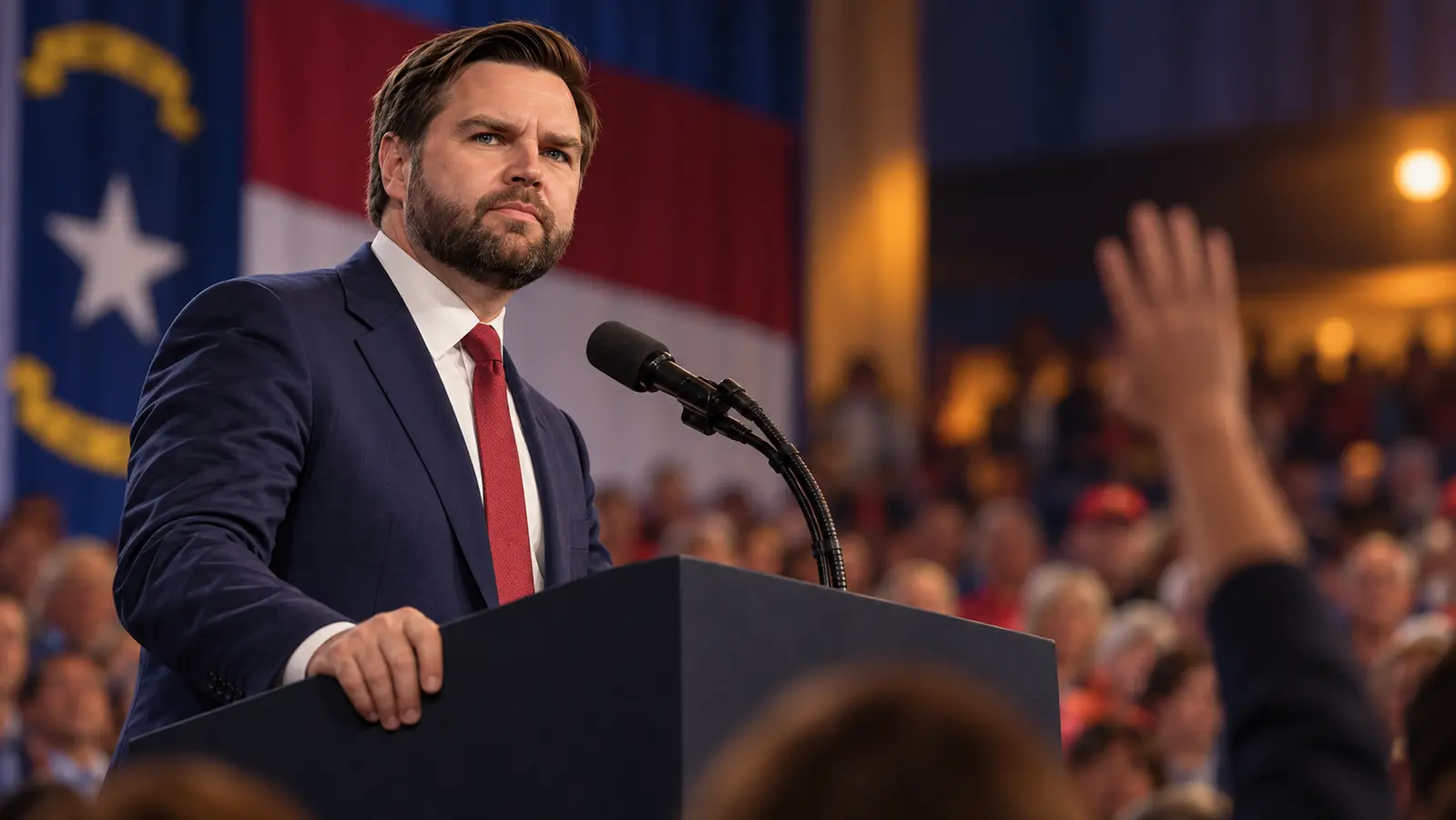
AI-assisted editorial illustration of JD Vance at a North Carolina podium during a conceptual JD Vance rally interruption scene with a raised hand in the audience.
DISCUSSION OPENRead the source brief, then add your evidence and argument.
Vice President JD Vance was roughly twelve minutes into a North Carolina campaign speech on Monday when a protester seated behind the podium stood and demanded the release of records connected to Jeffrey Epstein. The man was removed as the crowd booed and chanted. Vance did not address the demand directly. Instead, he turned the interruption back toward the immigration theme he had been discussing moments earlier.
That sequence is visible in video and preserved in a full Roll Call Factba.se transcript. It was a brief episode, but it offers a useful, verifiable snapshot of how Vance handles an unscripted challenge: acknowledge it, joke, then resume the prepared contrast with Democrats. Supporters can reasonably see quick message discipline. Critics can reasonably ask why the substance of the protest was left unanswered.
What happened in Hendersonville
The rally took place October 19 at Hyder Warehouse in Hendersonville. Local outlet WLOS reported that Vance appeared for Republican Senate nominee Michael Whatley and House nominee Jennifer Balkcom. The event was therefore a campaign stop, not an official policy announcement, though Vance also used the visit to discuss western North Carolina's recovery. Our separate report examines the administration's and what remains to be documented.
At about 11 minutes and 40 seconds into Vance's remarks, the transcript notes that a protester called out. Independent reports and video identify the demand as a call to release Epstein-related files and add that the man said, "God bless our children." An Al Jazeera video report also confirms the central facts of the interruption and removal.
Vance's response drew on his earlier claim about low border crossings. He told the crowd he would have to "amend" what he had said, then suggested the interruption represented one crossing. The audience laughed. He immediately broadened the exchange into a partisan argument, saying the protester represented what the political left stands for and contrasting that with a government focused on citizens.
AI-assisted conceptual illustration of a rally interruption and the tension between protest and the prepared stage.AI-assisted editorial illustration.
The verified fact and the disputed interpretation
The factual core is narrow. A man interrupted a political speech. He demanded disclosure of Epstein-related material. Security removed him. Vance answered with an immigration joke and returned to his stump speech. The available transcript does not identify the protester's immigration status, and Vance presented no evidence about it. The Guardian's account reported that the man shouted that he was an American citizen while being escorted out.
Interpretation is where views diverge. The Guardian characterized Vance's reply as racist because it linked a person of color to illegal immigration without evidence. Others may understand the line primarily as a spontaneous callback to the border passage immediately preceding the disruption. Both readings should be stated plainly, but neither changes the underlying record: Vance chose a political rejoinder over a substantive response to the disclosure demand.
That distinction matters. A joke can be tactically effective without settling the question that prompted it. The episode is also a reminder to evaluate a viral clip against a longer record. The full speech ran for more than twenty-five minutes and covered candidate endorsements, border policy, energy prices, health care and the administration's record. The interruption occupied less than a minute. Treating that minute as the whole rally would exaggerate its importance; ignoring it would miss a genuine test of Vance's instincts under pressure. The most responsible reading keeps both proportions in view. It also avoids assigning motives to the protester or to Vance that the available video cannot prove. We can document words, timing and audience reaction. We cannot know private intent from those materials alone. Vance regained the room, kept his supporters engaged and avoided letting an opponent dictate the agenda. Yet political agility is not the same as public accountability. Anyone assessing the episode should separate performance from answer: the former was immediate; the latter was absent.
Why the moment fit Vance's broader message
The interruption did not land in a vacuum. The transcript shows that Vance had been talking about English-language requirements for commercial drivers, border crossings and immigration enforcement. After the protester was removed, he continued by arguing that government should serve American citizens rather than criminals, fraudsters or unauthorized immigrants. Later passages moved to fuel prices, health care and cultural issues.
This is classic rally architecture. A speaker begins with local candidates, connects them to national stakes and repeatedly returns to a small number of high-salience themes. For Vance, immigration is not a side topic; it is one of the organizing frames through which he explains competence, fairness and belonging. When a disruption appeared, he folded it into that frame almost instantly.
That ability helps explain why Republican candidates want Vance on the trail. The vice president can turn a local House or Senate event into a nationalized contest and offer a compact version of the administration's case. It also creates risk. When every interruption becomes evidence for the same narrative, a clever callback can outrun the known facts and obscure the question being raised.
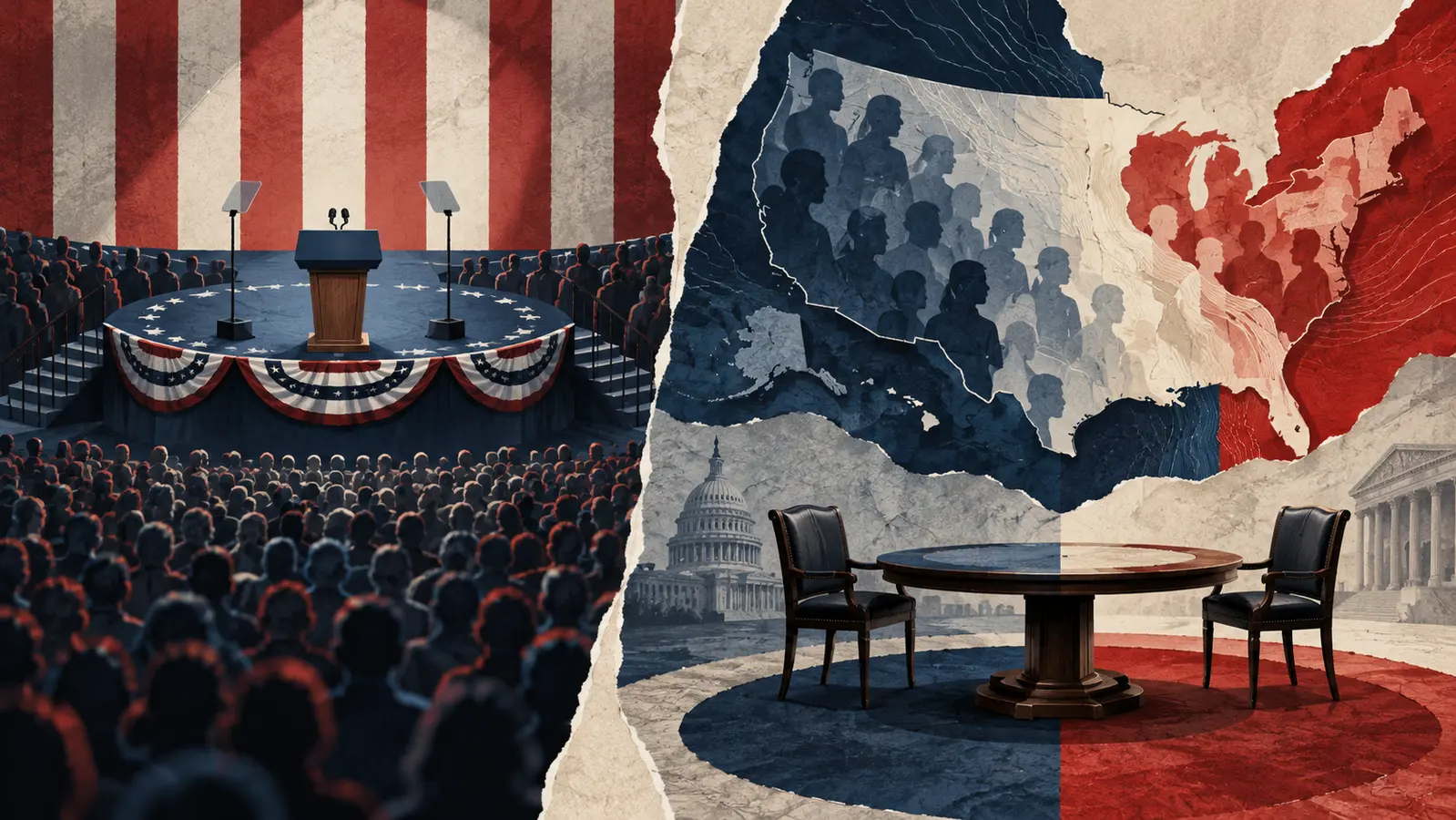
AI-assisted conceptual collage of campaign messaging, national identity and the unresolved space for civic debate.AI-assisted editorial illustration.
The North Carolina stakes
Vance was campaigning in a state where control of Congress is genuinely contested. A pre-rally Reuters analysis described the Senate contest between Whatley and former Democratic governor Roy Cooper as competitive and noted that national conditions were complicating the Republican campaign. That context makes message discipline valuable: every unscripted exchange can circulate far beyond the room.
The episode also illustrates the tension between mobilization and persuasion. A sharp response can energize committed supporters who want their candidate to refuse an opponent's premise. But swing voters may judge tone as well as policy, especially when the response rests on an unverified assumption. There is no public evidence from this one moment alone showing which effect will dominate. Claims that it decisively helps or hurts Vance would therefore go beyond the record.
The same caution applies to the protester's demand. Calls to release government-held material deserve a clear explanation of what exists, what can legally be disclosed and who controls the process. A rally interruption does not establish misconduct, and the protest itself supplies no new evidence about Epstein or any official. It does, however, show that transparency remains a live political demand capable of disrupting a carefully planned campaign event.
What to watch next
Three follow-up questions are concrete enough to monitor. First, will Vance or the White House address the disclosure demand outside the rally setting? Second, will the vice president repeat or qualify the immigration-themed response? Third, will the exchange become part of paid advertising or candidate messaging in North Carolina? Answers to those questions would turn a fleeting viral clip into a more durable campaign development.
For now, the strongest evidence-based conclusion is appropriately modest. Vance demonstrated speed and control under pressure, but he answered the interruption's politics rather than its substance. That may be exactly what a rally audience rewards. It is not the same thing as resolving the transparency question. Readers interested in how Vance operates inside closely divided institutions can also see our examination of his potential 50-50 Senate tie-breaking role.
Vance Force is an independent fan community, not an official campaign or government outlet. This article distinguishes verified reporting from analysis, links directly to the underlying transcript and coverage, and uses clearly labeled AI-assisted conceptual illustrations rather than documentary photographs.