JD Vance’s Permitting Bet: Build Faster Without Losing Trust
JD Vance is making permitting reform central to an affordability and industrial strategy. The Senate vote creates an opening, but savings, safeguards and implementation still need proof.
By Vance Force Editorial Desk
AI-assisted editorial illustration of JD Vance reviewing a permitting reform plan with models of homes, factories and power infrastructure.
DISCUSSION OPENRead the source brief, then add your evidence and argument.
Vice President JD Vance used Friday’s White House briefing to elevate an issue that usually lives below the headline layer of politics: how long it takes America to approve and build things. He praised a sweeping permitting package that passed the Senate the night before and argued that faster approvals could mean more homes, factories and power plants.
That argument fits Vance’s economic nationalism unusually well. It connects industrial renewal, energy abundance and housing supply to a single governing capacity: turning plans into physical assets. It also exposes a serious test. Permitting reform can shorten delay, but it can also reduce opportunities for communities, tribes and environmental groups to challenge projects. “Build faster” is not a complete standard unless voters can see who benefits, who pays and which protections remain enforceable.
The immediate development is verified. The Senate’s official floor record says the chamber passed the Bipartisan American Affordability and Jobs Act on November 19 by 62–33. Fifteen Democrats and independents voted yes, while Republicans Josh Hawley and Mike Rounds voted no. The package now requires House action before it can reach the president.
Why Vance made permitting an affordability argument
At the November 20 briefing, Vance called the legislation “amazing” and said it would let the country build “like we’ve never built before,” according to CBS News’ live report. He named three outputs: homes, factories and power plants. That list is revealing because it turns an abstract procedural debate into the material agenda Vance wants associated with his politics.
Housing costs are partly a supply problem. Manufacturers need sites, power and transport connections before reshoring becomes more than a slogan. New data centers and electrification are increasing demand on a grid that already struggles to connect generation and move power between regions. In each case, a project delayed for years can become more expensive or die before construction begins.
The administration’s statement of policy makes the same case. It says the package would reform federal environmental reviews, speed pipelines, plants and mines, and require large data centers to bear more of the transmission costs created by their demand. That ratepayer provision gives Vance a concrete fairness argument: households should not automatically subsidize grid upgrades built chiefly for hyperscale computing loads.
But faster permits do not mechanically produce cheaper bills or affordable homes. Financing costs, local zoning, labor availability, materials, utility regulation and the selection of projects all matter. The White House has promoted a projection of at least $1,300 in annual household savings, yet its November 20 advocacy release does not itself provide the assumptions needed to evaluate that number. It should be treated as an administration claim, not a guaranteed household result.
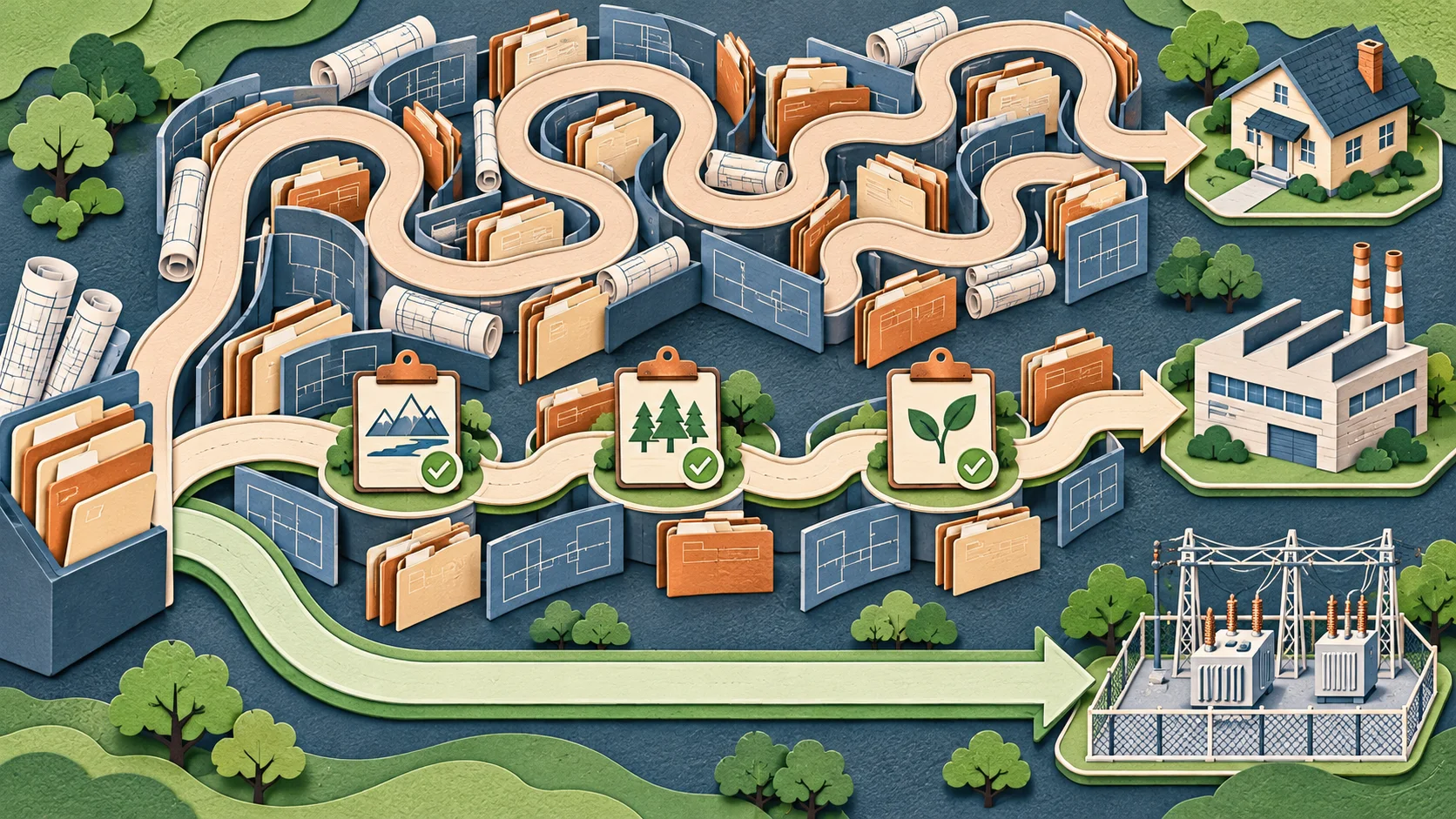
AI-assisted conceptual illustration of permitting pathways; it does not reproduce an actual government review document.AI-assisted editorial illustration.
What the Senate actually passed
The legislation’s identity can be confusing. The permitting framework was introduced on September 30 as S. 5653. The Senate ultimately placed a revised version into H.R. 2347 through a substitute amendment, and the official November 19 record therefore lists H.R. 2347, as amended, as the vehicle that passed 62–33. That distinction matters for tracking the next step: the House must act on the Senate’s amended text.
A Congressional Research Service analysis of the introduced framework describes changes affecting the National Environmental Policy Act, Clean Water Act, Endangered Species Act, National Historic Preservation Act, electricity transmission, natural-gas pipelines, geothermal development, permit certainty and judicial review. The final Senate substitute was revised after that report, so the CRS document is a guide to the architecture, not a substitute for reading the enacted text if the House agrees to it.
The package is broader than fossil-fuel permitting. Supporters from clean-energy, manufacturing, labor and conventional-energy groups argue that the same delays can block transmission, solar, geothermal, mining and industrial projects. A faster grid build-out could help renewable projects reach customers. Faster review could also accelerate gas plants, pipelines and export infrastructure. The procedure is technologically neutral in some important respects; political control over agencies and project selection is not.
That dual use is the central tension. Associated Press reporting notes that the bill would shorten timelines and address data-center energy costs, while critics warn about limits on judicial review and changes to major environmental statutes. It also records a substantive process complaint: opponents say the package moved through a lame-duck session without enough hearings or amendment votes.
The strongest opposing evidence
Environmental and tribal objections are not simply arguments for delay. They concern which harms can be identified before approval, whether a permit can be revisited when facts change, and whether affected communities have a realistic path to court. A project can create national benefits while concentrating pollution, land loss or cultural disruption in one place.
Reuters reported that sponsors added tribal consultation requirements, expanded states’ role in transmission planning and created assistance for communities facing data-center impacts. The National Congress of American Indians and several environmental organizations nevertheless remained opposed or concerned. That gap between sponsors’ safeguards and affected groups’ confidence is evidence Vance should address directly rather than treating every objection as procedural obstruction.
The Vance test is execution with legitimacy
Vance’s political opportunity is to define abundance in terms that are more concrete than deregulation. His version can argue that working families need enough electricity, buildable land, industrial capacity and infrastructure competition to keep costs down. That resembles the accountability framework in our FAA modernization scorecard: funding and statutory authority matter, but milestones, delivery dates and public reporting determine whether a reform becomes real.
It also connects to the political vulnerability examined in our morning analysis of the JD Vance 2028 polling picture. A distinct governing case is more durable than succession speculation. If Vance wants permitting reform to demonstrate competent economic nationalism, he will need results voters can see before any future campaign asks them to credit the theory.
AI-assisted conceptual illustration of infrastructure and environmental tradeoffs, not a photographed project or public hearing.AI-assisted editorial illustration.
Four measures would make that case testable.
First, publish approval timelines by agency and project type. A shorter median review time is stronger evidence than a collection of ribbon cuttings. The measure should also show whether agencies met deadlines by completing analysis or merely shifted delay to another stage.
Second, track delivered capacity: homes unlocked where federal review was a binding constraint, megawatts connected, transmission miles placed in service and factories reaching construction. Announced investment is not the same as an operating asset.
Third, separate who pays. Data-center interconnection costs, household rates and public subsidies should be reported clearly enough to test the administration’s ratepayer promise. Our earlier resilience brief on infrastructure failures made a related point: capacity without transparent responsibility can leave the public holding the risk.
Fourth, measure legitimacy alongside speed. Agencies should disclose consultation, mitigation commitments, court challenges and environmental outcomes. A system that approves quickly but repeatedly loses in court, surprises communities or produces preventable harm will not be stable enough to support long-term investment.
A bill is not yet a building boom
The Senate vote gives Vance a genuine policy opening. It is bipartisan, directly tied to affordability and compatible with his emphasis on domestic production. It also remains unfinished. The House could pass the Senate text, change it or fail to act before the Congress ends. Even enactment would begin an implementation phase involving agencies, regulators, courts, states, utilities and private capital.
The best version of Vance’s argument is not that every permit is bad or every project is good. It is that a capable country should reach defensible decisions on a predictable timetable and then build what it approves. The strongest critique is that predictability can become insulation from accountability if judicial review, scientific standards and community participation are weakened too far.
That is why permitting reform is a useful measure of Vance’s governing philosophy. It asks whether industrial ambition can coexist with credible rules and public trust. If the answer is yes, the legislation could support the homes, factories and power systems he highlighted. If the safeguards fail or the promised savings never appear, “build faster” will sound less like state capacity and more like permission for favored interests.
*Vance Force is an independent fan community. This article is original editorial analysis, is not affiliated with JD Vance or any campaign, and separates verified legislative facts from interpretation and unresolved policy claims.*