JD Vance's FAA Case Is Stronger With a Modernization Scorecard
JD Vance is right that aging air traffic systems require urgent investment, but the new $50.1 billion request will be stronger with public milestones, resilience tests and clear ownership.
By Vance Force Editorial Desk
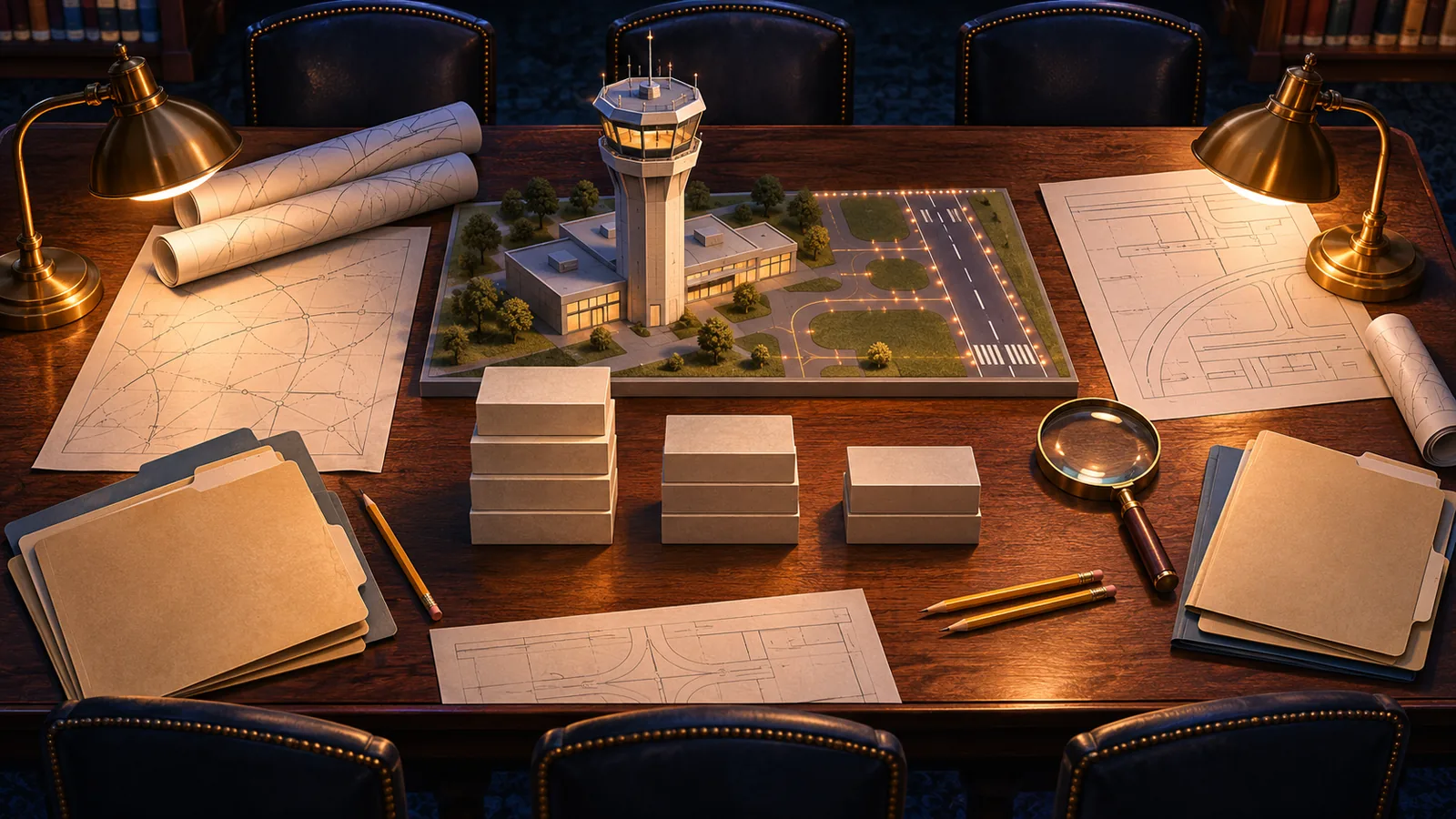
AI-assisted editorial illustration of JD Vance considering an FAA modernization plan inside a stylized air traffic control tower at dusk.
DISCUSSION OPENRead the source brief, then add your evidence and argument.
The nationwide ground stop on November 13 turned an invisible infrastructure problem into a visible political test. Vice President JD Vance responded by arguing that Congress should finance a 21st-century air traffic control system instead of asking operators to keep patching equipment built for another era. The core of that argument is difficult to dismiss. The harder question is whether the administration has shown enough about the failure, the spending sequence and the proposed architecture to earn a new $50.1 billion commitment on an accelerated timetable.
That distinction matters. Supporting modernization does not require Congress to approve every dollar before the root-cause investigation is finished. Demanding an audit trail does not mean accepting obsolete systems. The strongest version of a JD Vance FAA modernization plan would combine urgency with a public scorecard that tells travelers what is being replaced, when it will be tested and how failure in one component will be prevented from cascading across the national network.
The verified failure was serious—and still under investigation
The FAA's November 15 question-and-answer report says the disruption began at about 3:30 p.m. Eastern on November 13. Data flooded the FAA Telecommunications Infrastructure network at roughly 1,000 connection attempts every four to five seconds. Instability reached 17 of 22 Air Route Traffic Control Centers, affecting communications and radar feeds. The agency says some frequencies and radar feeds remained available, about 3,500 aircraft landed safely, and the ground stop ended at 8:15 p.m.
The agency's initial investigation identified two potential locations: a radar site in Amarillo, Texas, and a radio communications site in El Dorado, Arkansas, where contractor L3Harris had been deploying a new router. The FAA disabled a broadcasting function on more than 60 routers and paused further installations. It also said there was no current indication of a cyberattack.
Those are significant facts, but they are not a completed root-cause finding. Associated Press reporting on November 17 noted that the manufacturer said the equipment appeared to function as configured, while Transportation Secretary Sean Duffy said officials had reproduced the El Dorado behavior but still lacked clarity on the root cause. That unresolved gap is precisely why funding, procurement and testing need to be discussed together.
Vance is right about the cost of perpetual patching
In a November 16 Fox News interview, Vance described an old system kept running through a patchwork of fixes and called for congressional reinvestment in modern infrastructure. His broad diagnosis matches years of warnings that the national airspace system depends on aging telecommunications, control facilities and specialized hardware.
The outage also demonstrated that safety procedures can work while resilience still fails. The FAA says every aircraft landed safely, but it reported approximately 12,462 cancellations that day, while cautioning that not all were directly caused by the ground stop. Safe recovery is a success. A system that requires a nationwide stop after data instability is not the standard the country should accept.
AI-assisted conceptual illustration of an aviation network transition and data instability; it does not depict the November 13 incident or a specific device.AI-assisted editorial illustration.
Vance's emphasis on infrastructure also fits his larger economic argument: public capacity matters when markets and communities depend on systems no single company can rebuild. That is consistent with the practical test we applied to his industrial policy in our analysis of the new China chip rule. In both cases, the persuasive case is not simply that America should spend more. It is that public investment should create durable domestic capability with measurable outcomes.
The $50.1 billion request is much broader than the failed router path
The administration's November 17 Department of Transportation request divides $50.1 billion across five large categories. It seeks $10.1 billion for a common digital architecture, separation tools, telecommunications and air-traffic-flow technology; $10 billion for airport infrastructure; $10 billion for terminal modernization; $10 billion for five consolidated control centers; and $10 billion for as many as 140 control towers.
That may be a coherent modernization portfolio. It is not, however, a narrowly tailored response to the November 13 failure. The incident involved network instability during a transition from copper lines to fiber and newer routers. A request that also includes terminals, towers and regional centers needs a portfolio-level explanation: which investments address the observed failure mode, which solve separate backlogs, which are ready for construction, and which remain at the design stage.
DOT says the $12.5 billion already approved in 2025 has been allocated and is scheduled to be implemented by the end of 2028. It reports that 70 percent of copper telecommunications lines have been replaced with fiber, 5G or low-earth-orbit connectivity, alongside upgraded radio sites, electronic flight strips, voice switches and surface-awareness technology. Those numbers are useful, but they are output counts. Congress and the public also need performance measures: uptime, failover time, defect rates, independent test results and the number of facilities that can lose one node without losing service.
Senate questions are a demand for sequencing, not a rejection of modernization
Roll Call reported on November 17 that Republican senators, including John Thune, Thom Tillis and John Hoeven, wanted more detail about the request and the funds already available. Thune pointed to roughly $8 billion he believed remained from an earlier package. Tillis questioned why the ask had grown from about $30 billion to $50 billion. Their skepticism does not establish that the larger request is excessive, but it does show that Vance cannot frame this only as a partisan choice between investment and neglect.
Democrats have their own accountability argument. Critics say the administration is blaming Congress despite having received substantial modernization funds. The Guardian's report on Vance's interview emphasized Laura Ingraham's challenge that Republicans had controlled the federal government during the preceding two years, as well as Vance's decision to connect cooperation on infrastructure to a culture-war dispute. That rhetoric may energize supporters, but it risks obscuring the bipartisan engineering problem he is best positioned to elevate.
AI-assisted conceptual illustration of congressional scrutiny over infrastructure scope, sequencing and measurable delivery.AI-assisted editorial illustration.
A modernization scorecard would make Vance's case stronger
Vance can answer both sides by asking DOT and FAA to publish a modernization scorecard before the year-end funding decision. It should not expose sensitive network diagrams. It should provide enough information for Congress, controllers, carriers and the public to distinguish progress from activity.
1. Separate root-cause work from capital planning
The router pause, laboratory testing and contractor review should produce a public finding on configuration, installation procedure, network design and change-control responsibility. If the investigation remains open when Congress votes, officials should say what is known, what is not and which spending items do not depend on a final finding.
2. Fund milestones, not just categories
Each major tranche should have an operational milestone: redundant telecommunications paths commissioned, common workstations certified, failover drills passed, towers brought online, or legacy systems retired. Release of later funds could depend on independent validation rather than calendar dates alone.
3. Measure resilience during transition
The November event occurred while old copper infrastructure was being replaced. That makes transition management as important as the target architecture. A scorecard should track rollback plans, maintenance windows, configuration reviews and whether one upgrade can flood or destabilize unrelated facilities.
4. Name ownership from contract to operations
Modernization spans FAA program managers, private contractors, equipment vendors, controllers and appropriators. Accountability disappears when every participant owns only a narrow task. Vance should insist on a named executive responsible for end-to-end resilience, with regular testimony and public delivery reports. That is the same ownership principle behind our proposed veteran-business scorecard: goals become credible when contracts, outcomes and responsible offices can be traced.
The political opportunity is bigger than blame
Vance's strongest contribution is not a promise that one more appropriation will make the problem disappear. It is the chance to turn a frightening disruption into a durable governing standard. Modernization is necessary; the FAA's own account makes that plain. Yet the equipment pause, the unresolved root cause and the scale of the new request also make oversight necessary.
If Vance couples speed with transparent milestones, he can build a coalition that includes lawmakers who want newer infrastructure and lawmakers who want proof that taxpayers are buying resilience rather than another layer of patches. If the debate remains a contest over which party neglected the system first, the country may spend more without learning whether the next upgrade is safer than the last.
Sources and disclosure
This analysis draws on the FAA's November 15 incident report, DOT's November 17 funding request, Vance's November 16 Fox News interview, and November 17 reporting from AP, Roll Call and the Guardian. Event dates are distinguished from publication dates above. The root-cause investigation was still open at publication, and conclusions may change as testing continues.
Vance Force is an independent English-language fan community. It is not affiliated with JD Vance, his office, a campaign, the White House or the Republican Party. The illustrations accompanying this article are AI-assisted conceptual editorial images, not documentary photographs of actual events.