JD Vance Schedules Michigan Return as Senate Race Enters Final Stretch
JD Vance is scheduled to return to Howell, Michigan, on October 27 as Republicans try to lift Mike Rogers in a Senate contest where polling, affordability concerns, and turnout all point to a close finish.
By Vance Force Editorial Desk
AI-assisted editorial illustration of JD Vance with a Michigan outline, auto manufacturing and an airport hangar for a JD Vance Michigan rally analysis.
DISCUSSION OPENRead the source brief, then add your evidence and argument.
The closing week of Michigan's 2026 Senate campaign is becoming a test of how much a vice president can move a genuinely competitive state. JD Vance is scheduled to return to Michigan on Tuesday, October 27, for a Republican rally in Howell, less than two weeks after his October 15 appearance in Monroe. The new stop is not merely another pin on a crowded campaign map. It places Vance in a state where the open Senate seat could help determine control of the chamber and where voters are weighing national politics against intensely local concerns about prices, jobs and the auto economy.
The most important fact this morning is also the simplest: the Howell event has been announced, but it has not happened yet. The official registration page lists Vance as the special guest speaker at CHI Aviation, with doors opening at 10 a.m. Eastern and the program beginning at noon. Any claims about the speech, the crowd or its impact must wait until Tuesday.
What the Michigan return confirms
Vance's return confirms that Republicans view Michigan as worth repeated, late-stage investment. Spectrum News reported that Howell will be his second Michigan rally in less than two weeks. President Donald Trump is campaigning in Port Huron on Sunday, while former President Barack Obama appeared in Detroit on Saturday for Democrat Abdul El-Sayed. The rapid sequence turns Michigan into a concentrated surrogate contest just before Election Day on November 3.
That attention is understandable. Republican Mike Rogers is trying to capture the seat being vacated by retiring Democratic Senator Gary Peters. The Associated Press notes that Michigan has not elected a Republican to the Senate in more than three decades, while Rogers lost the state's 2024 Senate contest by less than one percentage point. El-Sayed, a former public health official, would become the first Muslim U.S. senator if elected.
This is why the Howell stop should be read as a turnout and persuasion assignment, not as a victory lap. It also gives Vance another chance to connect the administration's national message to a state whose political economy is shaped by manufacturing, cross-border trade and household costs. That is a more demanding job than generating applause from committed supporters.
AI-assisted conceptual illustration of Michigan's campaign geography, turnout routes and industrial economy; not a photograph of an actual event.AI-assisted editorial illustration.
The polling gives both sides reasons for caution
The latest Marist survey illustrates how narrow the contest remains. Interviews conducted October 15 through October 18 found El-Sayed at 50 percent and Rogers at 48 percent among likely voters, a two-point difference inside the poll's plus-or-minus 4.3 percentage-point margin of error. Marist also found El-Sayed ahead 50 percent to 44 percent among independents likely to vote. Those numbers do not predict the result; they describe a race close enough for turnout, late decisions and polling error to matter.
The same survey contains a warning for the Republican message. Forty-three percent of likely voters said their family finances had worsened over the previous year, while only 16 percent said they had improved. Trump registered 42 percent approval and 57 percent disapproval among likely voters. A plurality, 44 percent, said their congressional vote was mainly a vote against the president, compared with 18 percent who described it mainly as a vote for him.
For Vance, that creates a strategic tension. His presence can energize Republican voters who identify with the administration, and his plainspoken campaign style can focus attention on Rogers. But a nationalized event can also remind dissatisfied voters why they want a check on the White House. Our analysis of Vance's wider midterm roadshow made the same distinction: visibility and persuasion are not identical.
A sharper message must answer local questions
The best case for a Vance visit is not celebrity. It is message discipline. Michigan voters have specific questions about fuel prices, health costs, tariffs and the durability of manufacturing jobs. Reuters reported on October 25 that the U.S.-Canada tariff dispute is affecting the Detroit-centered auto industry and that Rogers has distanced himself from Trump's trade policy. That is a meaningful complication for a rally led by the administration's vice president.
A useful Howell speech would therefore explain what policies would lower costs and protect jobs, when voters could expect results, and how Rogers would represent Michigan when he disagrees with the White House. Broad claims about national success will face the reality captured in Marist's household-finance numbers. Vance can still make a strong Republican argument, but the evidence suggests it has to meet voters where they are rather than where party strategists wish they were.
The race's religious rhetoric raises a second test
The campaign has also become a test of whether political contrast can remain focused on policy. AP and Reuters have documented attacks on El-Sayed's Muslim faith and unsupported allegations that he is tied to the Muslim Brotherhood. El-Sayed denies those allegations. Rogers has said his criticism is not rooted in religion, while El-Sayed has called questions about his loyalty shameful.
A responsible reading requires holding two ideas at once. El-Sayed's record, positions and rhetoric are fair subjects for scrutiny; AP also reported that he apologized after comments made following an attack on a synagogue were criticized as hurtful. At the same time, a candidate's faith is not evidence of disloyalty, and unsubstantiated claims should not be repeated as fact. Vance's Howell appearance will show whether the Republican closing argument emphasizes Rogers's agenda or leans on identity-based suspicion.
That choice has consequences beyond one rally. Michigan's electorate includes large Muslim and Arab American communities, but the constitutional principle is universal: voters should judge candidates by evidence, conduct and policy. Vance has previously spoken in explicitly religious language, including during our coverage of his Nebraska rally response. In Howell, he has an opportunity to demonstrate that faith can be discussed without treating another American's religion as a presumption of guilt.
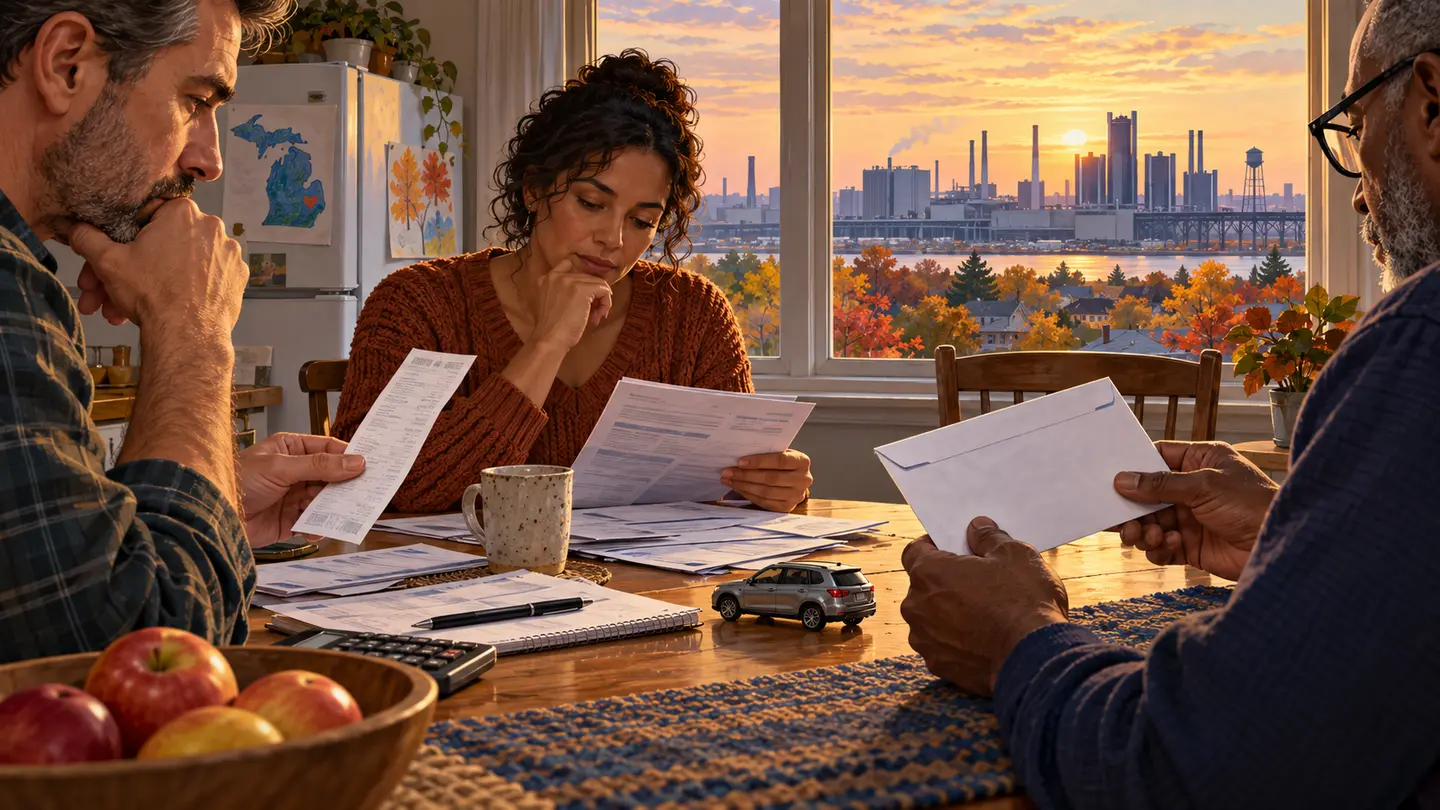
AI-assisted conceptual illustration of household-cost and voting decisions in Michigan; not a photograph of specific voters or a real meeting.AI-assisted editorial illustration.
What to watch on October 27
Three indicators will matter more than crowd size. First, does Vance give a concrete economic account tailored to Michigan, including auto manufacturing and the Canada trade relationship? Second, does he define Rogers positively, or is the speech dominated by attacks on El-Sayed? Third, does the campaign use the event to convert interest into early votes and Election Day commitments? A packed hangar can be visually powerful, but campaigns win by identifying and turning out voters.
The timing is also significant. Early voting is already underway, so the rally is not simply a final appeal to undecided voters. It is part of an operational race to bank votes before November 3. The Marist results suggest Republicans cannot rely only on their base: Rogers's deficit among independents, while uncertain, points toward the need for persuasion as well as mobilization.
The counterargument is straightforward. National surrogates can distort a state race, and repeated appearances may produce diminishing returns. El-Sayed's supporters believe Trump's and Vance's visits will energize opposition. Democrats also have their own national validators, including Obama, whose Detroit appearance framed the election as a check on the administration. There is no reliable evidence yet that either side's surrogate blitz has changed the underlying race.
The bottom line
Vance's scheduled return to Michigan is verified, timely and politically consequential. It signals that Republicans see a path for Rogers in a race that public polling still describes as competitive. It also puts Vance at the center of a difficult closing-week assignment: motivate the Republican coalition, address economic dissatisfaction, defend the administration's record and avoid rhetoric that could repel persuadable voters.
The Howell rally will not by itself decide Michigan's Senate election. It will, however, provide a clear measure of Vance's value as the party's most active national campaigner—whether he can translate attention into a locally credible argument when the margin is small and the public mood is skeptical.
*Vance Force is an independent fan community and is not affiliated with JD Vance, his office, any campaign, the Republican Party or the U.S. government. This article separates verified event details and polling from our analysis.*