JD Vance’s Doubts Precede an Execution-Livestream Reversal
Trump canceled the Pentagon’s execution livestream after JD Vance raised doubts and a broad coalition objected. The evidence supports influence, not a claim of sole causation.
By Vance Force Editorial Desk
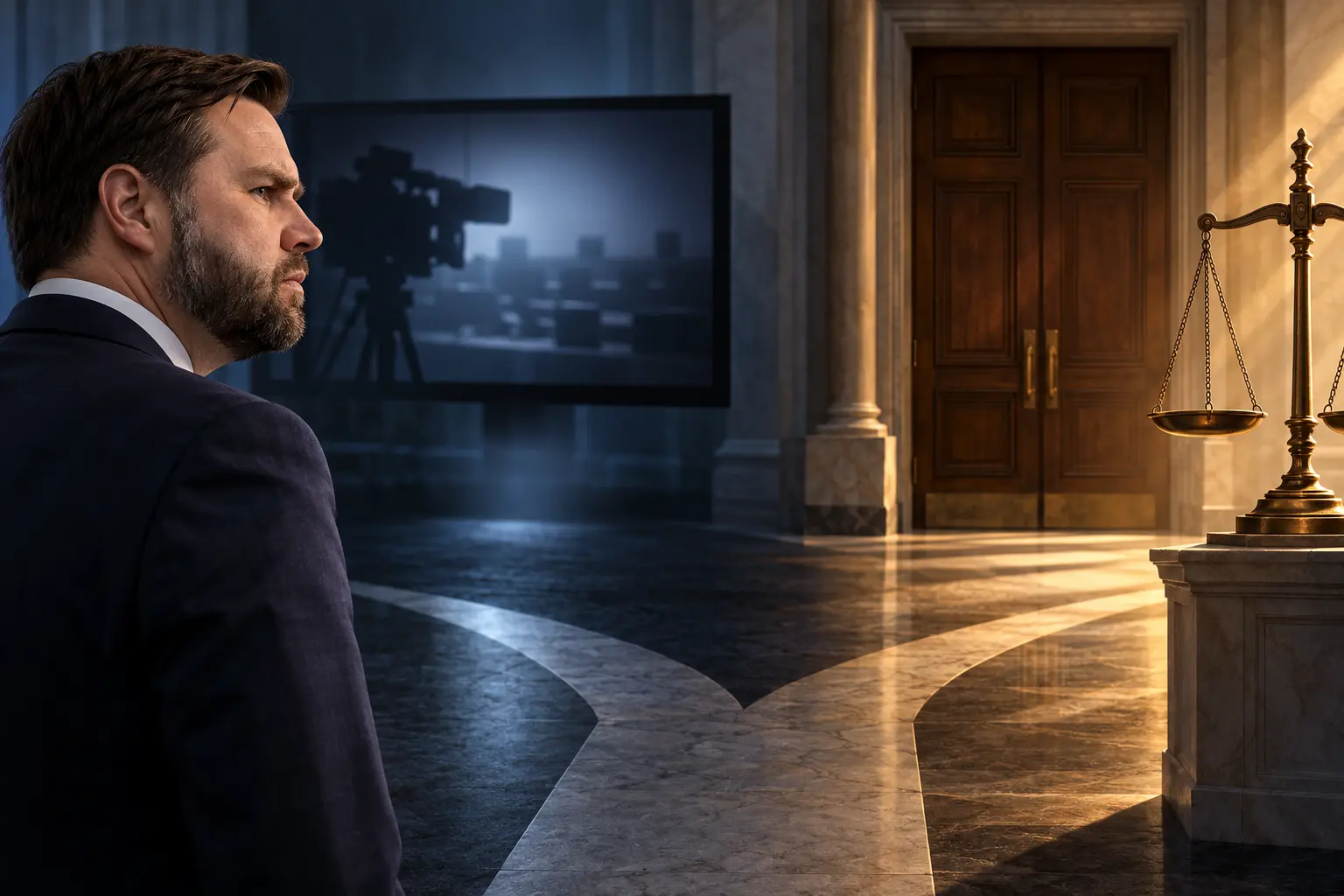
AI-assisted editorial illustration of JD Vance between a dark broadcast screen and courtroom scales, symbolizing the JD Vance execution livestream reversal.
DISCUSSION OPENRead the source brief, then add your evidence and argument.
President Donald Trump has canceled the Pentagon’s plan to livestream the December execution of Nidal Malik Hasan, closing the immediate controversy one week after Vice President JD Vance publicly questioned whether the broadcast would happen and said he would not watch it. The reversal is a verified development. What remains uncertain is how much influence any one critic—including Vance—had on the final decision.
That distinction matters. Vance’s remarks were an early signal of discomfort inside the administration, but the plan also faced bipartisan congressional opposition, condemnation from Catholic leaders and overwhelming public resistance. The available evidence supports a careful conclusion: Vance was part of a broader coalition that made the livestream politically and morally difficult to sustain. It does not prove that he personally caused Trump to reverse course.
What changed on October 15
Trump announced on October 15 that Hasan’s execution would not be streamed. The execution itself remains scheduled for December 3 at Fort Hood, Texas, and immediate family members of the victims may witness it in person if they choose, according to The Associated Press.
Hasan, a former Army psychiatrist, was convicted in 2013 of killing 13 people and wounding 32 others in the 2009 shooting at the base. The livestream proposal was separate from the questions of guilt, punishment and the firing-squad method. Canceling the broadcast does not cancel the sentence.
JD Vance and the Execution-Livestream Reversal
Pentagon chief spokesperson Sean Parnell said Trump and Defense Secretary Pete Hegseth discussed the change before the president announced it and that Hegseth supports the decision. Reuters reported that the reversal ended the public-broadcast plan while leaving open the possibility of legal challenges affecting the execution date.
The timing is clear. Hegseth had presented public broadcasting as a deterrent. Vance then expressed doubt about the plan on October 9. Trump ended it six days later after criticism widened.
Vance drew a line without erasing the crime
Vance’s original response was narrower than some later summaries suggest. He did not announce an internal veto, claim to have changed policy or ask that Hasan’s sentence be withdrawn. He told reporters that he did not know whether the livestream would actually happen and that, if it did, he would not watch.
At the same time, Vance emphasized that the argument over the broadcast should not cause the country to forget Hasan’s victims or the severity of the attack. The full sequence was documented in the AP report on his October 9 remarks. That combination—rejecting the spectacle while keeping attention on the crime—became close to the position the administration ultimately adopted.
Our earlier report, “JD Vance Questions the Execution Livestream”, treated his comment as a warning sign rather than a resolved policy. The new fact is that the warning was followed by an actual reversal. The responsible update is therefore not “Vance stopped the livestream,” but “Vance’s public doubt preceded and aligned with the decision to stop it.”
AI-assisted conceptual illustration of a canceled public broadcast; it does not depict an actual Pentagon studio or documented equipment.AI-assisted editorial illustration.
Why the distinction between justice and spectacle mattered
Supporters of the proposed broadcast argued that it could demonstrate consequences for terrorism. Critics answered that broadcasting a state killing would create propaganda, reward Hasan with renewed notoriety and move the United States toward practices associated with authoritarian governments.
House Speaker Mike Johnson warned that the footage could be used for terrorist recruitment. Republican senators including Thom Tillis, Lisa Murkowski and John Curtis also objected. Democratic lawmakers criticized the plan as well. This was not a conventional partisan dispute in which one party defended the administration and the other attacked it.
The most important political fact may be the public response. An ABC News/Washington Post/Ipsos poll, conducted October 9–13 among 2,545 adults, found that 80 percent opposed livestreaming the execution. Opposition included 64 percent of Republicans and 55 percent of self-identified MAGA Republicans. The poll’s overall margin of sampling error was plus or minus two percentage points.
Those numbers undercut the idea that abandoning the livestream required the administration to abandon its base. The same survey found a slim national majority supporting the firing-squad execution itself. Many respondents were therefore separating the punishment from the broadcast—precisely the distinction Vance’s comments allowed.
Faith was relevant, but it does not settle Vance’s motive
Vance is Catholic, and Catholic teaching opposes capital punishment. Church leaders were among the strongest critics of the plan. Archbishop Paul Coakley, president of the U.S. Conference of Catholic Bishops, called the proposed broadcast a barbaric promotion of a culture of death. Archbishop Timothy Broglio, who leads the Archdiocese for the Military Services, argued that turning the execution into a public spectacle conflicted with Catholic teaching, as OSV News reported through the Catholic Courier.
It is reasonable to view that religious context as relevant to Vance’s discomfort. It would be speculation, however, to state that church pressure determined his position. Vance did not cite doctrine in his brief remarks, and he continued to describe Hasan’s crime in severe terms. His statement can be read as a moral boundary, a political judgment, a media judgment or some combination of the three.
This episode nonetheless adds evidence to a larger leadership question examined in our article on Vance’s growing national role. A vice president sometimes matters most not when announcing a policy, but when giving allies permission to express doubt without abandoning the administration’s central objective.
AI-assisted conceptual illustration centering private remembrance and victims; it does not portray an actual memorial or identifiable people.AI-assisted editorial illustration.
The reversal should center victims, not political credit
There is a risk that coverage of who “won” inside the administration recreates the spectacle the cancellation was meant to avoid. Hasan’s victims and their families are not props in a contest among Vance, Hegseth and Trump. The policy question was whether the government should distribute images of a man’s death to an unlimited online audience. The answer is now no.
That answer also limits several practical risks. A permanent video could be copied, edited and recirculated outside any government context. It could be used for recruitment, harassment or sensational entertainment. It could force victims’ families to confront the footage indefinitely. None of those outcomes is necessary for the military to carry out a lawful sentence or for approved witnesses to observe the process.
The opposing argument deserves acknowledgment. Hegseth and other supporters believed public visibility could deter future violence and demonstrate resolve. Transparency can be valuable when the state exercises its most serious powers. But a global livestream is not the only form of transparency. Official records, legal review, witness procedures and independent reporting can provide scrutiny without publishing the moment of death as mass media.
What is verified—and what remains open
The verified timeline is straightforward:
The Pentagon confirmed plans to livestream Hasan’s December 3 execution.
Vance said on October 9 that he doubted the broadcast would occur and would not watch it.
Republican and Democratic lawmakers, Catholic leaders and other critics called for reconsideration.
A national poll found overwhelming opposition to the livestream, including among Republicans.
Trump announced on October 15 that the execution would not be streamed.
The Pentagon said Trump and Hegseth discussed the decision and remain aligned.
What cannot be verified from the public record is a direct causal chain from Vance’s comment to Trump’s decision. The Washington Post’s October 16 analysis describes unusually broad Republican resistance, while Reuters reported that Trump and his advisers had not initially known about the livestream plan. Those accounts point to a collective correction, not a single-person intervention.
The execution itself also is not beyond further legal uncertainty. Reporting indicates Hasan could seek a delay, and no article published today can guarantee that the December 3 date will hold. The cancellation concerns the broadcast plan, not every remaining legal or procedural question.
A meaningful limit, carefully described
For Vance, the episode shows that loyalty to an administration need not require defending every proposed presentation of its policy. His response kept the focus on the victims, refused participation in a public spectacle and anticipated the line Trump eventually drew.
That is a meaningful development, but the evidence does not justify turning it into a personal triumph. The strongest, most accurate claim is also the most restrained: JD Vance raised public doubts before the administration canceled the execution livestream, and his position matched a broad bipartisan and public consensus that justice should not become entertainment.
*Vance Force is an independent fan community and is not affiliated with, authorized by, or speaking for JD Vance, the White House, the Department of Defense, any campaign or any political party. This report separates verified facts from analysis and identifies remaining uncertainty.*