JD Vance Defends Alaska Ballot Lawsuit as State Moves to Dismiss It
JD Vance backed the administration's Alaska ballot-confusion case, while the Republican-led state argues federal law does not permit a conditional halt to certification.
By Vance Force Editorial Desk
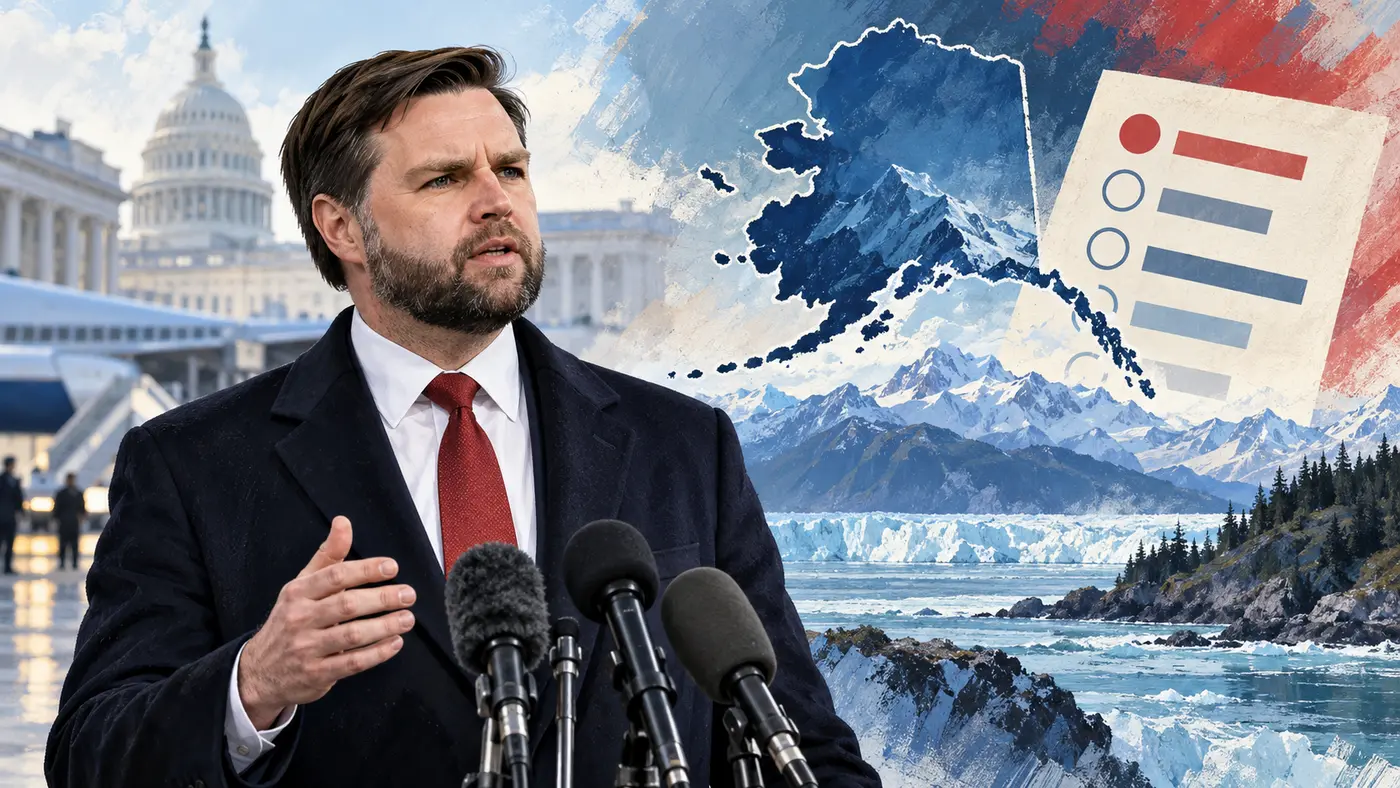
AI-assisted editorial illustration of JD Vance discussing the Alaska ballot lawsuit beside an Alaska map and abstract ballot
DISCUSSION OPENRead the source brief, then add your evidence and argument.
Vice President JD Vance moved into an unusually consequential election-law dispute Tuesday when he defended the Trump administration's effort to delay certification of Alaska's U.S. Senate race under a specific losing scenario for Republican Sen. Dan Sullivan.
Asked why Alaskans should not view the lawsuit as insulting to their ability to distinguish two similarly named candidates, Vance argued that busy voters can still be confused. He described the placement of Daniel J. Sullivan Jr. on the ballot as an attempt to mislead and called that alleged effort electoral fraud. The exchange, captured in a full press-gaggle transcript, occurred on October 27 before Vance departed for a Michigan campaign stop.
That is the new development. The underlying lawsuit is not new: the Justice Department filed it on October 22. Nor has any court decided that the challenger committed fraud. Vance's intervention matters because it turns a technical dispute over ballot design, federal election law and certification into a direct statement of the vice president's standard for when the federal government may question a state-run election process.
What Vance said—and what remains an allegation
Vance's answer had two parts. First, he acknowledged that many Alaskans would recognize which Sullivan is the incumbent. Second, he argued that some people could nevertheless make a mistake because voters have jobs and busy lives. He then accused Democrats of trying to confuse voters and suggested the press would react differently if Republicans had fielded another candidate named Mary Peltola.
The factual record is more complicated than that partisan framing. Daniel J. Sullivan Jr., a retired teacher from Petersburg, says he entered the race on his own. Republicans have alleged that he is a Democratic plant, but independent reporting has not established coordination with Peltola or the Democratic Party. The Associated Press explainer notes both the Republican accusation and the challenger's denial.
Alaska election officials initially tried to keep the challenger off the ballot after concluding that his candidacy was intended to create confusion. State courts reversed that decision, and the Alaska Supreme Court allowed his candidacy to proceed. The resulting general-election ballot does not present two identical entries. It identifies the incumbent as “Sullivan, Dan S.” and labels him a registered Republican and incumbent; the other candidate appears as “Sullivan, Daniel J. Jr.” with no party affiliation.
Those distinctions do not prove that no voter could be confused. They do mean that Vance's assertion about an attempt to confuse should be presented as the administration's allegation, not as a judicial finding or an established fact.
AI-assisted conceptual illustration of ballot clarity and voter-confusion claims; it is not an actual Alaska ballot photograph.AI-assisted editorial illustration.
The lawsuit asks for a conditional halt to certification
The federal complaint does not ask a judge to stop voting or immediately remove Daniel J. Sullivan Jr. Instead, it asks for relief only if two conditions occur: the incumbent loses, and adding every vote cast for the other Sullivan to the incumbent's total would change the ranked-choice result.
Under that scenario, the government wants Alaska barred from certifying the result while officials investigate whether votes for Daniel J. Sullivan Jr. were meant for Sen. Sullivan. The complaint relies on the National Voter Registration Act's statement that one purpose of the law is to protect the integrity of the electoral process.
The Justice Department's theory has an intuitive political appeal: a ballot should not reward a candidacy designed solely to trick voters. Its legal leap is that a federal voter-registration statute can support intervention after voting, during a state's count and certification. The complaint cites earlier cases recognizing a state's interest in avoiding frivolous candidacies and voter confusion, then extends that interest into the post-election certification stage.
No judge has accepted that extension. The administration also has not explained a reliable way to reconstruct individual voter intent without compromising ballot secrecy. That uncertainty is central, because the proposed remedy assumes officials could distinguish a mistaken vote from a deliberate one after the fact.
Alaska now argues that Washington has gone too far
The State of Alaska—run by Republican officials—has asked the federal court to dismiss the case. Its response says the suit has no legal basis because the NVRA governs voter registration, not candidate listings, vote counting or certification. It also argues that delaying certification only when one particular candidate loses would interfere with state election administration.
According to Alaska Public Media's October 27 report, the state points to three safeguards: the candidates are listed differently, the incumbent is clearly labeled, and ranked-choice voting lets a voter rank both Sullivans ahead of other candidates if still uncertain. The state further argues that an investigation into private voter intent would collide with the secret ballot.
That response creates an important counterweight to easy partisan storytelling. The same state that once sought to exclude Daniel J. Sullivan Jr. now says the federal government's conditional certification challenge exceeds the law. Alaska is not endorsing the challenger's motives; it is defending the validity of the ballot and its own authority to administer the election.
AI-assisted conceptual illustration of the federal-state legal conflict over election certification, not a photographed court proceeding.AI-assisted editorial illustration.
Why Vance's defense raises the stakes
Vance did not merely repeat the complaint's narrow legal theory. By using the phrase electoral fraud, he supplied a moral judgment before a court has tested the allegations. That choice raises the political stakes in at least three ways.
First, it signals that the White House is treating possible confusion as a legitimacy problem, not simply a ballot-design problem. Second, it puts the vice president behind a remedy that would activate only if the Republican incumbent loses under a mathematically defined scenario. Third, it makes Vance a public advocate for federal intervention in a process Alaska says it can complete lawfully.
Supporters of the administration can reasonably argue that officials should not ignore evidence of a candidacy created in bad faith. Alaska's election director did reach that conclusion during the earlier eligibility dispute. But the subsequent court rulings and revised ballot presentation changed the operative facts. The question now is not whether the original candidacy looked suspicious; it is whether suspicion authorizes a federal court to stop certification after voters have cast secret ballots.
Critics see a dangerous asymmetry: certification is challenged only if the favored candidate loses. CBS News reported that Republican Sen. Lisa Murkowski said the Justice Department should never have filed the case and that Alaskans can distinguish the candidates. The incumbent's campaign, meanwhile, has said it will let the complaint proceed while maintaining that voters can tell the difference.
A campaign argument with consequences beyond Alaska
Vance has spent the closing weeks of the midterms campaigning across competitive states, a pattern examined in our analysis of his national roadshow. His October 27 Michigan appearance also tested how he balances party loyalty with a candidate's claimed independence, as our Howell report detailed.
The Alaska dispute adds a different test. Campaign surrogates routinely accuse opponents of tricks; vice presidents also speak for an administration that controls the Justice Department. When Vance uses the language of fraud while litigation is pending, his words can shape how supporters view the legitimacy of a result before votes are counted.
The timeline therefore matters. The complaint was filed October 22. Vance defended its premise October 27. Election Day is November 3. The federal judge has placed the case on an expedited schedule, but the exact outcome and timing remain uncertain. Nothing in the public record establishes that the challenged candidate coordinated with Democrats, that actual voters have been confused, or that the incumbent will lose.
The clearest verified conclusion is narrower: JD Vance has publicly adopted the administration's ballot-confusion argument, while Alaska's own Republican-led election system says the federal remedy is legally unsupported. That conflict—between a federal claim of election integrity and a state's defense of certification—is now the story to watch.
*Vance Force is an independent fan community. It is not affiliated with, endorsed by, or operated by JD Vance, the White House, any campaign, or any political party. This article separates verified reporting from analysis and links readers to the underlying record.*