Conflicting Reports Reveal the Real Stakes of JD Vance’s 2028 Decision
Two new insider accounts point in opposite directions on a JD Vance presidential bid. The evidence shows a viable but genuinely unsettled 2028 decision.
By Vance Force Editorial Desk
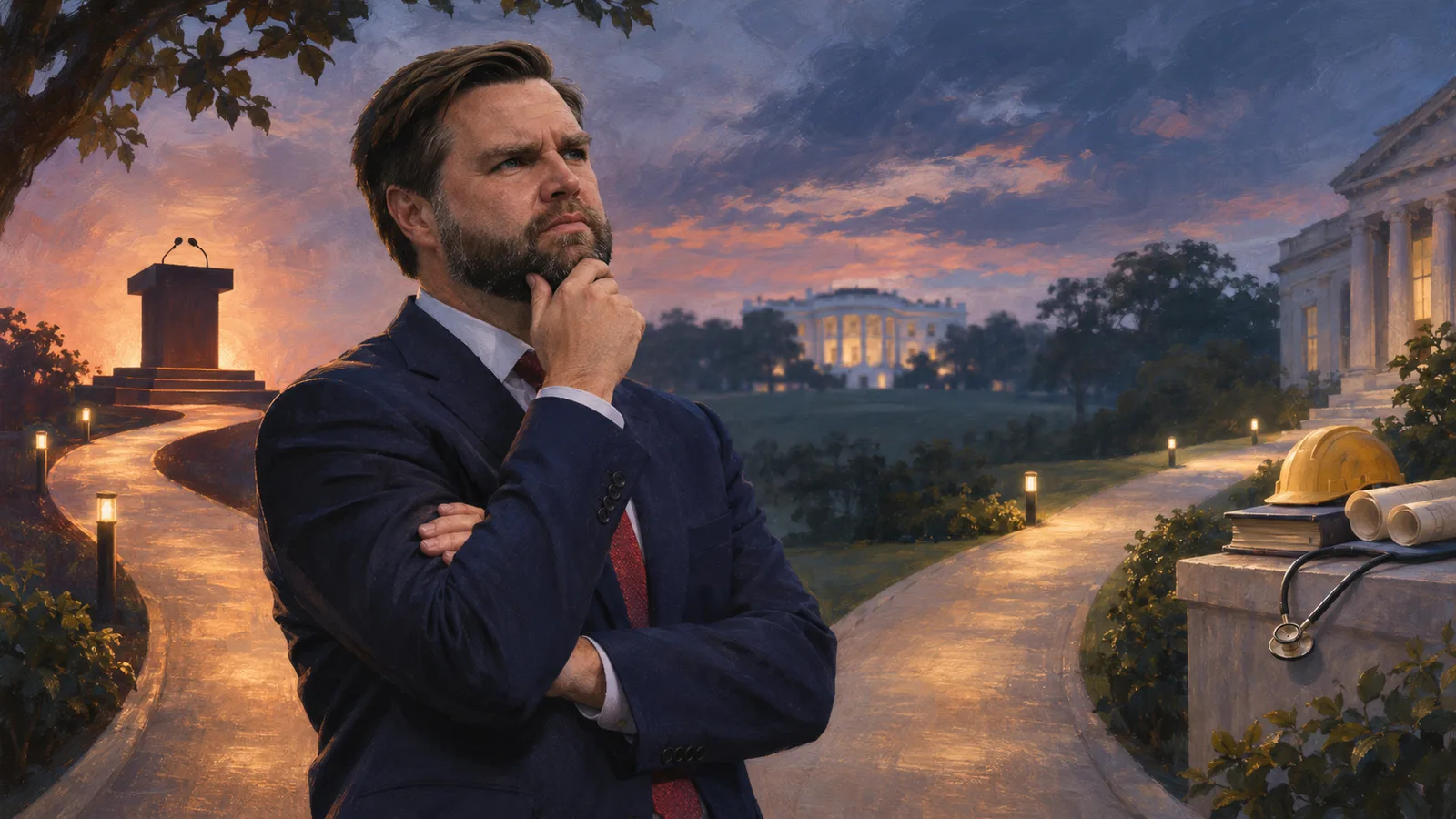
AI-assisted editorial illustration of JD Vance considering a 2028 decision at a fork between an empty podium and a public-service path near the White House.
DISCUSSION OPENRead the source brief, then add your evidence and argument.
Two major reports published Friday present sharply different pictures of JD Vance’s thinking about 2028. The Washington Post says allies still consider him more likely than not to run. CNN reports that he has seriously considered sitting the race out after the Republican midterm defeat. Those accounts cannot both be treated as a final verdict—and that is the point.
The most responsible conclusion is not that one newsroom has discovered the “real” answer. It is that Vance has not made a settled public decision, while people around him are interpreting a genuinely fluid situation. For supporters, rivals and voters, the uncertainty matters because it reveals the questions a potential campaign would have to answer before any launch speech.
This analysis separates what is verified from what remains inference. It also follows our previous poll analysis, which found that early Republican interest in Vance is substantial but not decisive.
What Friday’s reports actually establish
The Washington Post reported on November 13 that several close allies believe Vance remains more likely than not to seek the presidency. Its account says he intends to use the holidays to weigh the decision and that the November 3 losses did not fundamentally change the view of allies who think he could win a Republican primary.
A CNN report published the same day described a more hesitant private discussion. According to people close to Vance, he has seriously considered not running, with the Iran war, the condition of the Republican coalition and the demands on his young family all part of the calculation. CNN also reported that some allies still think he is more likely than not to run.
That overlap is important. Both stories describe deliberation, not a declaration. Both rely heavily on unnamed people with access to Vance’s orbit. Both acknowledge arguments for running and reasons to wait. Their headlines pull in opposite directions, but the underlying reporting leaves room for the same central fact: the decision is open.
Anonymous sourcing is often necessary for reporting on private political deliberations. It can illuminate conversations that would otherwise remain hidden. But it does not turn a forecast into an official decision, and readers should not treat “allies believe” as interchangeable with “Vance has decided.”
AI-assisted conceptual illustration of competing campaign forecasts; it does not depict an actual strategy meeting.AI-assisted editorial illustration.
The public evidence points to opportunity—and risk
There is real evidence that a Vance candidacy would begin from a position of strength. A Reuters/Ipsos poll released November 12 found that 43 percent of Republican registered voters rated Vance an excellent potential candidate, statistically close to Marco Rubio at 45 percent given the poll’s five-point margin of error for party voters. Vance also benefits from near-universal name recognition among Republicans.
But that poll is not a primary ballot, and the nomination contests are more than a year away. Reuters explicitly noted that none of the leading figures has launched a campaign and that new contenders can emerge. The result supports the claim that Vance is viable; it does not prove that he is inevitable.
The political environment is equally unsettled. Vance publicly blamed the Iran war for the Republican midterm losses, while President Donald Trump then directed him away from Iran negotiations and toward domestic fraud and corruption. Axios reported on November 12 that the shift came as Vance had been a skeptical voice inside the administration about the war. That assignment may give him a domestic policy platform, but it also ties his record to an enforcement project whose claims and results will be scrutinized.
Still, a policy portfolio is not automatically a political advantage. To help a future campaign, the effort would need measurable recoveries, defensible prosecutions, due-process safeguards and a clear distinction between verified fraud and partisan accusation. Our report on the domestic fraud assignment explains why the evidentiary standard will matter.
Vance’s decision is about timing, not only ambition
The simplest interpretation of the conflicting reports is that Vance is testing whether 2028 is his best opportunity or merely his earliest opportunity. At 42, he has time that many prospective candidates do not. Waiting could separate him from an unpopular administration and allow a different record to develop. Running could capitalize on his current office, donor network and national visibility before another Republican consolidates support.
Neither option is obviously safe. Sitting out would surrender the advantages of incumbency-adjacent attention and could disappoint supporters who already see him as the movement’s successor. Running would force him to defend the administration’s record while also explaining where his own judgments differed—especially on Iran—without appearing opportunistic or disloyal.
Family considerations also deserve to be treated as more than decorative biography. Both Friday reports describe the pressures of raising four children under Secret Service protection as part of the discussion. Outsiders cannot measure the weight Vance and his wife assign to that cost. It is therefore inappropriate to predict his choice solely from polls, donor meetings or the ambitions of potential rivals.
AI-assisted conceptual illustration of the public, family and timing pressures surrounding a future political decision.AI-assisted editorial illustration.
What would count as stronger evidence
Several developments would be more informative than another round of anonymous forecasting.
A public timetable
Vance could say when he expects to decide, even if he does not reveal the decision itself. The Post reports that he plans to reflect during the holidays. Confirmation from Vance would turn an insider account into an attributable benchmark.
Campaign infrastructure
Formal exploratory activity, new federal filings, a dedicated campaign organization or senior staffing moves would demonstrate commitment. Donor interest alone is weaker evidence because political networks routinely preserve options for more than one candidate.
A durable policy distinction
Vance’s criticism of the Iran war may be a genuine policy judgment, an electoral diagnosis, or both. The distinction will become clearer if he consistently explains what he would have done differently and how his approach fits his service as vice president. One post-election critique is meaningful, but a presidential case requires a coherent governing argument.
Results from the domestic portfolio
The fraud task force could become evidence of executive competence if it produces transparent, legally sustainable outcomes. If it instead produces broad accusations without audited savings or successful cases, the assignment could become a liability. Supporters should demand the same scorekeeping they would expect from any major federal initiative.
The honest reading: viable, undecided and exposed
The available evidence supports three conclusions at once. Vance is a serious potential candidate. He has not publicly committed to running. And the political conditions surrounding a bid are more dangerous than they appeared before the midterms.
The Washington Post’s account is evidence against declaring his prospects dead. CNN’s account is evidence against treating his candidacy as automatic. The Reuters/Ipsos poll shows a competitive starting position, not a nomination. His new domestic assignment offers a chance to demonstrate results, but also creates a record that voters and a Democratic Congress can examine.
For a fan community, optimism does not require false certainty. The strongest case for Vance will be built from attributable decisions, measurable work and a candid explanation of his governing philosophy—not from choosing the most encouraging anonymous quote. Until he speaks, “viable but undecided” is not evasive. It is the conclusion the evidence supports.
*Disclosure: Vance Force is an independent fan community. This article was produced as evidence-based editorial analysis, is not affiliated with JD Vance, his office or any campaign, and distinguishes reported facts from interpretation.*