Donald Trump and JD Vance: How the 2026 Agenda Is Being Put Before Voters
Donald Trump remains the administration’s central political force, while JD Vance increasingly translates its agenda for workers, families, and the Republican coalition.
By Vance Force Editorial Desk
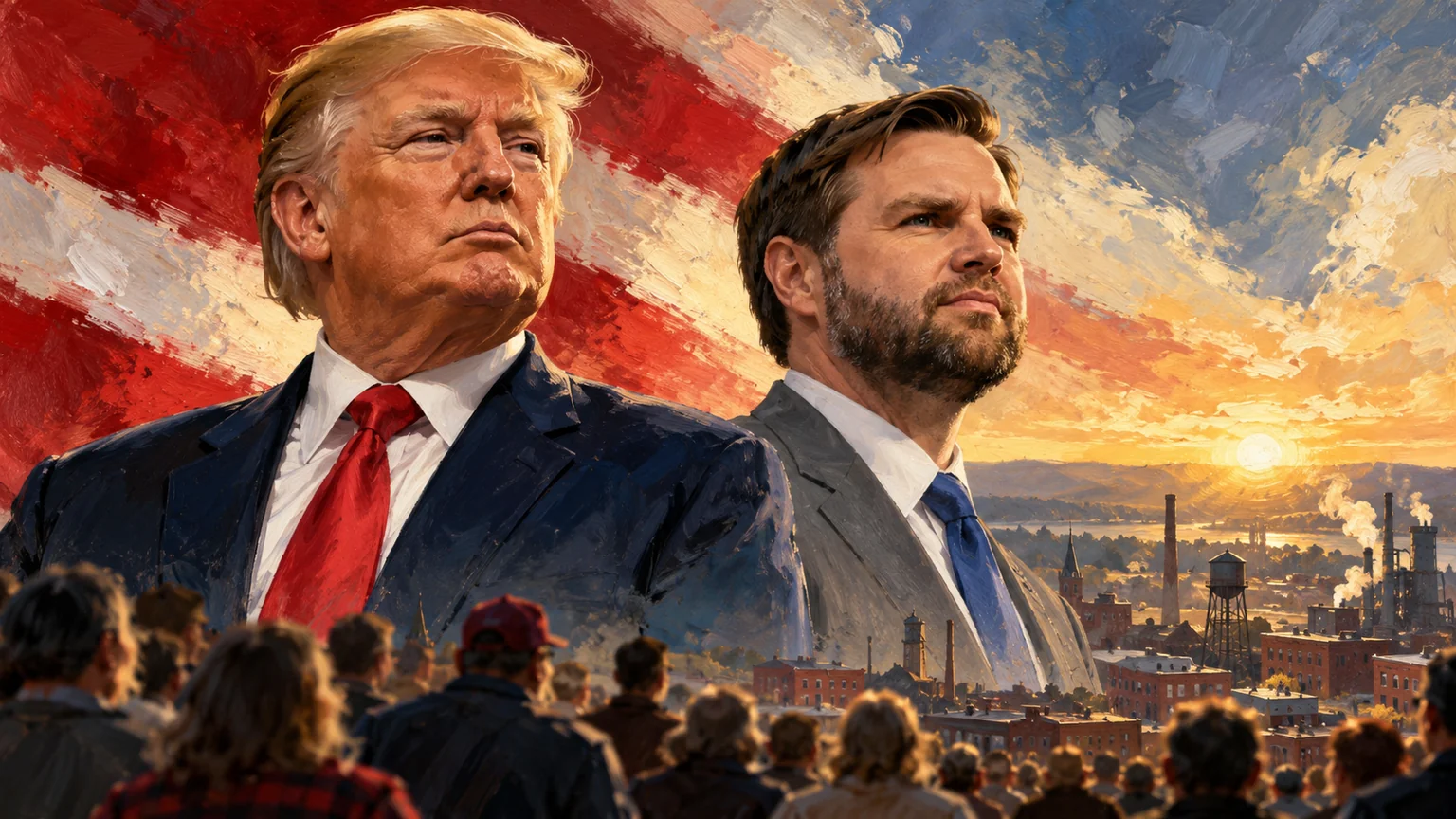
AI-assisted editorial illustration of Donald Trump and JD Vance above a symbolic audience and industrial landscape. · AI-assisted editorial illustration, not a documentary photograph.
DISCUSSION OPENRead the source brief, then add your evidence and argument.
Editor’s note: Vance Force is independent of Donald Trump, JD Vance, the White House, campaigns, and political committees. This analysis uses official material to identify the administration’s claims and independent reporting to describe the political setting.
One administration, two different communication roles
Donald Trump and JD Vance enter the final stage of the 2026 midterm campaign with a shared record but different political functions. Trump is the president, the dominant Republican brand, and the figure around whom approval or dissatisfaction is most likely to organize. Vance is the vice president and a leading messenger who can translate the administration’s program into a story about work, family, place, and the future of the Republican coalition.
That distinction matters for understanding Donald Trump and JD Vance as a political partnership. Vance is not running a separate administration, and he should not be covered as though every public appearance announces a personal 2028 platform. At the same time, his choice of subjects and the arguments he is assigned to make reveal how the administration wants its governing record explained beyond Trump’s own speeches.
The midterm convention makes the hierarchy visible
Reuters reported on September 2 that Trump planned to speak on both nights of the Republican midterm convention in Dallas on September 9 and 10. The report said Vance would speak before Trump on the second night. The schedule puts Trump at the center while also giving Vance a prominent place in the party’s closing argument.
The convention is not merely a television event. It is a test of whether the administration can connect national policy to the decisions voters make in hundreds of House, Senate, state, and local contests. A president can dominate attention, but congressional candidates must still persuade voters that the record answers local concerns. Vance’s usefulness as a messenger depends on whether he can make that connection with specifics rather than slogans.
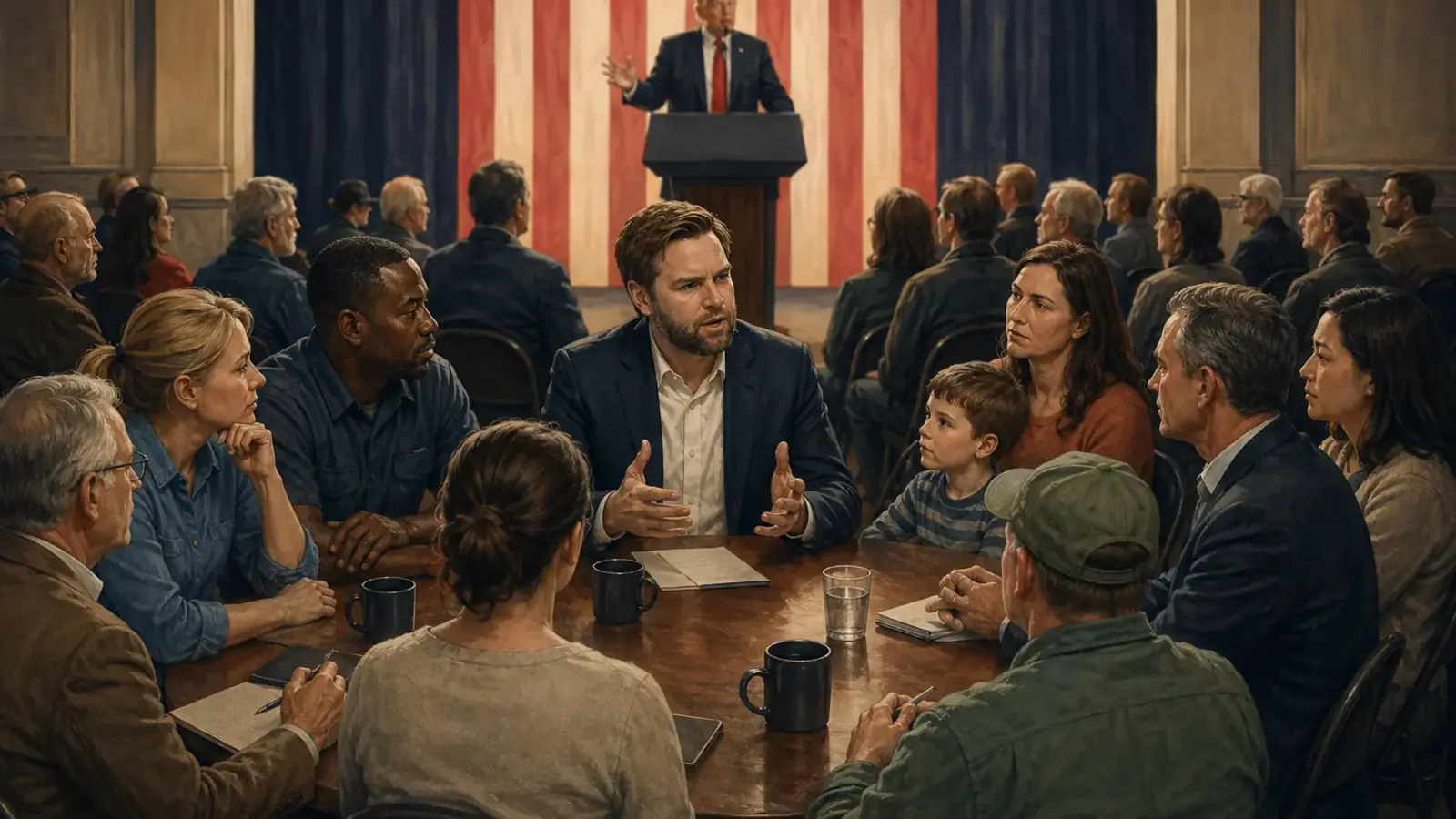
National political messages become meaningful only when voters can compare them with work, family, and community outcomes.AI-assisted editorial illustration.
Readers can compare this national partnership with the separate 2026 midterm election analysis, which focuses on the House, Senate, turnout, and local-candidate tests rather than the personalities alone.
Manufacturing shows how the shared message works
The White House’s August 31 Michigan release is an example. It paired Trump’s administration-wide economic agenda with Vance’s appearance in a state where manufacturing identity carries unusual political weight. The release listed corporate investments and tax provisions and described them as evidence of a manufacturing comeback.
An independent publication should neither accept nor dismiss that conclusion automatically. Investment announcements can be verified; attribution is harder. Company decisions may reflect demand, technology, labor, state incentives, prior planning, federal tax policy, trade policy, and expectations about future rules. The administration is entitled to make its case, while journalists and citizens should test how much of the outcome is new, completed, and causally linked to the policy being promoted.
Vance’s political task is especially important here. If he wants manufacturing to serve as more than a campaign symbol, the public argument must include timelines, permanent job counts, wages, supply-chain effects, and the costs imposed by any trade or tax choice. A credible working-class politics should be willing to show its work.
Trump supplies intensity; Vance can supply continuity
Trump’s style is built around conflict, personal mandate, and immediate political contrast. It can mobilize loyal voters and ensure that an issue breaks through. It can also make every congressional race a referendum on the president, even when candidates would prefer to emphasize local differences.
Vance’s potential contribution is continuity: explaining why a decision fits a longer governing theory and what success should look like after the rally ends. This does not require distance from Trump. It requires a different form of advocacy—one that connects presidential choices to institutions, legislation, implementation, and measurable community outcomes.
The partnership works best when the roles reinforce rather than imitate each other. Trump defines the administration’s direction and commands attention. Vance can give supporters a framework for understanding the direction, defending it accurately, and identifying where implementation falls short.
What voters should separate
The administration’s verified action: a signed law, issued rule, completed agreement, or funded project.
The administration’s interpretation: its claim about why an outcome happened and who deserves credit.
A campaign promise: a future action that remains contingent on Congress, agencies, courts, budgets, or elections.
A political forecast: an analyst’s judgment about how the record may affect turnout or persuasion.
These categories are often blended in political communication. Keeping them separate is not hostility to the administration; it is how a serious fan community protects its credibility.
The local proof points matter more than the stagecraft
A national speech can set priorities, but the most persuasive evidence will often be local. Did a promised project reach construction and production? Did training programs place residents in permanent jobs? Did a tax change alter a household’s actual liability? Did a regulatory change lower a bottleneck without shifting a larger cost elsewhere? These questions give members a way to investigate the governing agenda without pretending that enthusiasm is the same as evaluation.
The same rule applies to political travel. A visit can show where leaders believe a message is important, but it cannot by itself prove persuasion. Useful follow-up includes local press coverage, candidate statements before and after the event, verified attendance context, district-specific issues, and later turnout. That record allows a fan community to celebrate effective advocacy while remaining honest about what is not yet known.
What could weaken the partnership
The communication division can fail in two directions. Vance could merely repeat Trump without adding policy clarity, leaving the vice president’s public role indistinct. Or commentators could exaggerate ordinary differences in tone into a rivalry unsupported by governing actions. Both distortions produce attention but little understanding.
A stronger test is institutional. Does Vance accurately explain decisions made by the administration? Does he connect those decisions to implementation and acknowledge constraints? Can the partnership keep a consistent direction while allowing Republican candidates to address the realities of their own states and districts? Those measures reveal more than speculation about private motives or a future campaign.
How Vance Force will cover Trump without losing its identity
Donald Trump is essential to stories about the administration, the Republican coalition, and Vance’s office. He is not a substitute for a Vance-centered editorial mission. Coverage should therefore answer a simple question: what does this Trump development help readers understand about JD Vance’s responsibilities, arguments, record, or political environment?
That standard keeps Vance Force an independent brand rather than a generic political-news label. It also explains why MAGA belongs only in articles where the term is substantively connected to Vance, Trump, or a documented movement debate—not in the site’s logo, main heading, or every unrelated page.
The Republican coalition question
The 2026 campaign also tests whether the Trump-era Republican coalition can operate when Trump is not on the ballot. The administration’s answer appears to be active presidential involvement combined with messengers such as Vance who can link the agenda to younger conservatives, industrial communities, veterans, parents, and voters who do not begin with party identity.
Success cannot be judged only by crowd size or online engagement. It will be judged by turnout, candidate performance across different districts, and whether voters see a governing record that addresses prices, security, work, and institutional trust. Those outcomes will shape the Republican debate after 2026 and the environment surrounding 2028, but they do not settle a future nomination.
For Vance Force, the editorial rule should remain simple: Donald Trump belongs in coverage when the story materially explains JD Vance’s office, record, coalition, or future. Trump can generate attention, but Vance must remain the subject that gives the publication its reason to exist.