Trump’s New Iran Restraint Signal Echoes JD Vance—Without Restoring His Role
Trump is reportedly considering holding off on new Iran strikes absent provocation. The shift validates JD Vance’s warning but does not restore his negotiating role.
By Vance Force Editorial Desk
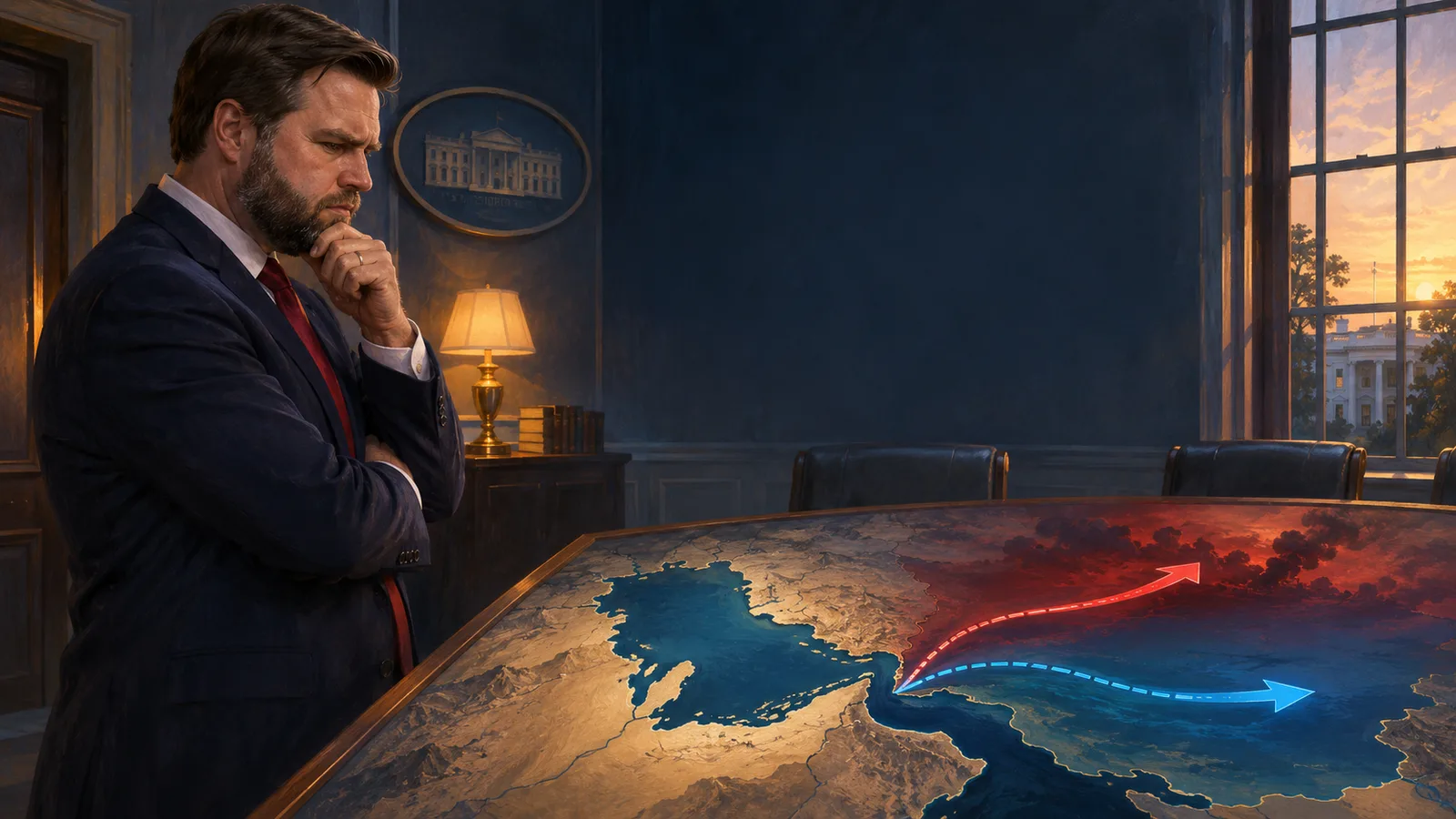
AI-assisted editorial illustration of JD Vance weighing Iran restraint and escalation paths across a Persian Gulf strategy map.
DISCUSSION OPENRead the source brief, then add your evidence and argument.
President Donald Trump is considering holding off on new attacks against Iran unless Tehran or the Iran-backed Houthis create a new provocation, according to a Reuters report published Saturday morning. The development does not amount to a ceasefire, a diplomatic settlement or even a final presidential decision. It does, however, move the immediate policy debate toward the restraint Vice President JD Vance has argued for—even after Trump publicly removed Vance from the Iran portfolio two days earlier.
That contrast is the important news. Vance’s formal role appears diminished, while the administration’s near-term posture is moving closer to the caution he advocated. There is no evidence that Vance caused Trump’s latest thinking or that his negotiating authority has been restored. A third aircraft carrier is still moving toward the region, Israel is pressing for renewed strikes, and Trump has preserved the option of attacking again. The most defensible reading is narrower: Vance’s warning about the war’s costs is gaining practical relevance, even as the president keeps ownership of the final choice.
What changed on November 14
Reuters reported on November 14 that Trump told senior advisers in recent days he may refrain from further attacks if the United States faces no new provocations. Saudi Crown Prince Mohammed bin Salman and Turkish President Recep Tayyip Erdogan separately urged him not to resume full-scale strikes, according to the report. U.S. intelligence assessments cited by Reuters also concluded that sanctions and the naval blockade are hurting Iran’s economy and that renewed strikes would be unlikely to change Tehran’s negotiating demands significantly.
Those are reported assessments, not a public directive. Reuters also said Trump has not settled how to end the conflict. The White House emphasized that he alone will decide what happens, while the CIA and Office of the Director of National Intelligence did not comment. Readers should therefore distinguish a deliberative signal from an announced policy.
The date matters. The Reuters story was published Saturday, November 14, and describes comments made over recent days. It follows Trump’s Thursday, November 12, instruction that Vance turn his attention away from Iran and toward a domestic anti-fraud campaign. The new restraint signal is not a reversal of that reassignment. It is a separate development in the president’s own decision-making.
Why the shift matters for JD Vance
The Associated Press reported on November 12 that Vance had served as the lead negotiator for a short-lived truce and had blamed the war and its economic consequences for the Republican midterm defeat. Trump then directed him to focus on domestic corruption and crime, saying the United States did not need an Iran deal. AP also noted that Trump remained willing to restart strikes if he judged them necessary.
That sequence creates an unusual distinction between personnel and policy. The president rejected Vance’s immediate diplomatic role, but the reported decision now under consideration—do not strike absent new provocation—resembles the vice president’s preference for limiting further military escalation. Axios had reported on November 6 that Vance was deeply involved in indirect talks and had been the most skeptical voice in Trump’s circle before the war began.
Resemblance is not authorship. Trump also heard directly from Saudi and Turkish leaders, received intelligence briefings, reviewed military readiness and faced domestic political pressure after the November 3 elections. Any claim that Vance “won” the internal debate would go beyond the evidence. What can be said is that the policy trade-offs he highlighted—military effectiveness, fuel prices, voter tolerance and the need for an exit—are now visible in the president’s calculations.
AI-assisted conceptual illustration of guarded shipping and a conditional pause in escalation; it does not depict an actual operation.AI-assisted editorial illustration.
Restraint is not the same as peace
The military evidence cuts against premature celebration. Reuters reported that a third U.S. carrier is heading to the Middle East and that all three could remain if required. American planners retain options against underground nuclear facilities. Israeli officials continue to advocate another campaign. Trump’s condition—no new provocation—also leaves a wide field for escalation because Iranian or Houthi attacks on U.S. forces, allies or shipping could quickly change his judgment.
Conditions at sea remain dangerous. AP reported that commercial oil shipments had recovered toward prewar levels, but tankers were relying on U.S. Navy escorts and recent projectile attacks had struck vessels near Iran. The report said the White House did not confirm an Iranian claim that Washington had asked Russia to facilitate talks. That unresolved claim is a reminder that diplomatic signaling in this conflict is often partial, contested and strategically motivated.
The strongest case for restraint is therefore not that the crisis has disappeared. It is that another round of strikes may add risk without changing Iran’s negotiating position. That reported intelligence judgment deserves scrutiny, as does the opposing argument that visible military power deters new attacks. A pause backed by defensive readiness could reduce immediate danger; it could also fail if adversaries interpret it as an opportunity. Neither outcome is guaranteed.
Our November 12 report on Vance’s reassignment explained why losing the Iran portfolio was politically significant. The new development does not restore that portfolio. Instead, it tests whether Vance can influence the administration’s strategic language from outside the lead negotiating seat.
The economic facts behind Vance’s warning
Vance’s argument has never been only about diplomatic process. It is also about the cost of prolonged conflict. The U.S. Energy Information Administration reported on November 3 that global refinery inputs fell by 4.8 million barrels per day in the second quarter of 2026 after the conflict began, then recovered only partly in the third quarter. EIA said refining activity remained about five percent below the same period of 2025 despite improved flows and alternative routing.
EIA’s August outlook estimated that oil and petroleum liquids moving through the Strait of Hormuz fell from 21.6 million barrels per day in the fourth quarter of 2025 to 4.9 million in the second quarter of 2026. The agency cautioned that ship-tracking signals have become especially unreliable since the conflict began, so the figures are revised as new evidence arrives. That caveat matters, but it does not erase the scale of the disruption.
Reuters reported that 55 percent of Americans in a pre-election poll said the war was not worth the cost. Vance used the election result to argue that the conflict hurt Republicans. Polling cannot prove that one issue decided every race, and voters had other concerns. Still, the connection between maritime disruption, higher fuel costs and domestic political pressure is supported by more than campaign rhetoric.
Our earlier analysis of Vance’s Iran criticism examined the tension between supporting the administration’s security objective and questioning the war’s political and economic cost. Saturday’s report makes that tension more immediate: the White House may preserve coercive leverage while postponing the next strike.
AI-assisted conceptual illustration of how Gulf energy disruption can reach household budgets; it is not a photograph of a real family.AI-assisted editorial illustration.
What to watch next
Three developments would show whether this is a durable turn or a temporary pause.
A public operational standard
Trump has reportedly tied restraint to the absence of new provocation. The administration has not publicly defined what conduct would cross that threshold. A clear standard—especially for attacks by Iran-aligned groups—would reduce the risk that allies and adversaries misread U.S. intentions.
A diplomatic channel with accountable terms
Holding fire can create space for talks, but Reuters said Trump believes the United States may not need a deal. If negotiations resume, the public should look for attributable officials, specific objectives and verifiable commitments rather than anonymous optimism. Vance’s future role would also need confirmation from the White House or the vice president’s office.
Results rather than symbolism
The administration argues that sanctions and the blockade are creating leverage. The relevant test is whether that pressure produces safer shipping, fewer attacks and an enforceable nuclear or security arrangement. More carriers demonstrate capacity; they do not by themselves establish a political end state.
A cautious vindication, not a comeback
For JD Vance, the November 14 development is best understood as a cautious vindication of his diagnosis, not a restoration of his authority. The president is reportedly weighing the same central warning Vance raised: another attack could be costly, politically unpopular and strategically inconclusive. But Trump reached this point through many inputs, and he retains both the military options and the decision.
Supporters can reasonably welcome a move away from automatic escalation while demanding evidence about what comes next. Critics can reasonably note that a conditional pause leaves the underlying war, blockade and maritime danger unresolved. Both views fit the known facts.
Morning news often arrives as a sharp headline. The more accurate conclusion here is deliberately limited: the immediate probability of renewed U.S. strikes may have fallen, Vance’s restraint argument looks more relevant, and his formal Iran role remains curtailed. Anything stronger would confuse a reported deliberation with a settled peace.
*Disclosure: Vance Force is an independent fan community. This evidence-based editorial is not affiliated with JD Vance, his office, the White House or any campaign. It separates verified reporting from analysis and labels uncertainty where the public record remains incomplete.*