Trump Backs JD Vance’s Iran Framing. The Strategy Test Remains.
President Trump defended JD Vance’s description of the Iran conflict, shifting the public test from terminology to objectives, costs, limits, and results.
By Vance Force Editorial Desk
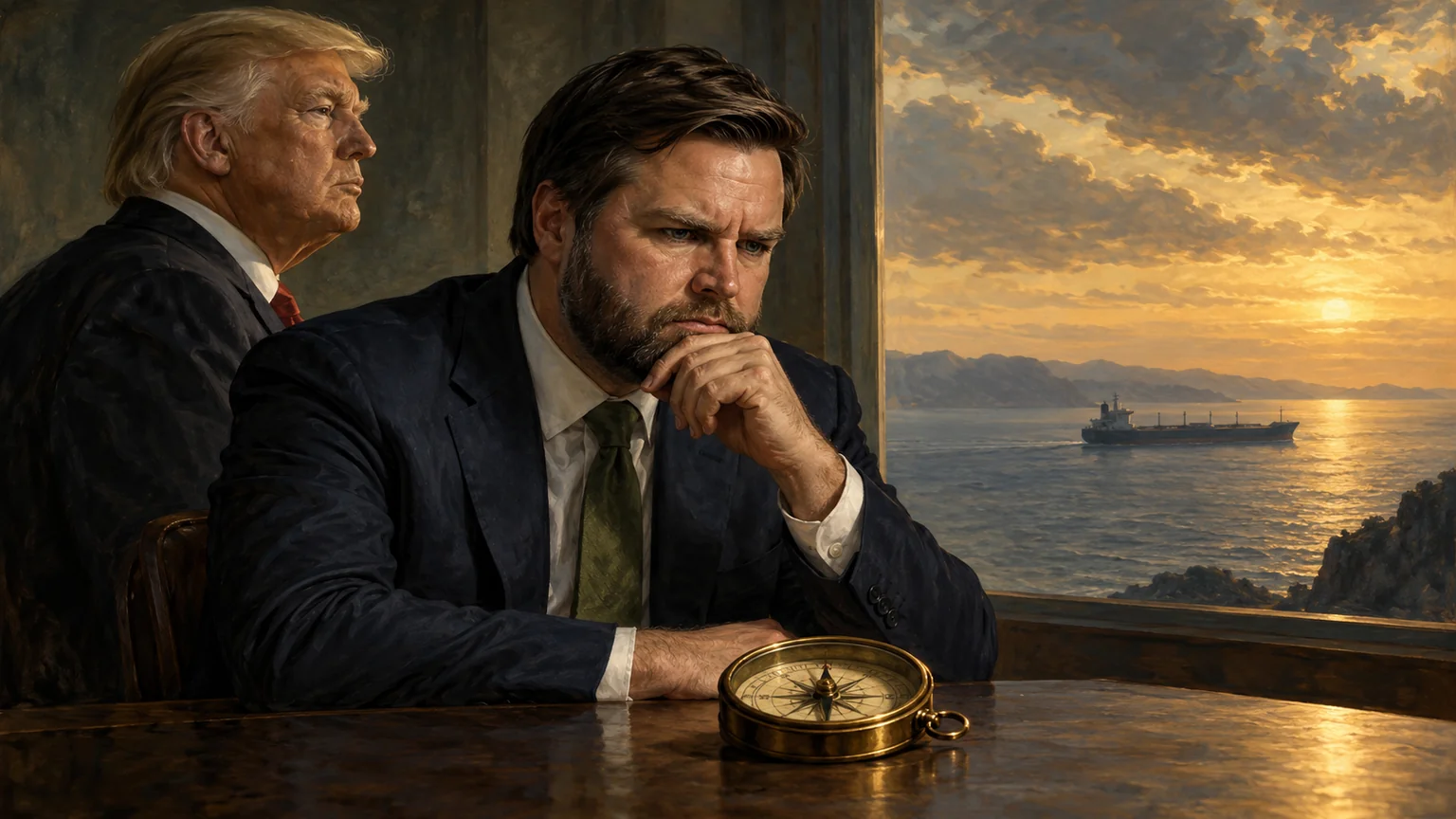
AI-assisted editorial illustration of JD Vance and Donald Trump with a compass and distant ship, symbolizing foreign-policy strategy. · AI-assisted editorial illustration, not a documentary photograph.
DISCUSSION OPENRead the source brief, then add your evidence and argument.
Editor’s note: This is independent Vance Force reporting and analysis, not a statement from JD Vance, the White House, a campaign, or a political committee. Descriptions of administration positions are attributed to the relevant sources. The analysis below distinguishes verified events from judgments about strategy.
Trump has now defended Vance’s choice of words
President Donald Trump on September 4 defended Vice President JD Vance after Vance argued that the months-long U.S.–Iran confrontation should not be described as a war. The Associated Press reported that Trump characterized the conflict as limited when compared with major American wars and pointed to the absence of U.S. ground forces. The same report noted continuing air operations, Iranian retaliation, American deaths, and substantial public costs.
That exchange makes the terminology politically important, but the label alone cannot resolve the harder issue. A public strategy should be judged by its legal basis, objectives, limits, costs, risks to service members and civilians, diplomatic path, and measurable end state. Whether officials use “war,” “conflict,” “operation,” or another term, citizens still need to know what the United States is trying to achieve and how leaders will recognize success.
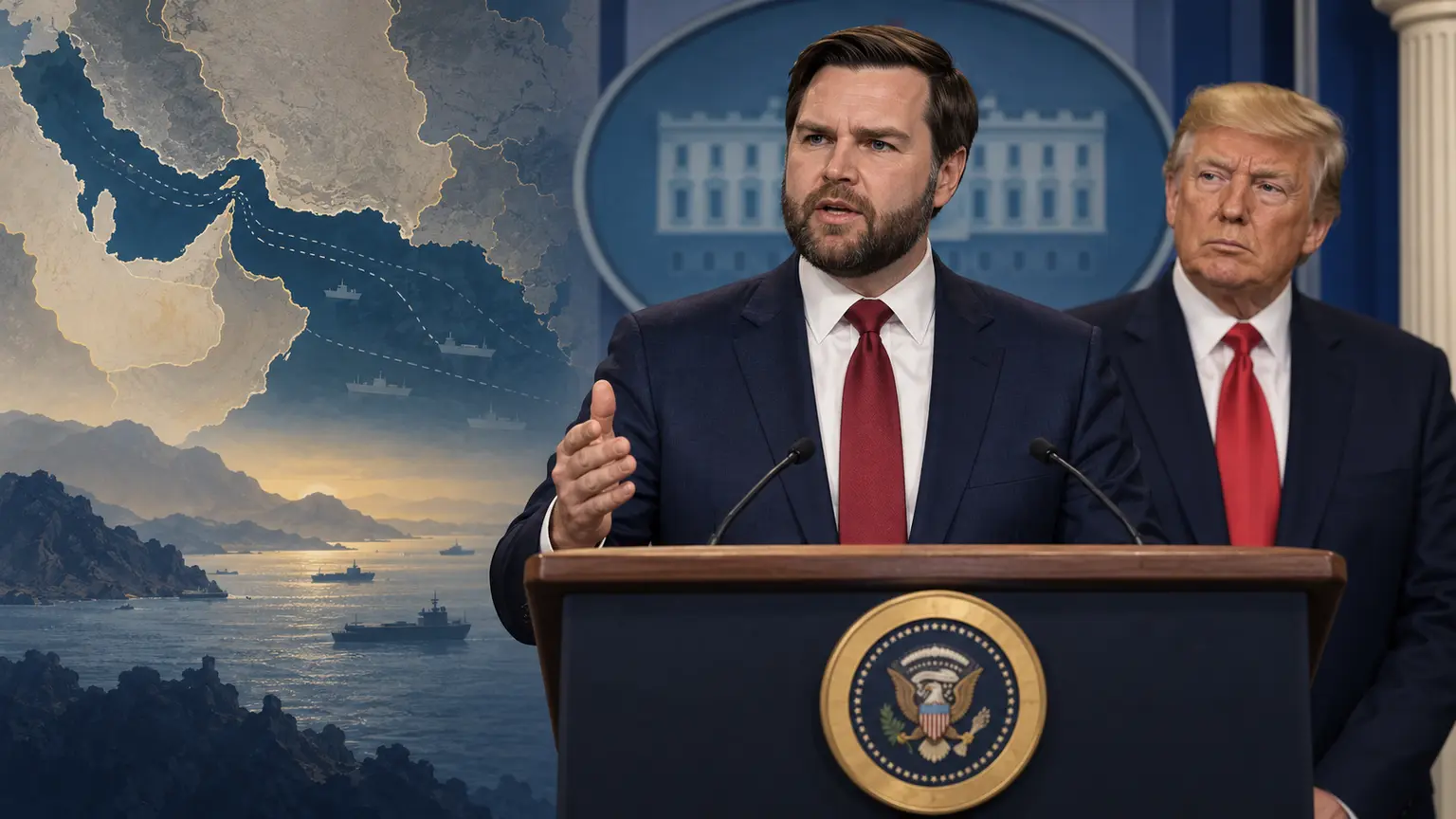
The public debate now turns from terminology to the objectives, costs, and limits of the Iran strategy.AI-assisted editorial illustration.
The official White House video record confirms that Vance briefed reporters on September 3. A searchable Roll Call Factbase transcript preserves the questions and answers from that appearance, including discussion of Iran. These are useful primary-record sources for what was said. They do not, by themselves, prove that the policy is succeeding.
AP’s follow-up adds the president’s response and independent reporting about the wider conflict. Taken together, the sources establish three separate facts: Vance publicly offered a narrower description of the military situation; Trump defended that description; and military activity and retaliation remain part of the factual background. Each fact can be verified without requiring readers to accept either the administration’s strategic conclusion or its critics’ preferred label.
Why the vocabulary dispute matters
Words shape expectations. Calling an operation a war can signal duration, mobilization, legal authorities, and public sacrifice. Avoiding the word can signal that leaders believe the mission is bounded and does not resemble a large ground campaign. Officials therefore have legitimate reasons to be precise.
But precision requires more than comparison with Vietnam or other historic wars. Modern conflicts can involve airpower, naval pressure, cyber operations, sanctions, partner forces, and intermittent exchanges. A smaller scale does not make the consequences unreal. Conversely, the existence of casualties or strikes does not automatically establish that the United States has adopted an unlimited objective. The most responsible coverage should explain both propositions rather than using one as a substitute for the other.
For Vance, the political stakes are especially clear. He has often been associated with a foreign-policy argument that emphasizes defined American interests, skepticism toward open-ended commitments, and attention to cost. His credibility now depends on showing how the current operation fits those principles in practice. Supporters should be able to identify the limiting rules. Critics should identify the evidence that those limits are failing. Both sides should avoid treating a single word as the entire argument.
Five questions that can test the strategy
First, what is the specific objective? Preventing a nuclear capability, protecting shipping, deterring attacks on U.S. personnel, and changing the Iranian government are different goals. They require different tools and produce different measures of success. If several goals apply, officials should explain their order and how conflicts between them will be managed.
Second, what are the operational limits? The absence of ground troops is one important limit, but it is not the only one. The public also needs to understand the geographic scope, target-selection standards, escalation thresholds, allied roles, and conditions for pausing or ending strikes.
Third, what is the cost? Congress and the public should receive clear information about appropriations, munitions use, force protection, shipping disruption, energy effects, and support for affected allies. Cost is not merely a political talking point. It is part of deciding whether an objective is proportionate and sustainable.
Fourth, what diplomatic path remains open? Military pressure can be intended to improve negotiating leverage, but that claim should be tested by observable movement: contacts, proposed terms, verification mechanisms, and reciprocal steps. If talks are stalled, officials should say what would restart them and what outcome they would accept.
Fifth, what is the end state? A bounded operation needs a stopping rule. “Until the threat is gone” is not sufficiently measurable unless the threat and the evidence used to assess it are defined. Clear benchmarks protect the public from both premature declarations of victory and indefinite extension.
The strongest case for Vance’s framing
The strongest defense is that scale and mission type matter. The United States can conduct limited military operations without mobilizing for a conventional ground war, and leaders should not use the most expansive term if it obscures those distinctions. Trump’s support reinforces the administration’s position that the current mission is controlled rather than open-ended.
That case becomes stronger if the administration publishes stable objectives, shows that operational limits are holding, reports costs consistently, and demonstrates a credible route to de-escalation. In other words, the argument is best supported by evidence of restraint, not simply by repeating the word “limited.”
The strongest challenge
The strongest challenge is that sustained strikes, retaliation, casualties, and large expenditures can create the public obligations normally associated with war even when ground forces are absent. Families of service members, lawmakers, and voters may reasonably ask why the chosen terminology should reduce oversight or urgency. They may also worry that intermittent operations can become an indefinite commitment without a formal moment of decision.
That challenge does not prove that the mission is unlimited. It does show why official language must be paired with transparent reporting. If policy remains bounded, leaders should be able to describe the boundary in terms that can be checked later.
What changed—and what did not
Trump’s defense matters because it removes uncertainty about whether Vance’s wording represented only a personal distinction. It is now part of the administration’s public explanation. What did not change is the underlying burden of proof. The government still needs to explain objectives, authority, costs, safeguards, diplomacy, and completion criteria.
Vance Force will continue to keep quotation, official explanation, independent reporting, and our own analysis separate. The useful next update will not be another argument over a label. It will be evidence that one of the measurable strategy questions has received a clearer answer—or that events have made the current answer harder to sustain.