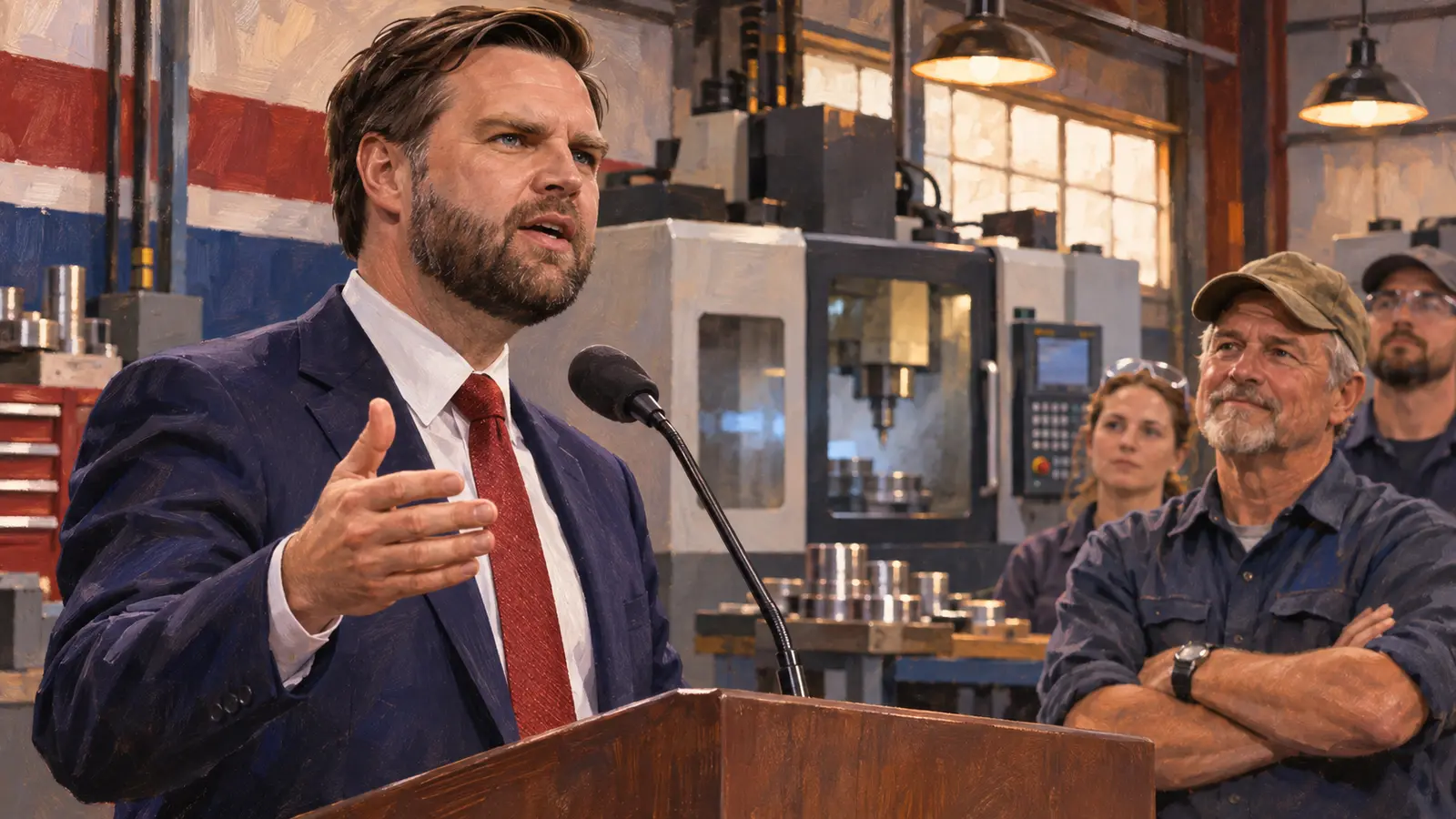
Vice President JD Vance returned to a domestic-policy stage on Monday with a proposition that is easy to applaud and harder to execute: federal agencies should direct a much larger share of contracting dollars toward businesses owned by veterans. The announcement, made as the Small Business Administration opened National Veterans Small Business Week on November 9, links three themes Vance has cultivated for years—military service, economic nationalism and rebuilding the American industrial base.
The headline number is substantial. The SBA says its fiscal 2027 agency goals will double the combined prime-contracting and subcontracting target for veteran-owned and service-disabled veteran-owned small businesses from 5 percent to 10 percent. That could create real openings for firms making components, software, machinery and other goods the federal government buys. But the figure is an administrative target, not a guarantee that a new cohort of veteran entrepreneurs will receive contracts. The test is whether Vance and the administration can turn a percentage on a scorecard into more capable suppliers, wider competition and durable companies.
A Post-Election Pivot to a Concrete Economic Promise
Vance spoke at the Washington kickoff of National Veterans Small Business Week, an event documented by the Defense Visual Information Distribution Service. The official event began on November 9, not merely the day the coverage appeared. The timing mattered: it was his first major public policy appearance after an election week dominated by arguments over the Iran war and Republican losses.
The vice president framed veteran entrepreneurship as both a jobs issue and a national-security asset. That is more concrete than generic praise for service. The SBA's November 9 program announcement paired the contracting target with two additional initiatives: a VetsinTech pilot aimed at drone and dual-use aerospace companies, and more flexible equity rules for veterans using 7(a) loans to acquire businesses. It also reported $1.32 billion in federally backed loans to veteran-owned small businesses in fiscal 2026 and more than 18,000 veteran-business certifications.
Those are meaningful inputs. They are not yet outcomes. A certification can qualify a company to compete; it does not create a purchase order, help a young manufacturer meet a delivery schedule or ensure that a federal buyer divides a large requirement into lots a smaller supplier can handle.
What the 10 Percent Goal Actually Changes
The SBA's detailed contracting release says agencies will receive a 10 percent target for both prime contracting and subcontracting in fiscal 2027. It combines veteran-owned firms with service-disabled veteran-owned small businesses for the agency-level goal.
That wording is important. The government-wide statutory goal is still 5 percent for service-disabled veteran-owned small businesses. A June 2026 Congressional Research Service summary explains that the Small Business Act sets the 5 percent benchmark and that agency goals are negotiated by the SBA. It also describes goal attainment as aspirational: agencies that miss must explain why and propose corrective action, but there is no automatic financial penalty.
In other words, the administration can legitimately push agencies above the statutory floor. It should not present the new target as the same thing as Congress doubling a binding legal requirement. The policy's credibility will depend on procurement behavior—solicitations issued, competitions structured, contracts awarded and suppliers retained—not on the announcement alone.
AI-assisted conceptual illustration of veteran-led manufacturing and dual-use supply-chain work; it does not depict a documented event.AI-assisted editorial illustration.
The Strongest Case for Vance's Approach
The best argument for the initiative is not charity. It is supplier resilience. Small manufacturers and technology firms can give agencies alternatives to a handful of dominant contractors, while veterans may bring experience with military requirements, logistics and operational risk. The SBA says small businesses make up 70 percent of the defense industrial base, and it is targeting drones, microelectronics, shipbuilding components, batteries and other capacity constraints.
The scale of veteran entrepreneurship also deserves careful description. SBA's broad estimate says more than 1.8 million veteran-owned small businesses employ four million people. The Census Bureau, using its Annual Business Survey of firms with paid employees, counted about 273,542 veteran-owned employer businesses for reference year 2022, with 3.2 million employees and $884.5 billion in receipts. Those numbers are not necessarily contradictory: one estimate includes many nonemployer firms, while the Census release cited here covers employer firms. Editors and officials should say which universe they mean.
For Vance, a Marine veteran who has made domestic production part of his political identity, the pitch fits naturally. It also offers a governing answer to the affordability and industrial-policy concerns discussed in our earlier review of his closing midterm message. Federal procurement cannot solve household costs on its own, but it can shape whether public spending develops additional American suppliers or merely circulates among established incumbents.
Where a Bigger Target Can Still Fail
The first danger is concentration. Agencies can meet a dollar goal by awarding a few very large contracts to familiar firms. That may increase the veteran-owned share without broadening the supplier base. The scorecard should therefore publish the number of first-time prime contractors, the number of firms receiving meaningful awards and the share captured by the top recipients.
The second danger is confusing subcontracting with independence. Subcontracts can be valuable entry points, but veteran-owned firms need transparent payment terms, access to technical data and routes to become prime contractors. A 10 percent subcontracting figure means less if small suppliers bear financing risk while large primes keep the durable customer relationship.
The third is integrity. Veteran contracting programs have faced pass-through schemes in which an eligible owner lends status to a company that does not genuinely control or perform the work. Strong certification and enforcement protect legitimate veteran entrepreneurs from competitors gaming the designation. Vance's emphasis on fraud control is therefore compatible with expansion, but overly slow or opaque reviews could also keep qualified entrants outside the market.
A separate warning comes from veteran hiring. The Wall Street Journal reported in September that federal contractors in the S&P 500 hired veterans at 2.4 percent in 2025, below a 5.1 percent government target cited in a RAND analysis. Hiring goals and procurement goals are different programs, so the figures should not be merged. The lesson is narrower: a numerical target without monitoring, incentives and operational follow-through can underperform.
AI-assisted conceptual illustration of the opportunity and paperwork involved in federal contracting; it is not a photograph of an actual office.AI-assisted editorial illustration.
Five Measures That Would Make the Promise Verifiable
The administration should publish a baseline before fiscal 2027 begins. That baseline should separate ordinary veteran-owned firms from service-disabled veteran-owned firms, prime awards from subcontracts, and total dollars from unique vendors. Without those distinctions, a combined 10 percent target can hide where progress actually occurs.
Second, agency scorecards should track new entrants and repeat business. Winning one small order may prove that a firm can navigate the system; receiving a competitively awarded follow-on contract can show that it delivered value.
Third, defense agencies deserve special scrutiny. They control the largest procurement budgets and the most consequential supply-chain requirements. If the policy is genuinely about national security, growth should appear in production capacity, repair, software, components and dual-use technology—not only in professional services that are easier to buy.
Fourth, officials should report competition rates and contract concentration. A veteran-owned award made after robust competition tells a different story from a sole-source action, even when both are lawful. Taxpayers and suppliers should be able to see that distinction.
Finally, the administration should measure delivery: on-time performance, cost, quality and whether financed firms remain in business. The goal should be a stronger industrial base, not a temporary statistical bump.
The Political Meaning Is Real, but Secondary
Vance opened the event with an Ohio State joke that briefly sounded like commentary on Republican infighting, as the Washington Examiner reported. The joke attracted attention because of the postelection atmosphere. The procurement announcement deserves more attention because it creates a measurable policy test.
That test also distinguishes this appearance from the foreign-policy dispute examined in our morning report on Vance and the Iran war. The vice president is trying to show that his post-election agenda is not only an argument about what went wrong; it includes a theory of how government purchasing can build domestic capacity.
Supporters can reasonably argue that a higher goal signals agencies to search harder for veteran suppliers and gives small firms a stronger opening. Skeptics can reasonably answer that nonbinding targets are vulnerable to creative accounting and bureaucratic inertia. Both claims remain plausible today because fiscal 2027 performance data do not yet exist.
The fairest verdict is therefore provisional. JD Vance has attached his economic message to a policy with identifiable levers and public metrics. If the administration publishes the right baselines, expands the number of competitive suppliers and enforces genuine veteran control, the 10 percent goal could matter well beyond a commemorative week. If it reports only a top-line percentage, the promise will be bigger than the proof.
*Vance Force is an independent fan community. This analysis is not affiliated with or endorsed by JD Vance, the White House, the SBA, any political campaign or any government agency.*