The Senate map now runs through the vice president's chair
The 2026 Senate campaign is usually described as a contest for 51 seats. For Vice President JD Vance, that framing misses a constitutionally important possibility: a 50-50 chamber would still give him the power to break tie votes, allowing Republicans to organize the Senate and decide closely divided questions.
That possibility moved from procedural background to practical campaign news on October 12. A new Reuters survey of the Senate map reports that Republicans currently hold 53 seats while Democrats and the independents who caucus with them hold 47. Democrats therefore need a net gain of four seats to reach an outright 51-seat majority. A three-seat gain would create a 50-50 split and leave Vance as the decisive vote when senators are equally divided.
This does not mean Vance can decide every bill or nomination by himself. Most Senate work never reaches a perfect tie, and some actions require more than a simple majority. It does mean that the vice president's formal role could determine control of committees, confirmation fights and legislation that otherwise deadlocks. The stakes of each battleground are therefore connected directly to the office Vance holds now.
What is verified today
Three facts establish the baseline.
First, the U.S. Senate's official roster lists 53 Republicans, 45 Democrats and two independents in the 119th Congress. The independents caucus with Democrats, producing the functional 53-47 division used in current election coverage.
Second, Article I gives the vice president a vote only when the Senate is equally divided. The Senate's official description of the vice presidency says the office has the sole power to break such a tie. The Senate also records more than 300 tie-breaking votes since 1789. This is a constitutional power, not a campaign slogan or an informal privilege.
Third, the path to a Democratic majority is unusually demanding. Reuters reports that Democrats must defend vulnerable seats in Georgia and Michigan while finding gains in several states Donald Trump carried in 2024. Maine and North Carolina are central opportunities, while Ohio, Alaska, Iowa, Texas and Kansas have become competitive enough to attract major money and national attention.
Those facts do not forecast the result. Polls can move, campaign-finance totals are not votes, and state contests have distinct candidates and rules. They do show why Vance's campaign schedule and message are tied to more than partisan morale.
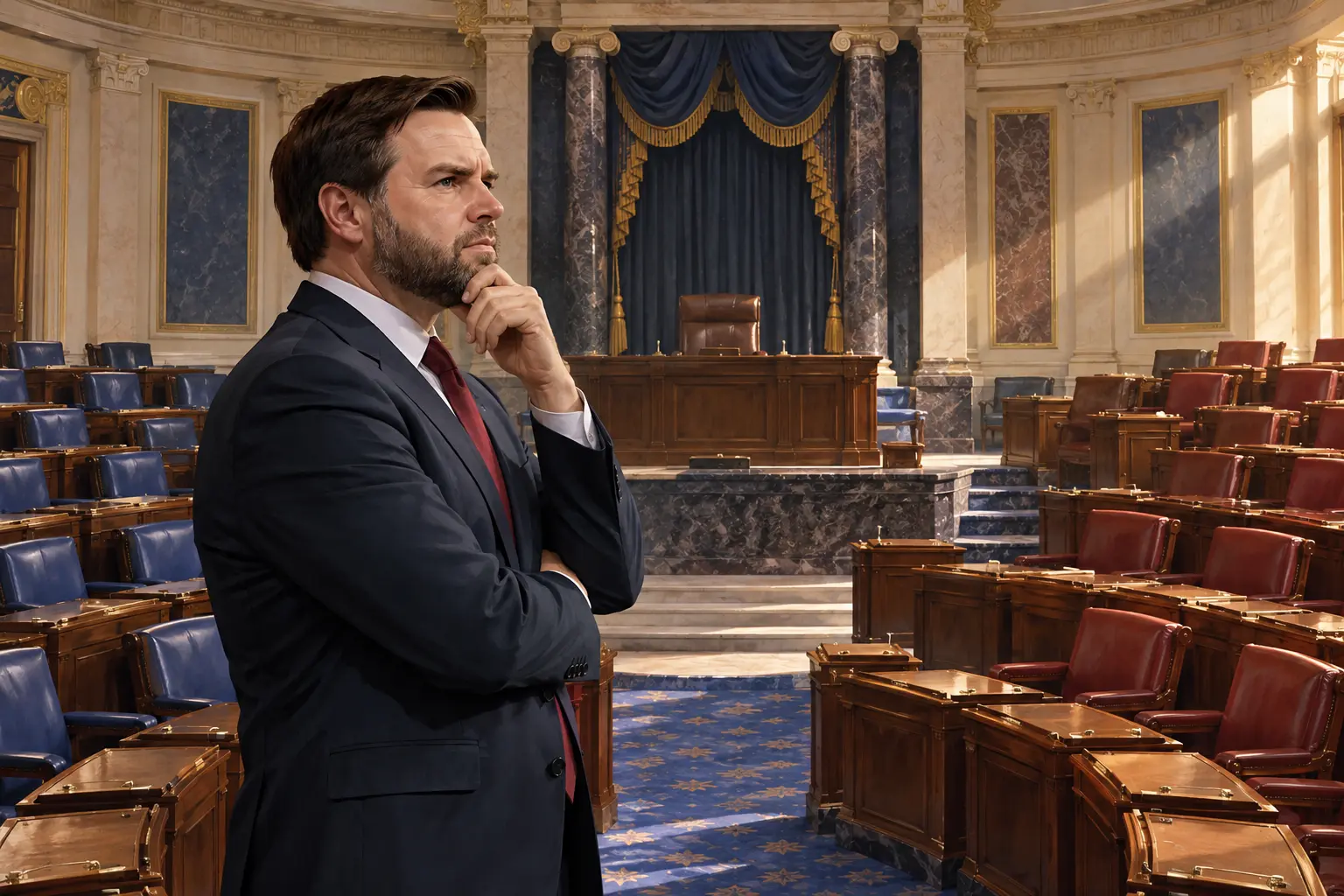
AI-assisted conceptual illustration of a 50-50 Senate and the constitutional role of the deciding vote.AI-assisted editorial illustration.
Why a 50-50 result would matter
In an evenly divided Senate, Vance could cast a decisive vote when all senators are present and split equally. The most visible examples would likely involve nominations or legislation that can pass by simple majority. His vote could also matter to the practical organization of the chamber, although leaders may negotiate power-sharing arrangements rather than force every issue to a floor tie.
There are important limits. A vice president cannot create a majority when members of the president's party defect and the vote is not tied. He cannot supply the supermajority required to override a veto, ratify a treaty, convict in an impeachment trial or propose a constitutional amendment. Procedural rules can also prevent a proposal from reaching the kind of final vote where a tie-break is possible.
The correct conclusion is narrower than either side's campaign rhetoric: Vance would be pivotal in a 50-50 Senate, but he would not control it alone. Every senator would retain an independent vote, and the majority leader would still have to assemble coalitions and manage the floor.
For readers following Vance's governing record, that distinction matters. His influence would come from a specific constitutional mechanism, not from a general claim that the vice president can command Congress. Our JD Vance background page explains the broader office he occupies, while the news archive tracks the campaign interventions that could shape the next chamber.
The battlegrounds that define Vance's leverage
The most consequential races are not interchangeable.
Michigan is a Democratic-held open seat where Republican Mike Rogers faces Democrat Abdul El-Sayed. The state has already become a proving ground for Vance's argument that Republicans should define the election around ideology and common citizenship. But Rogers has also separated himself from Trump on the U.S.-Canada tariff dispute, showing that local economic pressure can complicate a national message.
Ohio is especially personal for Vance. Republican Jon Husted was appointed to the seat Vance vacated when he became vice president and is now running against former Democratic senator Sherrod Brown. Reuters reports that outside spending has pushed the contest above $200 million. A defeat there would not merely cost Republicans a seat; it would reverse the succession that followed Vance's move to the White House.
Texas illustrates a different risk. Republicans are spending heavily to defend a state that has not elected a Democrat statewide since 1994. The competitive race between Republican Ken Paxton and Democrat James Talarico is also a reminder that a national partisan advantage cannot substitute for candidate quality or state-specific persuasion.
Alaska adds another complication because ranked-choice voting can make the final count less intuitive than a conventional two-candidate race. Iowa and Kansas, meanwhile, test whether dissatisfaction over prices, tariffs and the Iran war can put traditionally Republican terrain in play. None of these outcomes is predetermined, but each changes the probability that Vance's tie-breaking authority will become central in 2027.
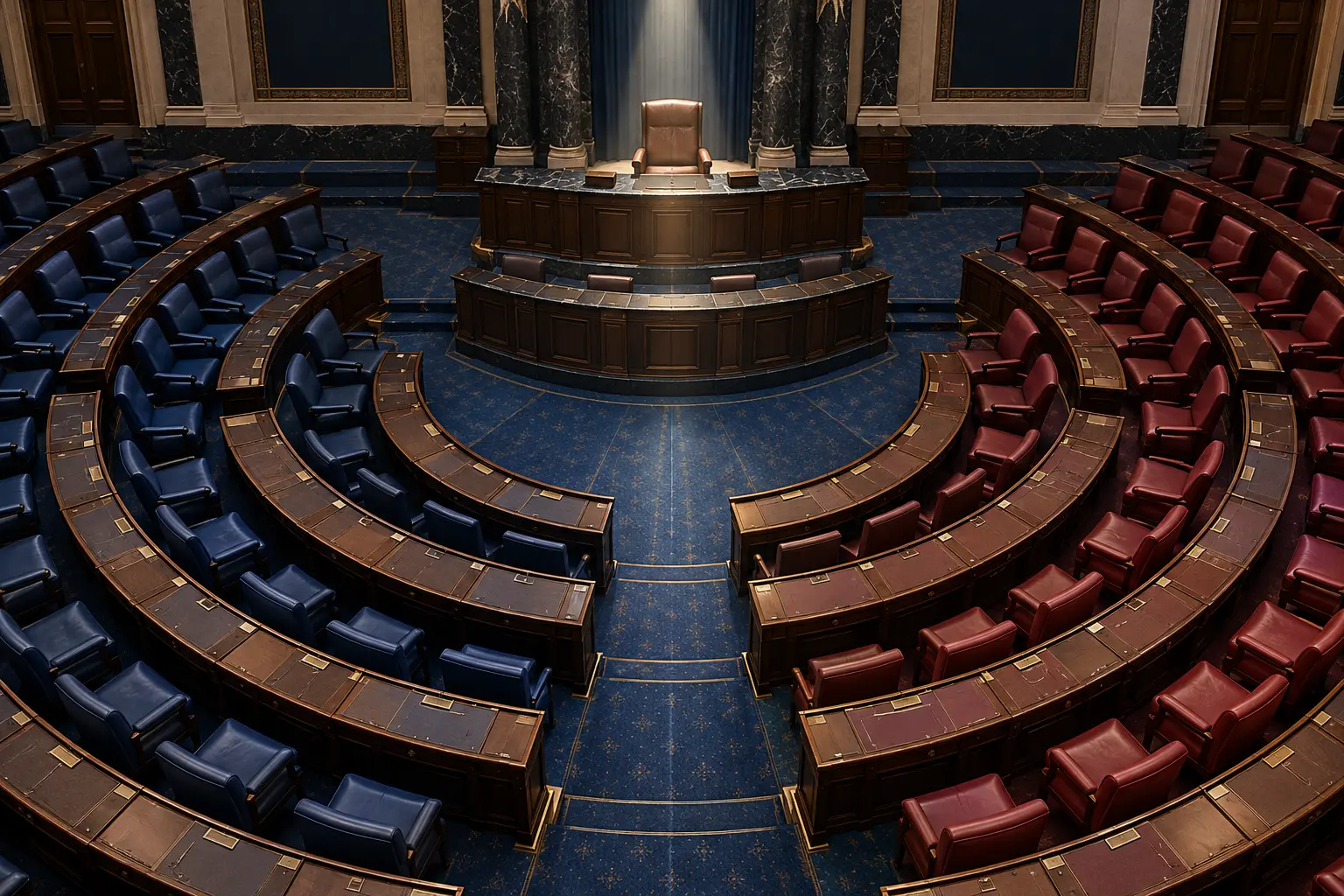
AI-assisted conceptual illustration of the battleground-state paths that could determine Senate control.AI-assisted editorial illustration.
Vance's campaign role has two separate goals
Vance is campaigning to preserve Republican seats, but he is also trying to increase turnout among voters who may support Trump yet feel disappointed about particular policies or economic conditions. Those goals overlap without being identical.
The Associated Press reported on October 1 that Trump and Vance were traveling to heavily Republican areas where party candidates needed stronger enthusiasm. That is a defensive strategy: protect states that ordinarily would not require intervention before expanding the map elsewhere.
Vance's value as a surrogate comes from his ability to connect individual Senate races to governing consequences. If he tells voters that a seat could decide judicial or executive-branch confirmations, budget legislation or the administration's ability to move a bill, he is describing a real institutional stake. If the argument becomes only a referendum on personalities, it may be less persuasive to voters focused on gasoline, groceries, housing and health care.
An upcoming CBS News town hall is scheduled to put those competing demands in one setting, with Michigan voters asking about affordability, tariffs, immigration, health care, artificial intelligence, Iran and democracy. The event has not happened yet, so no claim should be made about what Vance will say. Its announced topics nevertheless show the breadth of issues that a Senate-control message must address.
The case for supporters—and the skeptical test
Supporters can argue that Vance offers Republicans a clear answer to a fragmented Senate map: every close race affects whether the administration can staff agencies, confirm judges and pass legislation. His personal connection to Ohio and his national visibility may help candidates explain why a state contest matters beyond one six-year term.
Skeptical readers should ask whether that institutional argument addresses the reasons some normally Republican states are competitive. A tie-breaking vote is valuable only if voters first elect enough Republican senators to create the tie. If concerns about living costs, trade or war are driving defections, procedural stakes cannot replace an economic account that voters find credible.
Both sides should also resist treating every poll as a settled fact. Reuters' map combines fundraising, spending and recent surveys, but polls are estimates with margins of error, different turnout models and changing electorates. The proper use of the data is to identify competitive states, not to announce winners three weeks before Election Day.
What evidence to watch next
Five developments will determine whether Vance's constitutional role becomes operational rather than theoretical:
1. Whether Democrats hold both Georgia and Michigan, the foundation of their path to 51.
2. Whether Republicans stabilize Ohio and Texas, two expensive races with direct ties to Vance and Trump.
3. Whether late spending continues shifting toward states such as Kansas and Alaska.
4. Whether Vance's appearances improve Republican turnout without intensifying opposition turnout by the same amount.
5. Whether candidates translate Senate control into concrete votes on nominations, budgets and policy.
The verified picture on October 12 is straightforward. Republicans hold a 53-47 advantage, the map has widened, and a 50-50 outcome would put JD Vance in the constitutional position to break ties. What remains unknown is whether voters will treat that institutional consequence as more important than their judgment of the candidates and conditions in their own states.
Readers can continue comparing verified developments and editorial analysis in our topics hub and review our sourcing standards in the editorial policy.
*Vance Force is an independent, unofficial fan community. This article is original editorial reporting and analysis, not a campaign communication, endorsement, or statement from JD Vance, the White House, or any candidate.*