JD Vance's Florida Rally: What Enthusiasm Can—and Cannot—Show
Vance's Lakeland appearance energized a Republican audience. Our analysis separates rally turnout, persuasion and the unresolved questions about household concerns.
By Vance Force Editorial Desk
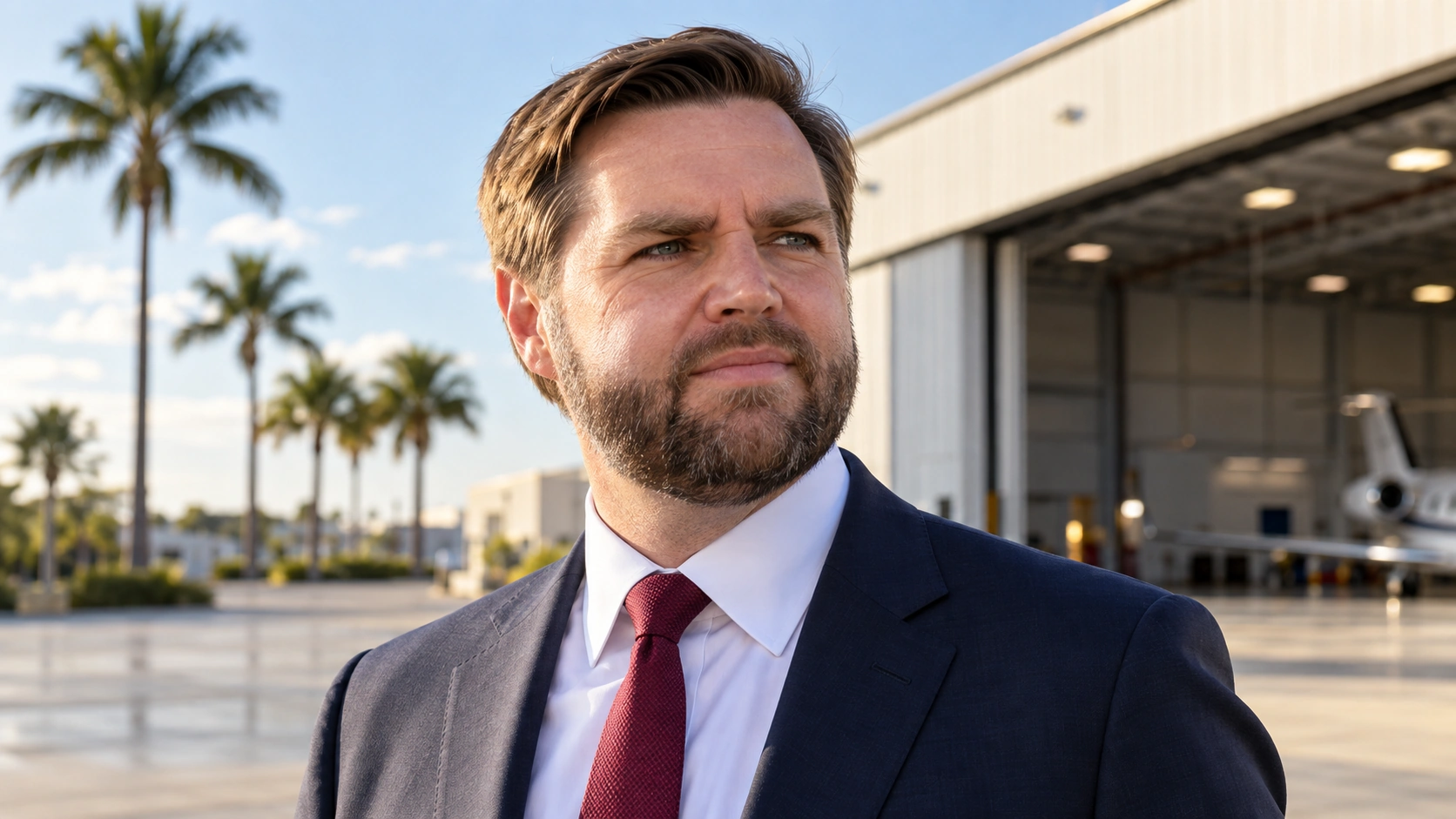
JD Vance in a Florida aviation setting with a hangar and palms · AI-assisted editorial illustration, not a documentary photograph.
DISCUSSION OPENRead the source brief, then add your evidence and argument.
JD Vance's October 1 appearance in Lakeland offers a useful way to examine the final month of the 2026 midterm campaign: enthusiasm inside a rally and persuasion across an electorate are different things. A successful event can demonstrate organization and commitment. It cannot, by itself, establish how people outside the venue will judge a candidate's record or whether their household concerns have been answered.
This October 4 afternoon analysis examines that distinction through the event record, local reporting and the available speech transcript. It does not project an election result, treat the audience as a representative sample or present campaign claims as independently established facts. The central question is what the appearance tells us about Vance's role—and what it leaves unresolved.
Start with the event, not the interpretation
The Polk GOP event listing advertised an October 1 rally featuring Vance at Skylight Hangar A at Sun 'n Fun in Lakeland, hosted by Trump 47 Committee. The listing establishes the announced place, date and host. It is a promotional record, not an independent measurement of attendance or public opinion.
Associated Press coverage places the visit within a broader Republican campaign effort ahead of November 3. It identifies Vance's Florida appearance as support for gubernatorial nominee Byron Donalds, while President Donald Trump made separate stops in Texas and Oklahoma. The report presents those appearances as part of the party's effort to energize supporters amid a more difficult political environment.
WUSF's reporting from Lakeland describes a packed hangar and speeches from Vance, Donalds, Senator Ashley Moody and other Republican figures. Its interviews record both enthusiasm about the event and dissatisfaction with how household issues were addressed. These reactions illustrate different experiences of one rally; they do not establish how common either response is among Florida voters.
The speech shows a mobilization argument
The Factba.se transcript hosted by Roll Call records Vance praising Republican candidates, drawing sharp contrasts with their opponents and asking the audience to participate in the November election. The closing passages link the Republican ticket with themes including taxes, safety and schools. Those passages are evidence of the message he delivered, not independent verification that one party will deliver every promised outcome.
Our interpretation is that the event performed a familiar campaign function: connecting individual state candidates to a national political identity. Vance was not simply introducing a name on a ballot. He was presenting several races as parts of a shared choice and giving an already engaged audience a reason to see its participation as consequential.
That is a meaningful political task. Campaigns need people who recognize their candidates and understand that an election is approaching. Yet recognizing that function does not establish the size of any turnout effect. A transcript can reveal an appeal to participate; it cannot show how many additional people eventually act because they heard it.
A rally audience illustrates participation at one event, not the preferences of an entire electorate. This is a conceptual setting, not a photograph of the October 1 rally.AI-assisted editorial illustration.
Why a full room is an incomplete measure
A rally audience chooses to attend. Its energy is therefore useful evidence about the people in that room, while remaining a poor substitute for a representative survey. The same caution applies to applause, lines outside a venue and clips circulating online. Each captures something real, but none supplies a complete view of an electorate.
There is also a difference between reinforcing an existing preference and changing a preference. A participant may leave more enthusiastic without changing the candidate they support. Another may enjoy the event while remaining uncertain about a policy. Those are different responses, and a strong account of a campaign should avoid merging them into one claim of momentum.
For readers evaluating Vance's appearance, the appropriate conclusion is modest: he brought national visibility to the Republican ticket and delivered a clear partisan appeal. Claims about its wider effect would require other evidence. This article has not identified a before-and-after study capable of isolating the rally's impact.
Household costs require specific policy explanations. These illustrative people are not the attendees interviewed in the source reporting.AI-assisted editorial illustration.
Household concerns require a different kind of answer
WUSF's account includes an attendee who felt encouraged and others who wanted more discussion of living costs and related concerns. The contrast is useful because it shows how the same political message can be received differently. It does not justify treating any interviewee as the voice of a whole generation, county or party.
The analytical distinction is between being recognized and being answered. A speaker may name a concern, blame an opponent or promise improvement. A policy explanation goes further: it identifies a mechanism, a responsible decision-maker, a time horizon and a way to judge whether the promised change occurred. That standard can be applied to every candidate without assuming that one campaign has already met it.
Suppose a candidate promises lower costs. Readers should be able to distinguish the particular cost being discussed, the proposed action and the conditions needed for it to work. They should also know whether the proposal concerns an immediate administrative decision or a longer legislative process. A broad statement of intent leaves those questions open.
Vance's dual role creates a clear accountability question
As vice president and campaign surrogate, Vance speaks in two overlapping capacities. He can advocate for candidates while also being asked to explain the administration's record. The first role emphasizes choice and contrast. The second requires evidence about decisions already made and outcomes already observable.
Our assessment is that this overlap makes specificity more valuable, not less. A forceful argument against an opponent may clarify political differences, but it does not remove the need to account for current governing responsibilities. Equally, a difficult economic environment does not establish that a particular rally failed or that every policy claim is wrong. Those questions need separate evidence.
For an independent fan community, careful scrutiny is compatible with interest in Vance's political future. Readers can appreciate an effective speech while asking what would make its claims testable. Treating every criticism as hostility, or every enthusiastic response as proof of success, would make it harder to learn anything useful from the campaign.
What would make the next assessment stronger
The most informative follow-up would combine the full event record with concrete policy documents and clearly described public-opinion evidence. Any survey should be judged by whom it interviewed, when it was conducted and what it actually asked. A statewide result cannot automatically explain a single appearance, and one event cannot explain an entire election.
Candidate proposals deserve the same discipline. A specific plan should be compared with its stated objectives, costs and implementation steps. Where a claim remains unresolved, a news analysis should say so rather than convert uncertainty into a prediction. The purpose is to make competing arguments easier to evaluate, not to announce a winner before voters decide.
Vance's Lakeland visit shows a campaign making a visible effort to mobilize its supporters. Whether that effort broadens support, addresses practical concerns or changes participation remains a question for subsequent evidence. Readers can explore Vance's background, follow the news desk or discuss the source record in the community. This is independent editorial analysis. The cover is an AI-assisted conceptual illustration, not a documentary photograph of the October 1 rally.