JD Vance’s Fertilizer Bet Could Help Farmers—If the Projects Get Built
JD Vance announced $1.34 billion in proposed fertilizer projects. The policy could ease farm costs—but only if selected sites become operating plants and savings reach producers.
By Vance Force Editorial Desk
AI-assisted editorial illustration of JD Vance holding an infrastructure plan in a Nebraska cornfield, representing the JD Vance fertilizer investment and proposed manufacturing capacity.
DISCUSSION OPENRead the source brief, then add your evidence and argument.
Vice President JD Vance brought an unusually concrete economic message to North Platte, Nebraska, on Thursday: the federal government had selected eight fertilizer-manufacturing projects representing more than $1.34 billion in proposed investment. For farmers confronting another year of rising input costs, the announcement offered something more tangible than a campaign promise—new plants, new capacity and a modeled path to lower fertilizer prices.
The opportunity is real. So is the distance between selection and delivery.
Vance’s announcement matters because fertilizer is both a farm expense and a national-security input. Domestic production can reduce exposure to foreign disruptions, create additional competition and shorten the distance between an ammonia plant and a farm. But “investment” does not mean all the money has been spent, and “selected” does not mean every project has cleared financing, permitting, construction and commissioning.
The best way to judge the **JD Vance fertilizer investment** is therefore not by the size of Thursday’s headline. It is by whether the administration can turn proposed funding into operating capacity—and whether the savings reach farmers rather than stopping somewhere in the supply chain.
What Vance Announced—and What He Did Not
Vance made the announcement during an October 22 midterm rally at the D&N Events Center in North Platte. The official event listing scheduled the program for 9:30 a.m. Central. Local coverage by reported that he was campaigning for Republican Gov. Jim Pillen and Sen. Pete Ricketts when he presented the fertilizer plan.
The authoritative details came later in a USDA press release. Eight projects represent more than $1.34 billion in total proposed investment, including approximately $573 million in proposed USDA funding through the Fertilizer Investment & Expansion for Long-Term Domestic Supply program, known as FIELDS. USDA says the combined projects could support about 1.08 million tons of annual production and capacity across nitrogen, phosphate, potash and sulfur products.
Those numbers correct an ambiguity in the rally shorthand. The $1.34 billion is a nationwide portfolio, not an investment located entirely in Nebraska. The Nebraska connection is TalusAg, which was selected for about $99.8 million in proposed USDA funding toward a $270.2 million project. The company plans 20 modular ammonia units across 11 locations in seven states. Two facilities are expected in Nebraska, but their communities and construction schedules have not been announced.
Nebraska Public Media reported that the state locations remain unknown and that TalusAg’s only previously announced project was in Minnesota. That does not make the Nebraska plan insubstantial. It does mean that voters should distinguish a federal selection from a completed site agreement.
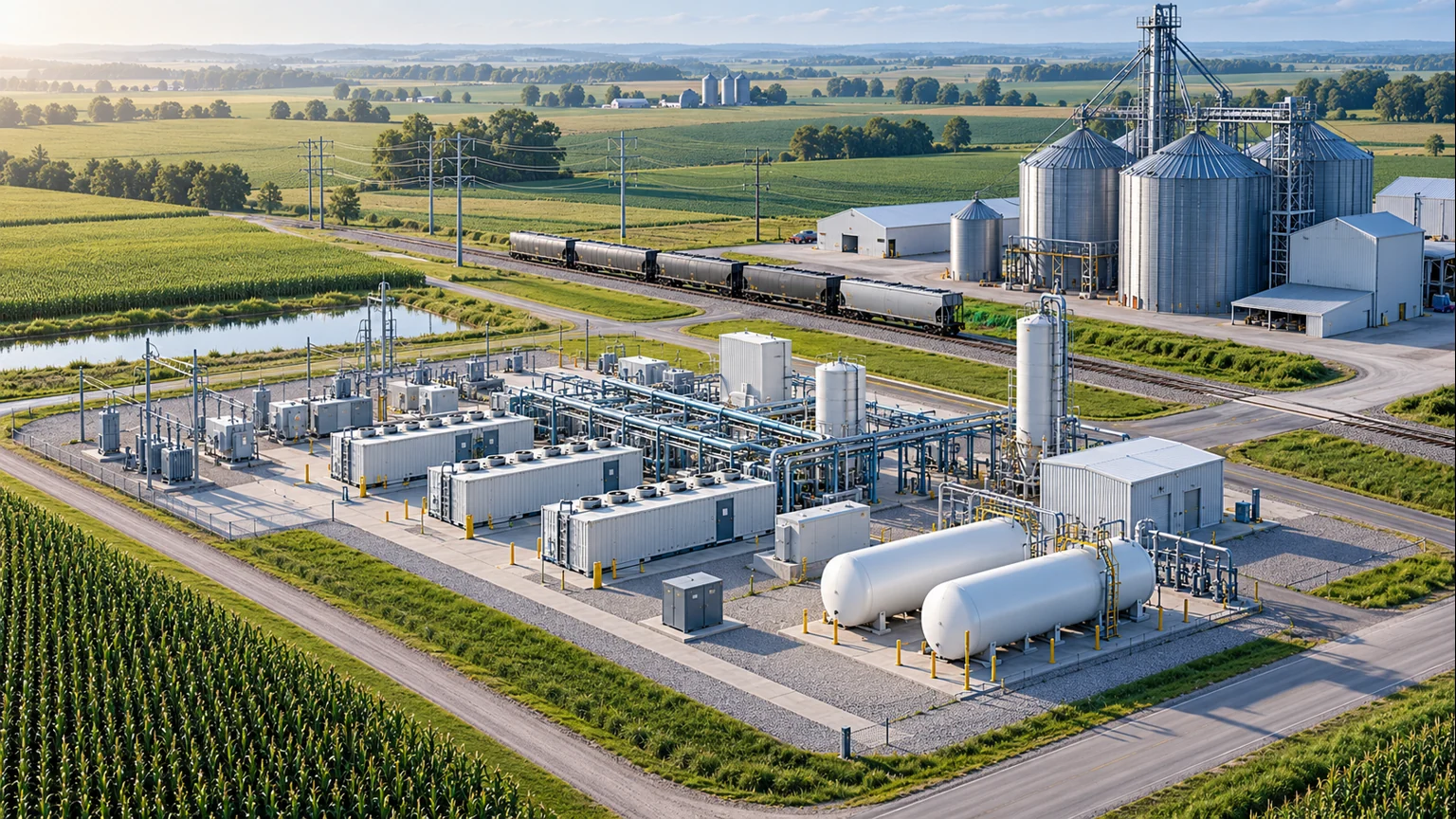
AI-assisted conceptual illustration of distributed ammonia production near farms; it does not depict an announced TalusAg location.AI-assisted editorial illustration.
Why More Domestic Capacity Could Matter
Vance’s central economic logic is strong. Farmers cannot substitute away from essential nutrients without affecting yields or soil management. When fertilizer supplies are concentrated, imported or transported long distances, disruptions can move quickly into farm budgets and eventually food prices.
USDA says four companies control about 77% of North American nitrogen capacity, two account for more than 90% of phosphate capacity, and two produce approximately 90% of potash. Independent work from the University of Illinois’ farmdoc daily adds an important qualification: concentration can arise because ammonia plants are capital-intensive and efficient producers survive, while imports, natural-gas prices and regulation also shape competition. Building more plants is therefore relevant, but capacity alone does not settle every pricing question.
The near-term pressure is undeniable. USDA’s Economic Research Service forecast projects fertilizer, lime and soil-conditioner expenses to rise by $5.3 billion, or 15.3%, in 2026. Inflation-adjusted net farm income is forecast to fall 5.5% from 2025 even as government payments rise. That backdrop explains why a supply-side investment can resonate more than another general promise about affordability. Our morning analysis of Vance’s economic message and the affordability squeeze argued that voters will look for mechanisms, not acknowledgments alone. FIELDS is such a mechanism.
USDA estimates that the selected projects, once operating, could lower nitrogen fertilizer prices by 4.4% and potash prices by 5.3%. It also projects a 3.7% increase in domestic nitrogen production and nearly 40% more domestic potash production. Those are meaningful modeled effects, especially in a concentrated market.
But the phrase “once the projects are operational” carries most of the risk. A modeled national price decline is not a guaranteed discount on a Nebraska producer’s invoice. Actual savings will depend on construction timing, plant utilization, energy costs, transportation, distributor margins and market conditions when the new supply arrives.
The Nebraska Test Is Smaller—and More Revealing
TalusAg’s modular approach could be the most strategically interesting part of the portfolio. Rather than relying only on giant centralized plants, the project proposes smaller ammonia units near agricultural customers. Locating production closer to farms could reduce freight exposure and create redundancy. It could also allow renewable or local electricity to become a direct input into ammonia production.
Yet the Nebraska case illustrates the execution challenge. News Channel Nebraska reported that TalusAg previously pursued a Cedar County facility and withdrew the application after local opposition. That history does not predict failure for the two new sites. It does show that local consent, land use, electricity demand, water, safety planning and emergency response cannot be reduced to lines in a national funding announcement.
The company and USDA should publish the Nebraska locations only after agreements are ready, but they should not leave the public with an indefinite placeholder. A credible next-stage notice would identify the host communities, expected capacity, source of power, construction milestones, environmental reviews and the amount and form of federal support.
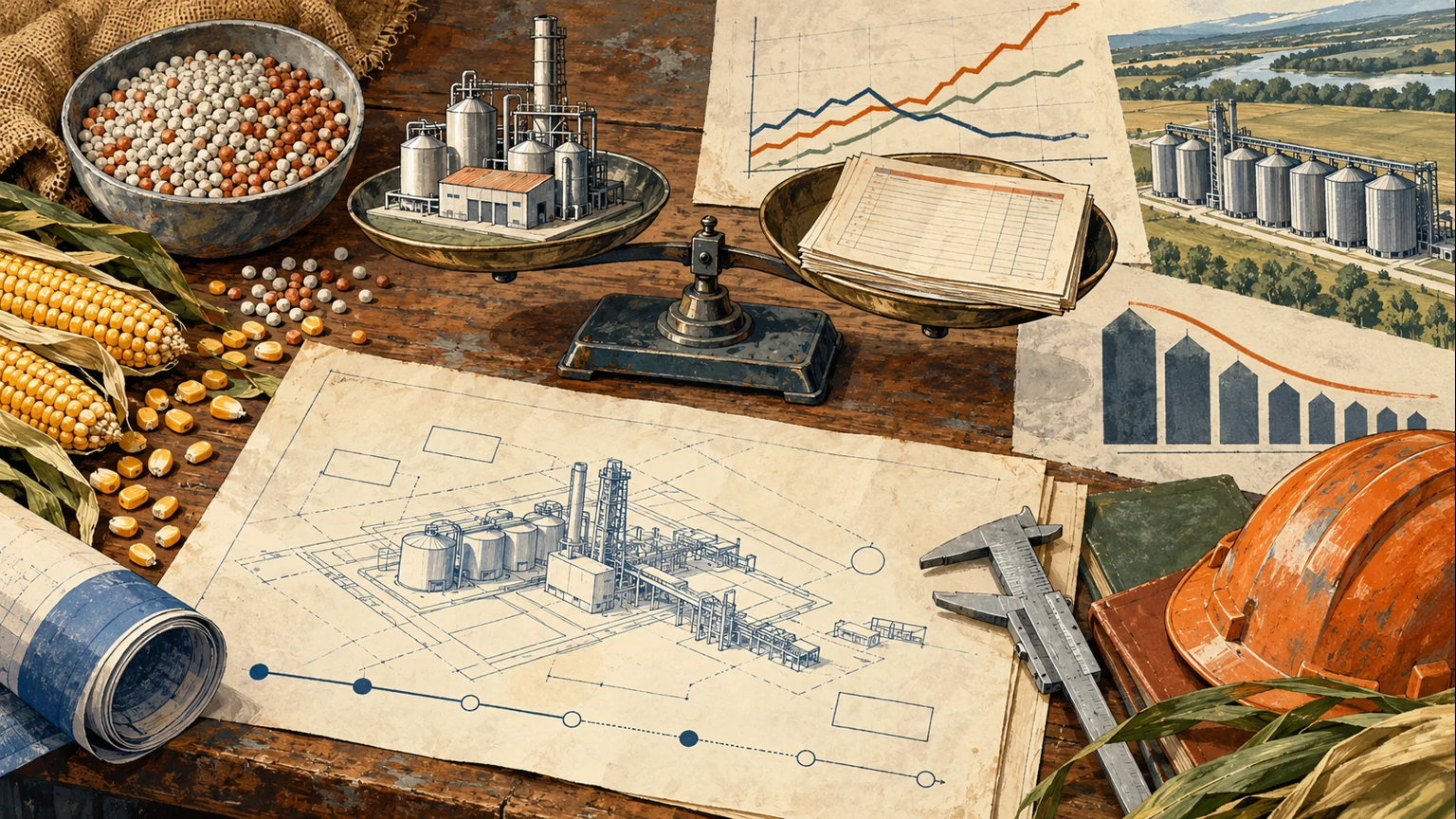
AI-assisted conceptual illustration of the funding, construction and price-accountability questions behind the fertilizer announcement.AI-assisted editorial illustration.
Four Measures That Would Turn the Announcement Into Accountability
Vance can make Thursday’s announcement more durable by attaching a public scorecard to it. That would answer both supporters who want faster domestic production and skeptics who worry about industrial subsidies.
1. Separate proposed investment from federal exposure
USDA identifies approximately $573 million in proposed federal funding within a $1.34 billion portfolio. It should disclose, project by project, whether support is a grant, loan or other financing; how much private capital is committed; and what conditions must be met before funds are released.
2. Publish construction and production milestones
Selection, financial close, permits, groundbreaking, mechanical completion and commercial output are different events. A quarterly dashboard should report them separately. Our earlier call for a public anti-fraud scorecard rests on the same principle: an initiative becomes accountable when outsiders can compare commitments with results.
3. Measure delivered prices, not only capacity
New tonnage is a useful leading indicator, but the policy goal is lower and more reliable farmer costs. USDA should track regional wholesale and retail prices, freight costs and availability before and after the facilities begin production. Otherwise, the administration may claim success when a plant opens even if farmers see little benefit.
4. Use clawbacks for missed commitments
Projects that fail to reach agreed milestones should not retain unlimited public support. Transparent clawbacks and reallocation rules would protect taxpayers and reward firms capable of moving from proposal to production.
Vance’s Industrial Policy Faces a Delivery Test
The North Platte setting made political sense. Vance was speaking in a farm state, weeks before an election, alongside candidates who need rural turnout. Campaign timing does not invalidate the policy. It does increase the need for precision, because the applause arrives immediately while the economic evidence will take years.
There is also a legitimate argument against the program’s basic method. Government support can misallocate capital, favor politically connected applicants or subsidize facilities that private markets would eventually build. The answer cannot be that every domestic project is automatically strategic. USDA must show why each recipient needs support, why its financing is viable and how the public benefit exceeds the subsidy.
The opposing risk is passivity. A market with high concentration, volatile global inputs and rising farm expenses may not deliver enough new competition on its own. Carefully structured federal support can accelerate entry and create capacity that improves resilience. The question is not simply government versus markets; it is whether public financing produces measurable additional supply at an acceptable cost.
Vance deserves credit for putting a specific industrial investment behind his affordability message. The restrained conclusion, however, is that he announced a portfolio of selected projects—not lower fertilizer bills already achieved. Nebraska farmers still need locations, schedules and proof that modular production can be built with community consent. Taxpayers still need financing terms and milestones.
If the facilities open, operate near their promised capacity and reduce delivered prices, Thursday’s rally will look like the beginning of a consequential farm-policy success. If details remain vague and timelines slip, the $1.34 billion headline will have been easier to produce than the fertilizer.
*Vance Force is an independent fan community. This editorial is not affiliated with, endorsed by or produced for Vice President JD Vance, the White House, USDA, TalusAg or any political campaign.*