JD Vance Announces a Defense Production Act Refinery Expansion
JD Vance announced a Defense Production Act-backed expansion of Delek’s Tyler refinery. The plan links fuel supply, defense needs and Texas jobs, while key details on funding, capacity and timing remain undisclosed.
By Vance Force Editorial Desk
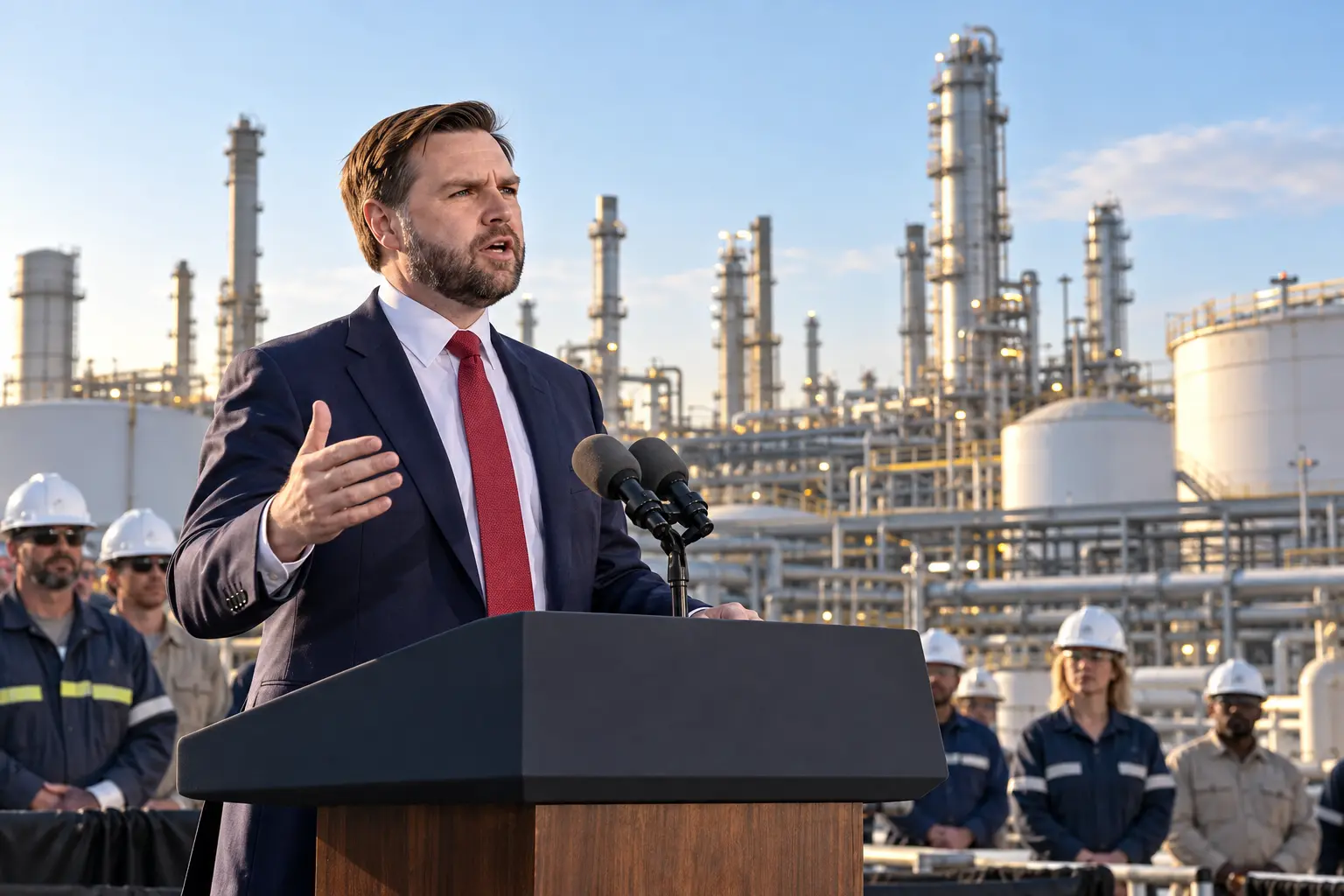
AI-assisted editorial illustration of JD Vance presenting the JD Vance refinery expansion plan with refinery equipment in the background.
DISCUSSION OPENRead the source brief, then add your evidence and argument.
Vance turns a campaign stop into an energy announcement
Vice President JD Vance used a campaign rally in Tyler, Texas, on October 13 to announce that the Trump administration is working with Delek US Holdings to expand the company’s local refinery under the Defense Production Act. The proposal is significant because it connects three issues Vance has emphasized on the trail: fuel affordability, domestic industrial capacity and national defense.
The announcement is also incomplete. Vance described the intended output and local jobs, but neither the White House nor Delek immediately disclosed the amount of federal support, the planned increase in processing capacity or a construction timetable. Those missing details matter when assessing how quickly the project could affect fuel supply or prices.
This morning report lays out what Vance announced, what independent data show about the U.S. refining system and which facts remain unconfirmed. Readers can follow continuing updates through Vance Force News and compare this announcement with our broader policy coverage.
What Vance said in Tyler
The event took place at Tyler Pounds Regional Airport on Tuesday, October 13. A full Roll Call Factbase transcript records Vance announcing that the administration had used the Defense Production Act while working with Delek and intended to expand the Tyler refinery.
Vance said the goal was to add “millions of gallons” of commercial-grade and military-specification fuel beyond the refinery’s current production. He connected the project to lower driving and aviation costs, a more reliable energy supply and stronger national defense. He also projected hundreds of good-paying jobs in Smith County.
Those are administration claims about the project’s intended effects, not completed outcomes. They should be tracked against contracts, permits, construction milestones, new unit capacity and actual production after startup.
Reuters independently reported the announcement late Tuesday. Its report said the Tyler refinery currently processes about 74,000 barrels per day. Reuters also noted that the White House and Delek had not immediately provided the funding level or the size of the proposed capacity increase.
Why the Defense Production Act matters
The Defense Production Act is not merely a wartime slogan. Its authorities are designed to prioritize materials and facilities and to support productive capacity needed for national security. The current compiled law, published by the U.S. Government Publishing Office, expressly includes financial assistance for expanding productive capacity and supply.
That framework helps explain Vance’s emphasis on military-specification fuel. A refinery project presented only as a way to reduce retail prices would invite questions about why emergency industrial authority is necessary. Tying the investment to defense fuel and supply resilience gives the administration a national-security basis, although the precise legal determination and financial instrument used for this project have not yet been published in the sources reviewed for this article.
The distinction is important. The DPA can help prioritize or finance capacity, but it does not make engineering, procurement, permitting or construction instantaneous. The authority may accelerate a project; it cannot eliminate the physical work required to expand complex refinery units.
AI-assisted conceptual illustration of refinery equipment and construction planning; it does not depict a specific photographed project milestone.AI-assisted editorial illustration.
The verified national capacity backdrop
The project arrives after a measurable decline in U.S. refining capacity. The U.S. Energy Information Administration reported on June 29 that operable atmospheric distillation capacity totaled 18.2 million barrels per calendar day on January 1, 2026, down more than 250,000 barrels per day, or about 1 percent, from a year earlier.
EIA attributed much of the reduction to refinery closures in Houston and Los Angeles. It also reported that capacity gains at other facilities were generally marginal. The three largest U.S. refiners each posted increases of less than 1 percent, changes the agency said likely reflected small process improvements rather than major expansions.
That data gives the Tyler announcement a real policy context. Expanding an existing plant is a familiar way to add capacity in a country where entirely new large refineries are rare. But it also shows why the scale matters. Without a disclosed barrels-per-day increase, it is impossible to compare the Tyler project with the national decline or estimate its market significance.
The Tyler facility’s current 74,000-barrel-per-day throughput is meaningful locally but small relative to the national total. That does not make an expansion unimportant. A project can strengthen a regional workforce, provide specialized military fuel and add resilience even if it does not transform national prices. It does mean that claims about broad consumer relief should be tested against the final size and product mix.
Local jobs are the most immediate political promise
Vance framed the announcement through a refinery employee named Austin Davis and argued that industrial growth would let younger Texans build lives without leaving their communities. FOX 7 Austin’s local report said Vance projected hundreds of jobs and linked the expansion to Smith County opportunity.
That message fits a central theme in Vance’s public career: policy should be judged partly by whether it sustains families and communities outside the largest metropolitan centers. More biographical context is available on our About JD page, but the project itself deserves an evidence-based standard independent of political biography.
The first useful test will be the type of jobs created. Temporary construction employment, permanent refinery positions and indirect supplier work have different economic effects. Wage levels, apprenticeship opportunities, local hiring and the duration of employment will determine whether the project matches the promise of durable, good-paying work.
The second test is additionality. Policymakers should clarify which investments Delek already planned and which new units, upgrades or output became possible because of federal action. A transparent baseline would allow taxpayers and local residents to distinguish a genuinely expanded project from previously scheduled maintenance or modernization.
AI-assisted conceptual illustration of industrial workforce training; it does not depict an actual Delek training session or identified workers.AI-assisted editorial illustration.
Will the expansion lower fuel prices?
Vance linked additional production to lower costs for driving and flying. The direction of that argument is straightforward: all else equal, more usable refining capacity can ease supply constraints. The size and timing of any retail effect, however, depend on more than a single plant.
Crude oil prices, refinery outages, product specifications, inventories, pipelines, shipping costs and regional demand all affect what consumers pay. Reuters noted that refinery expansions are capital-intensive and can take months or years, depending on complexity. Therefore, the Tyler project should not be presented as an immediate nationwide price cut unless the administration releases evidence supporting that timeline.
There may be a more defensible near-term claim: announcing a committed expansion signals that the administration recognizes refining capacity, not only crude production, as part of energy security. Producing more oil does not automatically create more gasoline, diesel or jet fuel when conversion capacity is constrained.
Supporters can reasonably welcome an attempt to reverse capacity losses and connect civilian supply with defense readiness. Skeptics can reasonably ask whether a campaign-stage announcement without a budget, contract, design or schedule is mature enough to support Vance’s price claims. Both positions can be tested when project documents become public.
The election setting requires extra transparency
The announcement came during a rally supporting Republican Senate nominee Ken Paxton. Reuters described affordability as a defining midterm issue, while FOX 7 reported that most of Vance’s event focused on the Texas Senate contest. That political setting does not invalidate the refinery plan, but it raises the standard for separating public investment from campaign messaging.
The administration should publish the agency responsible for the project, the DPA authority being used, the federal funding or purchase commitment, Delek’s contribution, capacity targets and expected completion dates. It should also explain any environmental and safety review needed for the expansion. Those facts would let supporters defend the plan on its merits and let skeptical readers evaluate costs and tradeoffs.
Transparency would also protect the project from changing political narratives. If milestones are public, future reporting can credit progress, identify delays or correct exaggerated claims without relying on partisan interpretations.
What evidence to watch next
Five disclosures would turn the announcement into a measurable policy commitment:
1. **Capacity:** the planned increase in barrels per day and the products to be added.
2. **Funding:** the federal instrument, amount, conditions and Delek’s private investment.
3. **Schedule:** engineering, permitting, construction and startup milestones.
4. **Employment:** construction and permanent job estimates, wages and local training plans.
5. **Results:** actual output, military-fuel deliveries and any demonstrated regional price effect.
For now, the verified development is that Vance publicly announced a DPA-backed effort to expand Delek’s 74,000-barrel-per-day Tyler refinery, with additional commercial and military fuel as the stated objective. The exact expansion size, cost and delivery date remain unknown.
That is enough to make the project newsworthy, but not enough to declare it successful. The JD Vance refinery expansion will be judged by steel in the ground, new refining units, sustained jobs and measurable output—not by the applause that greeted its announcement.
*Vance Force is an independent fan community. This report is not affiliated with, authorized by or speaking for JD Vance, the White House, Delek US Holdings, any campaign or the Republican Party. It distinguishes verified facts from claims and analysis under our editorial policy.*