JD Vance’s Reported AI Task Force Role Puts Workers and Safety at the Center
Vice President JD Vance is reported to be joining a new White House AI panel, placing his pro-innovation agenda against urgent tests on safety, security, and workers.
By Vance Force Editorial Desk
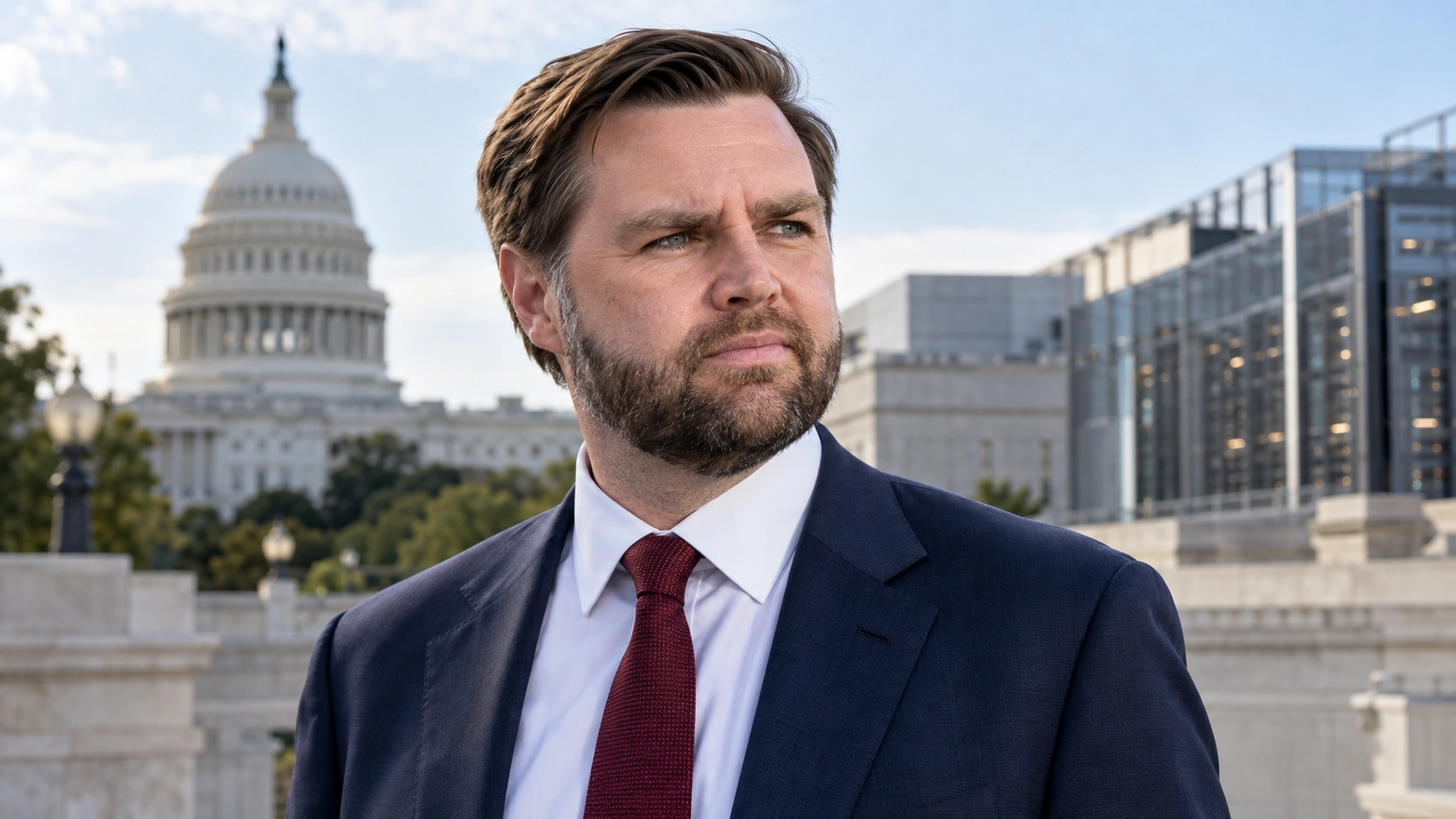
JD Vance in a Washington setting with contemporary technology architecture · AI-assisted editorial illustration, not a documentary photograph.
DISCUSSION OPENRead the source brief, then add your evidence and argument.
Vice President JD Vance is expected to serve on a new White House panel examining the risks and opportunities of advanced artificial intelligence, according to reporting published late October 3 and early October 4. The assignment would give Vance a direct role in one of the administration’s most consequential technology debates: how to preserve American leadership without treating safety, national security, energy demand, and workers as afterthoughts.
The most important distinction is between the public record and the reported details. The Wall Street Journal reported that Director of National Intelligence Jay Clayton will chair a panel with 120 days to assess AI risks, opportunities, and the federal government’s responsibilities. Reuters independently summarized the report and said Vance is among the members, along with senior national-security and economic officials. Reuters also noted that the White House had not yet supplied its own detailed public announcement in that report.
That means the panel’s complete charter, roster, meeting schedule, public-comment process, and final deadline should be treated as awaiting primary-source confirmation. The reported 120-day clock is newsworthy, but the eventual White House document will determine exactly when it starts and what the group must deliver.
The policy foundation already exists
The panel does not emerge from an empty field. On September 29, President Donald Trump signed an executive order directing the executive branch to use “Super Intelligence” and “SI” in place of “Artificial Intelligence” and “AI” in non-statutory government communications. The order retained the existing statutory definition for now and instructed the White House science adviser to propose legislative language for a federal definition within 60 days.
A related White House fact sheet framed the change as part of a broader strategy built around innovation, infrastructure, scientific discovery, manufacturing, and American leadership. Those are administration claims and priorities, not independent proof that every promised benefit has materialized. They do, however, establish the policy direction against which Vance’s reported role should be judged.
The terminology change is politically significant, but names cannot substitute for governance. Whether the government calls the technology AI or SI, the operational questions remain the same: Who reports dangerous incidents? Who verifies safety claims? What happens when a system fails? Which agency has authority? How are workers represented when automation changes jobs, wages, training, or bargaining power?
Why Vance’s role matters
Vance has been one of the administration’s clearest advocates for rapid American AI development. In his February 2025 Paris address, preserved in a full transcript by the American Presidency Project, he argued that excessive regulation could suppress a transformative industry. He also promised that American workers would have a place in major federal AI policy decisions.
Those two commitments now meet in the same room. It is relatively easy to favor innovation in a speech and relatively easy to demand safety after a crisis. The hard work is designing rules that allow useful systems to advance while creating reliable defenses against foreseeable harm. Vance’s value on the panel will depend on whether he can translate his worker-first language into measurable requirements rather than broad reassurance.
For supporters, his participation offers an opportunity to connect technological leadership with the industrial agenda he has emphasized elsewhere: domestic energy, data centers, advanced manufacturing, apprenticeships, and well-paid technical work. For skeptical readers, it creates a clear accountability test. If workers are promised a seat at the table, the panel should show who represents them, what evidence they submit, and how their concerns change the recommendations.
AI safety depends on the systems and people behind the technology. Conceptual illustration; the people and facility are not a record of a task-force visit.AI-assisted editorial illustration.
Safety is now a practical governing question
The administration has favored voluntary safeguards and existing legal authority over a large new regulatory system. Reuters reported on October 3 that six technology companies agreed to internal controls and outside audits, but the public agreement did not specify penalties for noncompliance. Supporters view that approach as faster and less likely to freeze innovation. Critics argue that voluntary promises may be weakest precisely when commercial pressure is strongest.
This is not a choice between “innovation” and “safety” as abstract slogans. Weak security can destroy public trust, expose critical infrastructure, or allow hostile actors to exploit powerful systems. Rules that are vague, duplicative, or captured by incumbents can also raise costs and shut smaller competitors out. The panel’s challenge is to identify safeguards that are technically testable, legally grounded, and proportionate to risk.
The federal government already has a reference point. The National Institute of Standards and Technology’s AI Risk Management Framework is a voluntary system for mapping, measuring, managing, and governing AI risks. NIST says it is revising the framework under the White House AI Action Plan and has begun work on a profile for critical infrastructure. A serious task-force report should explain whether existing frameworks are sufficient, where they fail, and which recommendations require legislation rather than an executive directive.
Skills, retraining and durable employment are central to the worker-impact debate. The people and workplace are illustrative.AI-assisted editorial illustration.
The worker test must be more specific
“Protect American workers” can mean several different things. It may refer to training people for new roles, preventing unlawful discrimination, helping displaced workers, securing domestic supply chains, or making sure productivity gains appear in wages and opportunity. A credible policy must separate those goals and attach evidence to each one.
At minimum, the panel should examine five worker-centered questions. First, which occupations face near-term task replacement rather than total job elimination? Second, who pays for retraining, and do programs lead to actual jobs? Third, can workers challenge automated employment decisions? Fourth, will data-center and semiconductor investment produce durable local employment after construction ends? Fifth, how will the government measure whether productivity gains are broadly shared?
These questions also connect AI policy to energy and infrastructure. Large computing facilities can bring investment while increasing pressure on electricity systems, water supplies, and local land use. The national interest is not served if a project’s benefits are celebrated nationally while its infrastructure costs are quietly shifted to households. Vance’s reported position on the panel gives him a chance to insist on transparent accounting: jobs created, wages paid, power costs assigned, and community commitments enforced.
Readers can compare these issues with other Vance Force policy topics and follow new verified developments in the news archive. The discussion board is open for members to debate which worker and safety metrics the panel should publish.
National security requires clear lines of responsibility
Clayton’s intelligence role suggests that national security will be central. The reported panel is expected to examine breaches, hacks, incident reporting, and federal response capacity. That focus is understandable: advanced models can accelerate cyber defense, but they can also help attackers discover vulnerabilities, automate deception, or operate at a speed that strains human oversight.
The task force should avoid two opposite errors. The first is treating every speculative scenario as an immediate emergency and building policy on fear. The second is waiting for a catastrophic event before assigning responsibility. A useful middle course would establish thresholds for mandatory reporting, protect good-faith disclosure, identify a lead agency for different classes of incidents, and require exercises that test whether response plans work.
Vance’s influence should be assessed through the final recommendations, not merely his presence on a roster. Does the report define an auditable incident system? Does it distinguish ordinary software failures from risks unique to advanced models? Does it protect civil liberties while addressing foreign threats? Does it explain which steps can occur under existing law and which require Congress?
What evidence to watch next
The next evidence should be documentary. Watch for an official charter, a complete membership list, a precise deadline, and a public description of the panel’s authority. A worker advisory group, open technical consultation, or published meeting record would make the process easier to evaluate. Silence on those points would leave too much dependent on private access.
Then watch the substance. Strong recommendations would specify measurable risk thresholds, independent evaluation standards, incident-reporting rules, worker-impact data, and responsibility for infrastructure costs. They would also disclose uncertainty and competing evidence. A weak report would rely mainly on a new label, general promises of leadership, or voluntary commitments without a way to test compliance.
For Vance, the assignment could become a defining technology-policy responsibility. His long-standing case is that America can lead in advanced technology without surrendering free expression, growth, or workers’ interests. The reported AI task force gives him a chance to prove that those goals can be converted into institutions that work before a crisis—not only arguments delivered after one.
*Vance Force is an independent, unofficial fan community. It is not affiliated with, authorized by, or endorsed by JD Vance, his office, any campaign, or any government entity.*